You have a budget for one tool. You are looking at an impact driver in one hand and a circular saw in the other. Both seem useful. Both are in your price range. Which one do you buy first? Impact Driver vs Circular Saw comparison solves the problem.
This is one of the most common questions new tool buyers face — and the answer is not the same for everyone. It depends entirely on what projects you are planning, what materials you work with, and what tools you already own. This guide breaks down both tools completely and gives you a clear framework for making the right decision for your specific situation.
What Each Tool Actually Does
Before Impact Driver vs Circular Saw Guide, first let’s understand them.
Impact Driver — The Fastening Specialist
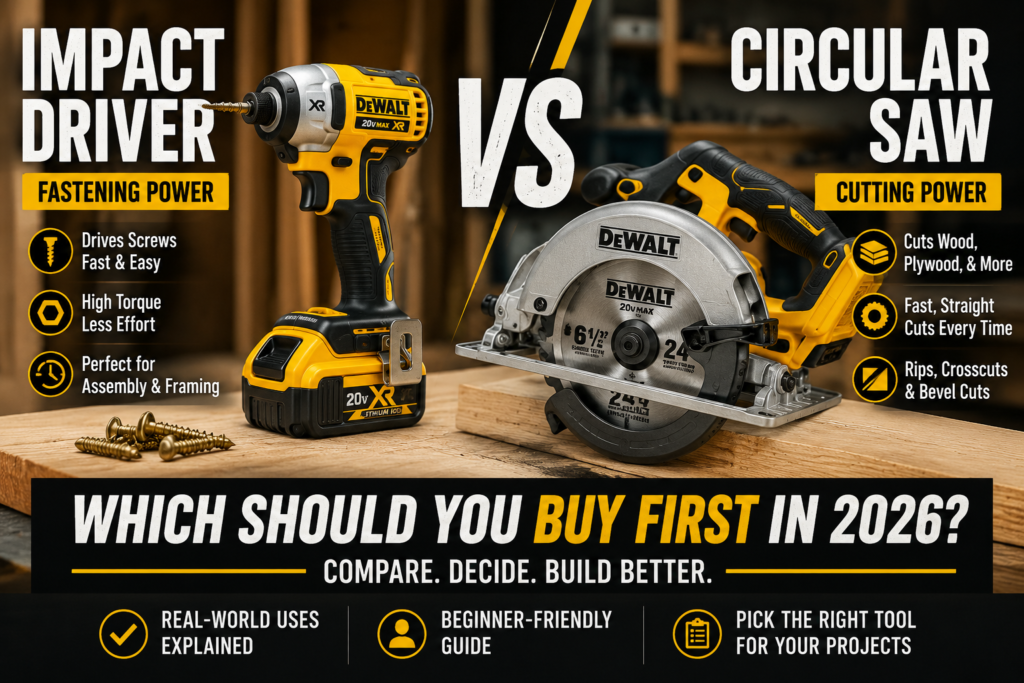
An impact driver is a fastening tool. It drives screws, bolts, and other fasteners with rapid bursts of rotational force delivered by an internal hammering mechanism. It is not designed for drilling holes — it is designed for driving fasteners faster, with less effort, and with more torque than a standard drill.
The impact mechanism means the tool absorbs most of the rotational force internally rather than transferring it to your wrist. This makes driving long screws, lag bolts, and structural fasteners far less physically demanding than using a standard drill.
What an impact driver excels at:
- Driving 2 to 4 inch screws into wood quickly and cleanly
- Installing decking, fencing, and structural framing
- Driving lag bolts and hex head screws
- Removing stubborn or rusted fasteners
- High-volume screw driving with minimal fatigue
What an impact driver cannot do:
- Cut wood, metal, or any material
- Drill precise holes (limited without a clutch)
- Work with large diameter drill bits effectively
Circular Saw — The Cutting Specialist
A circular saw is a cutting tool. It uses a rotating toothed blade to cut through wood, plywood, metal, and other materials in straight lines. It is the most versatile cutting tool for construction and woodworking — faster than a jigsaw for straight cuts, more portable than a miter saw, and capable of cutting materials that no hand saw can handle efficiently.
What a circular saw excels at:
- Ripping and crosscutting dimensional lumber
- Cutting sheet materials like plywood and OSB
- Making angled bevel cuts
- Breaking down large materials on site
- Cutting metal and masonry with the right blade
What a circular saw cannot do:
- Drive any type of fastener
- Make curved cuts (you need a jigsaw for that)
- Make highly precise repeat cuts (you need a miter saw for that)
They Do Completely Different Jobs – Impact Driver vs Circular Saw
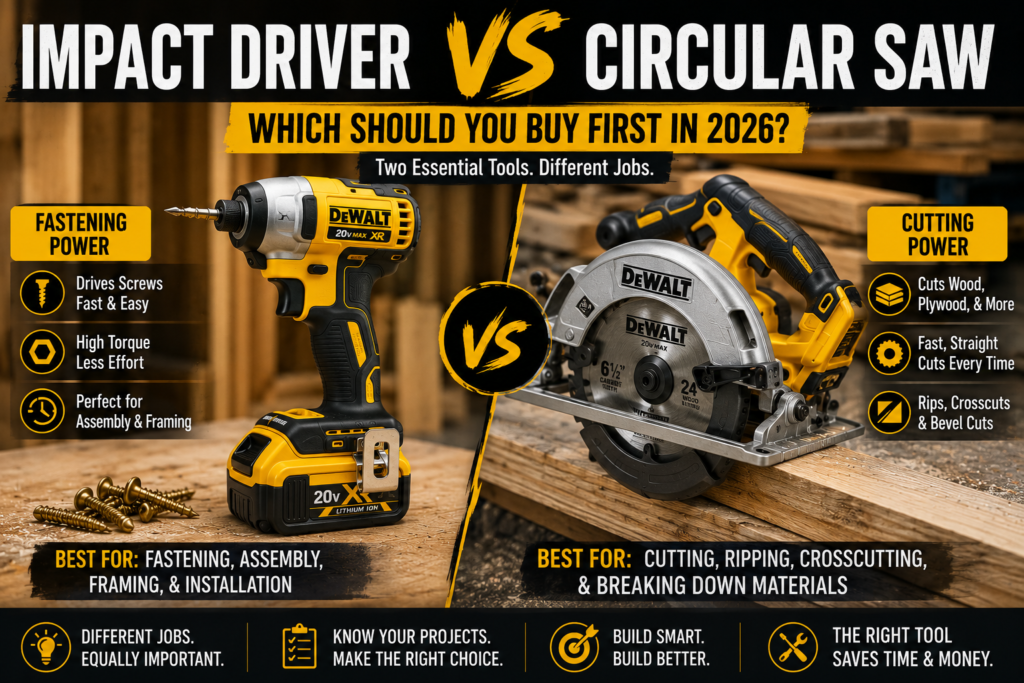
This is the most important thing to understand — an impact driver and a circular saw do not overlap in function at all. One drives fasteners. One cuts material. You cannot use one to do the job of the other.
This means the right question is not which is better — it is which one you need first based on what you are actually building or fixing.
| Feature | Impact Driver | Circular Saw |
|---|---|---|
| Primary function | Drives fasteners | Cuts material |
| Can it cut? | ❌ No | ✅ Yes — wood, metal, masonry |
| Can it drive screws? | ✅ Excellently | ❌ No |
| Safety risk | Low — no exposed blade | Higher — rotating blade requires care |
| Skill level needed | Low — easy to learn | Medium — requires practice for accuracy |
| Typical price range | $80–$200 | $100–$250 |
| Battery drain rate | Low to moderate | High — motors work hard |
| Noise level | Moderate (impact mechanism) | High (blade through material) |
Buy the Impact Driver First If…
You are assembling, building, or installing things
If your projects involve putting things together — building furniture, installing cabinets, assembling a shed frame, fixing fences, or mounting anything to a wall or floor — an impact driver is the tool you will reach for constantly. Most assembly projects involve far more fastening than cutting.
You already have something to cut with
A hand saw cuts wood. Slowly and with effort, but it does the job for occasional cuts. There is no hand-powered equivalent of an impact driver for driving screws at any useful speed. If you already have a hand saw or jigsaw, add the impact driver first.
You are doing deck, fence or framing work
These projects involve thousands of screws and relatively straightforward cuts that can often be done at the lumber yard or with a hand saw. The impact driver is used constantly throughout — it is the non-negotiable tool for this type of work.
You are a first-time tool buyer
An impact driver is safer and easier to learn than a circular saw. It has no exposed blade, requires less technique to use accurately, and delivers immediate value across a wide range of everyday tasks. For someone just starting to build their toolkit, an impact driver combined with a cordless drill covers the vast majority of home repair and DIY needs.
For a detailed comparison of impact drivers vs regular drills, read our Impact Driver vs Drill guide. For the best impact driver models available in 2026, read our Best Impact Drivers of 2026 ranking.
Buy the Circular Saw First If…
Your projects require cutting lumber to size
If you are building anything that requires custom-length timber — a raised garden bed, a pergola, a bookshelf from scratch, a deck with angled cuts — you cannot avoid needing a saw. Pre-cut lumber from the hardware store only goes so far. Once you need a non-standard length or angle, you need a circular saw.
You are working with sheet materials
Plywood, OSB, and MDF sheets need to be cut to size for almost every construction project that involves them. A circular saw is the most practical tool for breaking down full sheets on site. Nothing else comes close for this specific task at this price point.
You already own a drill or impact driver
If you already have something to drive fasteners with — even a basic cordless drill — your fastening needs are covered. The circular saw is then the logical next addition because it covers a function your existing tools cannot perform at all.
You are doing renovation or demolition work
Cutting out old flooring, removing sections of wall, trimming door frames, cutting pipe channels — renovation work requires a saw constantly. For this type of work a circular saw is the most-used tool from the moment you start.
For detailed blade selection guidance for your circular saw, read our Circular Saw Blade guide. For a detailed review of the DeWalt 20V circular saw, read our DeWalt Circular Saw Review.
Project-Based Decision Guide
| Your project | Buy first | Why |
|---|---|---|
| Building a deck | Impact driver | Thousands of screws — get lumber pre-cut or use hand saw for cuts |
| Building a fence | Impact driver | Fastening pickets is the main task |
| Building shelves or furniture from scratch | Circular saw | Need to cut lumber and sheet material to size |
| Kitchen cabinet installation | Impact driver | Mounting and fastening is primary task |
| Flooring installation | Circular saw | Need to cut boards to fit around edges and obstacles |
| General home repairs | Impact driver | Most repairs involve fastening not cutting |
| Framing a wall or room | Both equally | Need to cut studs to length AND fasten them |
| Shed construction | Circular saw first | Extensive cutting required before any fastening |
| Assembling flat-pack furniture | Impact driver | All fastening — no cutting needed |
Top Picks — Impact Drivers in 2026
| Model | Torque | Price | Best for |
|---|---|---|---|
| DeWalt DCF787 | 1,825 in-lbs | ~$129 | Best overall value |
| Milwaukee 2853-20 | 2,000 in-lbs | ~$179 | Best professional performance |
| Ryobi PSBID01B | 1,800 in-lbs | ~$99 | Best budget brushless |
Top Picks — Circular Saws in 2026
| Model | Blade | Price | Best for |
|---|---|---|---|
| DeWalt DCS578 | 7.25 inch | ~$199 | Best FLEXVOLT performance |
| DeWalt DCS565 | 6.5 inch | ~$149 | Best 20V MAX option |
| Makita XSS02Z | 6.5 inch | ~$129 | Best value brushless saw |
🔧 Which Tool Should You Buy First? — Decision Tool
Answer 4 quick questions about your projects and situation to get a personalised recommendation.
What About Buying Both at Once?
If your budget stretches to it, buying a combo kit that includes both an impact driver and a circular saw is often better value than buying each separately. Several brands offer such kits:
| Kit | Includes | Price | Saving vs separate |
|---|---|---|---|
| DeWalt DCK277C2 | Drill + impact driver + 2 batteries | ~$199 | ~$80 |
| Ryobi PCK300K2 | Drill + impact + circular saw + 2 batteries | ~$299 | ~$120 |
| Milwaukee 2696-23 | Drill + impact + circular saw + batteries | ~$449 | ~$150 |
For guidance on choosing the right drills and impact drivers to add to your collection read our Best Cordless Drills Under $200 and our DeWalt vs Milwaukee comparison. For understanding motor types across all these tools read our Brushless vs Brushed Motor guide.
Frequently Asked Questions
Can an impact driver replace a circular saw?
No — not in any way. An impact driver drives fasteners. A circular saw cuts material. They perform completely different functions and neither can substitute for the other. If you need to cut a piece of timber, only a saw will do it. If you need to drive a screw, only a driver will do it efficiently.
Which is more dangerous — an impact driver or a circular saw?
A circular saw carries significantly more risk. It uses a high-speed rotating blade capable of causing serious injury if used incorrectly or without proper safety precautions. An impact driver has no exposed blade and is one of the safer cordless tools to learn on. Always wear eye protection with both tools and hearing protection with both for extended use. According to CPSC safety data, circular saws are among the most common causes of serious workshop injuries.
Do I need both tools for most DIY projects?
For most complete DIY projects that involve building something — yes, eventually. Projects that involve cutting material to size and then assembling it require both cutting and fastening capability. You can get started with just one tool by working around its absence, but a complete home workshop eventually needs both an impact driver and a circular saw as minimum tools.
Which uses more battery power — an impact driver or circular saw?
A circular saw drains batteries significantly faster. Its motor works continuously under high load while cutting, drawing far more current than an impact driver which fires in short bursts. A 4Ah battery typically gives you 30 to 50 minutes of impact driving but only 15 to 25 minutes of continuous circular saw cutting. For battery guidance read our Battery Runtime guide.
What should I buy after getting my first tool?
The standard progression for building a home toolkit is: cordless drill → impact driver → circular saw → jigsaw → random orbital sander. If you started with an impact driver, add a cordless drill next for hole drilling capability, then a circular saw for cutting. If you started with a circular saw, add an impact driver next for fastening. A complete basic home toolkit has all three — drill, impact driver, and circular saw.
Is a cordless circular saw as good as a corded one?
For most residential tasks — yes. Modern brushless cordless circular saws on 20V or 60V platforms deliver performance matching standard corded saws for typical framing, decking, and sheet material cutting. For sustained professional cutting of large volumes of hardwood or dense materials, corded saws still have a power and runtime advantage. Read our Cordless vs Corded Tools guide for a full comparison.