Walk into any hardware store or scroll through any tool listing online and you will see the word brushless everywhere. Brushless drill. Brushless impact driver. Brushless circular saw. It is used as a selling point on almost every premium cordless tool in 2026.
But what does brushless actually mean? Is it genuinely better or is it just marketing language designed to justify a higher price tag?
This guide explains the real difference between brushless and brushed motors in plain language — no engineering degree required — and helps you decide whether paying the premium is actually worth it for your situation.
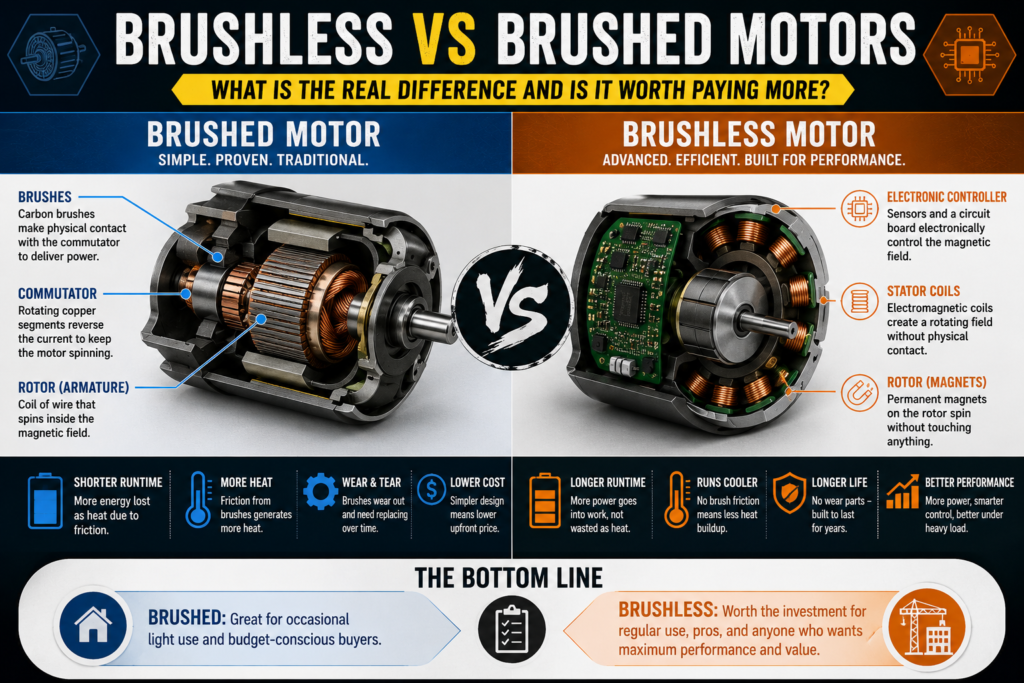
How a Brushed Motor Works
A brushed motor has been around for over a century. It is a simple, proven design. Inside the motor there are two main components that create rotation:
- The rotor — a coil of wire that spins inside the motor
- The brushes — small carbon or graphite contacts that press against the rotor and deliver electrical current to it
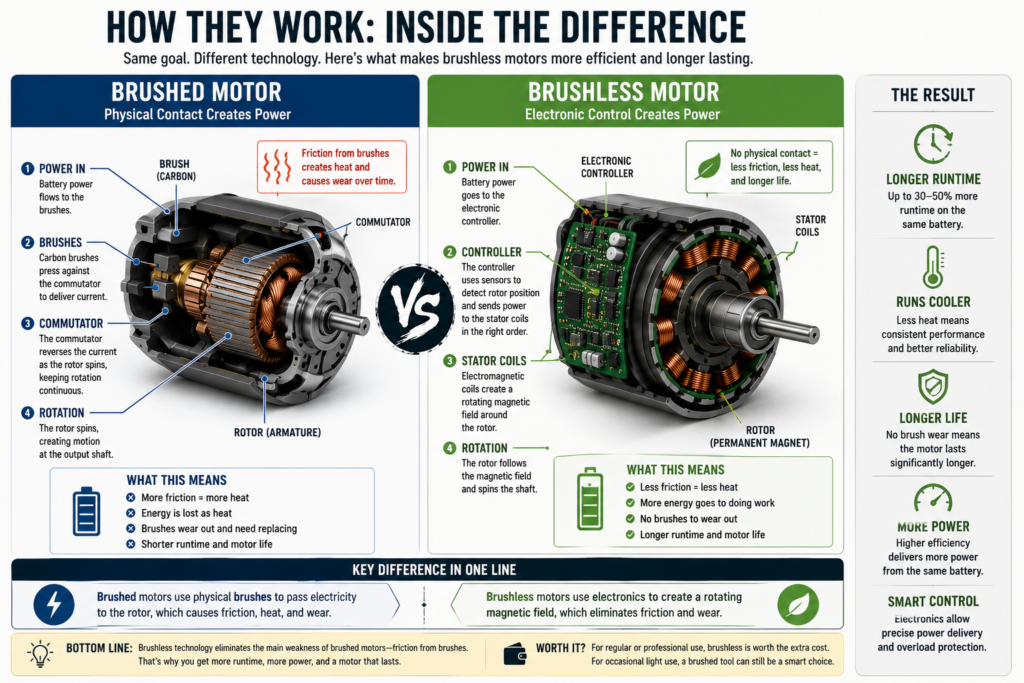
As current passes through the brushes into the rotor, it creates a magnetic field that causes the rotor to spin. The brushes maintain constant physical contact with the spinning rotor to keep the current flowing.
This physical contact is the key limitation of a brushed motor. Every time the brushes press against the spinning rotor, there is friction. That friction generates heat, wastes energy, and gradually wears down both the brushes and the rotor surface over time.
According to Electrical4U, brushed motors typically convert around 75 to 80 percent of electrical energy into mechanical power, with the rest lost as heat due to friction.
How a Brushless Motor Works
A brushless motor removes the physical brushes entirely and replaces them with an electronic controller. Instead of carbon contacts pressing against a spinning rotor, the motor uses sensors and a circuit board to detect the rotor position and switch the magnetic field electronically.
Because there is no physical contact between the stationary and moving parts, there is no friction from brushes. The result is a motor that:
- Runs cooler
- Wastes less energy as heat
- Has no parts that wear down from friction
- Can be electronically controlled more precisely
Brushless motors typically convert 85 to 90 percent of electrical energy into mechanical power — a meaningful improvement over brushed motors. This efficiency gain is one of the main reasons DeWalt, Makita, and Milwaukee have all moved their professional tool lines to brushless technology.
Brushless vs Brushed — Side by Side Comparison
| Feature | Brushed Motor | Brushless Motor |
|---|---|---|
| Physical brushes | Yes — carbon contacts | No — electronic control |
| Energy efficiency | 75–80% | 85–90% |
| Heat generation | Higher (friction-based) | Lower (no friction) |
| Motor lifespan | Shorter (brushes wear) | Longer (no wear parts) |
| Maintenance | Brushes need replacing | Virtually maintenance-free |
| Battery runtime | Shorter per charge | Longer per charge |
| Power output | Lower for same battery | Higher for same battery |
| Smart features | None | Can adapt power to task |
| Tool price | Lower upfront cost | Higher upfront cost |
| Best for | Occasional light use | Regular and professional use |
The Runtime Difference — Is It Really That Big?
One of the most practical differences between brushless and brushed tools is battery runtime. Because a brushless motor wastes less energy as heat, more of your battery charge goes directly into doing actual work.
In real-world use, a brushless tool will typically give you 30 to 50 percent more runtime on the same battery compared to a brushed equivalent. For occasional home use this may not matter much. But if you are spending four or five hours a day on a job site, that difference translates directly into fewer battery swaps and more productivity.
A study by Popular Mechanics found that brushless drills consistently outperformed brushed models in extended runtime tests, particularly under heavier loads where the efficiency gap widens further.
The Lifespan Difference
Brushed motors have a finite lifespan because the carbon brushes wear down with use. Depending on how heavily the tool is used, brushes typically need replacing after 50 to 100 hours of operation. In a professional setting that can mean annual maintenance. Replacement brushes are inexpensive but the tool needs to be taken apart to replace them.
Brushless motors have no such wear mechanism. The electronic controller does not make physical contact with the rotor so there is nothing to wear out in normal operation. A well-built brushless motor in a quality tool can last the lifetime of the tool itself under normal use conditions.
According to This Old House, this lifespan advantage is one of the strongest arguments for brushless tools for anyone who plans to use their tools regularly over many years.
The Smart Power Advantage
One underappreciated advantage of brushless motors is their ability to adjust power output intelligently. Because a brushless motor is controlled electronically, it can sense load and adjust accordingly.
When you are driving a screw into softwood, the motor uses less power. When you hit resistance — a knot in the wood, a harder material — the motor automatically increases output. This happens in milliseconds and is completely invisible to the user.
The result is better performance across a wider range of tasks and less battery drain during lighter work. Brushed motors simply run at whatever power level you set them to regardless of the actual load.
Pros and Cons
Brushed Motor Tools
| ✅ Pros * Lower upfront cost * Simple, proven technology * Widely available and repairable * Fine for occasional light use * Good entry point for beginners | ❌ Cons * Shorter battery runtime * Generates more heat * Brushes wear and need replacing * Less efficient energy use * No smart power adjustment |
Brushless Motor Tools
| ✅ Pros * Longer battery runtime * Longer motor lifespan * Runs cooler and quieter * Smart power adjustment * Better performance under load * Virtually maintenance-free | ❌ Cons * Higher upfront cost * Electronic controller can fail * Repairs are more complex * Overkill for very light occasional use |
Is Brushless Worth the Extra Cost?
The honest answer depends on how often you use your tools.
If you use tools occasionally — a few times a month for home repairs, furniture assembly, or weekend projects — a brushed tool will serve you perfectly well. The runtime difference will not matter much because you are rarely running the battery flat. The lower price makes more sense for light use.
If you use tools regularly — several times a week, on larger projects, or professionally — brushless is worth every extra dollar. The longer runtime, longer lifespan, and better performance under load will pay for the price difference many times over across the life of the tool.
As a general rule: if you are spending more than $100 on a cordless tool, it is worth paying a little more for the brushless version. The performance gap is real and the long-term value is better.
The following tool will answer your question directly.
Brushless vs Brushed Tool Advisor
Find out whether a brushless tool is worth paying extra for.
Brushless Tools Worth Considering in 2026
| Tool | Model | Motor Type | Best For |
|---|---|---|---|
| Compact drill | Makita XFD131 | Brushless | DIY and regular use |
| Mid-range drill | DeWalt DCD791 | Brushless | Serious DIY and light pro |
| Budget drill | DeWalt DCD771 | Brushed | Occasional home use |
| Pro drill | DeWalt DCD999 | Brushless | Professional daily use |
For more detail on specific models, read our Makita XFD131 Cordless Drill Review and our DeWalt 20V Max Drill Review. If you are also deciding between a drill and an impact driver, our Impact Driver vs Drill guide covers everything you need.
Frequently Asked Questions
Can you feel the difference between brushless and brushed tools?
Yes, in most cases. Brushless tools tend to feel smoother and more responsive, especially under load. They also run noticeably cooler during extended use. The difference is most apparent when you push the tool hard — a brushless motor maintains performance while a brushed one can feel like it is lagging or overheating.
Do brushless tools require any maintenance?
Very little. Because there are no brushes to wear out, the main maintenance tasks are keeping the tool clean, checking the battery contacts, and ensuring vents are not blocked. The motor itself is essentially maintenance-free under normal use conditions.
Are all brushless tools better than all brushed tools?
Not necessarily. A well-built brushed tool from a quality brand like DeWalt or Makita will outperform a poorly built brushless tool from an unknown brand. The motor type is one factor — overall build quality, battery platform, and design also matter significantly.
How long do brushed motor tools last before the brushes need replacing?
This depends heavily on usage. For a professional using the tool daily, brushes may need replacing after six to twelve months. For a homeowner using the tool occasionally, the same brushes could last five years or more. Most manufacturers sell replacement brushes for their brushed tools.
Is the runtime difference between brushless and brushed really noticeable?
Yes, particularly under load. In light use the difference may be modest, but when you are drilling into hardwood or driving long screws continuously, a brushless tool will run significantly longer on the same charge. The harder you push the tool, the more the efficiency gap matters.
Why do some cheap tools advertise brushless motors?
The brushless label has become a marketing term and some budget brands use it loosely. A brushless motor in a poorly designed tool with cheap electronics and a weak battery system will not deliver the same benefits as a brushless motor in a well-engineered professional tool. Always consider the overall quality of the tool, not just the motor type.
Are brushless tools louder or quieter than brushed?
Generally quieter. The absence of brush friction reduces motor noise. However, the total noise level of a tool depends on many factors including gear design, housing materials, and the specific task being performed. The difference is usually subtle rather than dramatic.