One of the most common questions new cordless tool owners ask is how long their battery will actually last — both per charge and over its total lifespan. The answer depends on several factors that most manufacturers never clearly explain.
This guide covers everything — what affects runtime per charge, what affects how many years a battery lasts, how to extend battery life, and when it is time to replace. We have also built a free battery life calculator below so you can estimate runtime for your specific drill and battery combination.
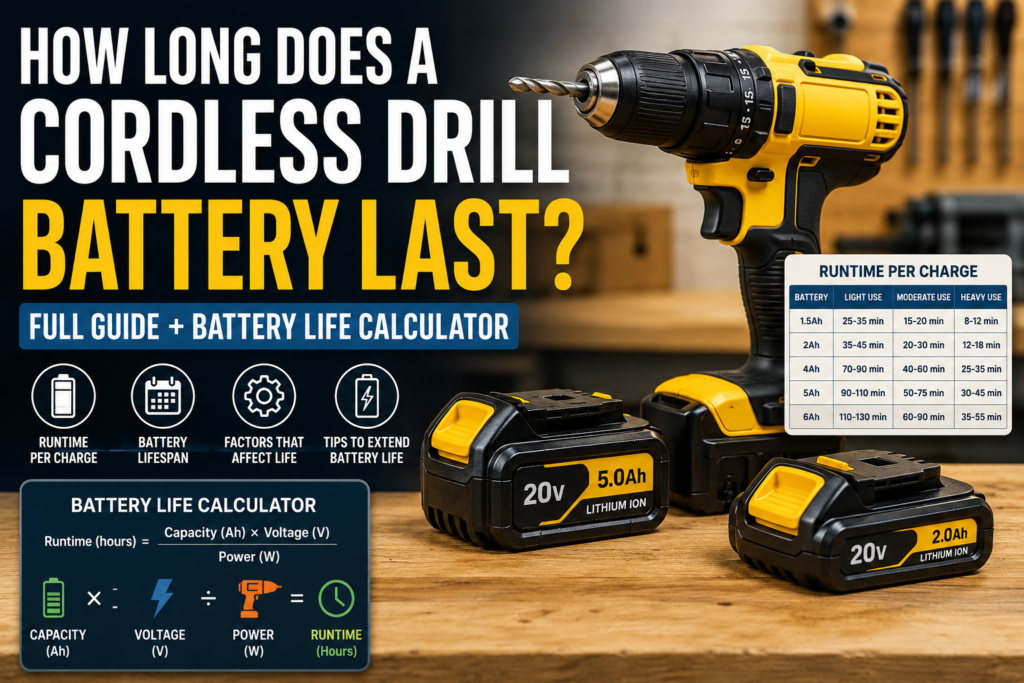
How Long Does a Cordless Drill Battery Last Per Charge?
Runtime per charge depends on three things — battery capacity (Ah), motor current draw (amps), and how hard you are pushing the tool. There is no single answer that applies to every situation.
As a general guide:
| Battery | Light use | Moderate use | Heavy use |
|---|---|---|---|
| 1.5Ah | 25–35 min | 15–20 min | 8–12 min |
| 2Ah | 35–45 min | 20–30 min | 12–18 min |
| 4Ah | 70–90 min | 40–60 min | 25–35 min |
| 5Ah | 90–110 min | 50–75 min | 30–45 min |
| 6Ah | 110–130 min | 60–90 min | 35–55 min |
These are estimates based on continuous use. In practice most people use a drill intermittently — drilling a hole, then pausing, then driving a screw. Intermittent use significantly extends apparent runtime because the battery recovers slightly between bursts.
For a detailed comparison of the 2Ah and 5Ah options specifically for DeWalt tools, read our DeWalt 5Ah vs 2Ah Battery Comparison.
What Is Ah and Why Does It Matter?
Ah stands for amp hours — it is the measure of how much electrical charge a battery stores. Think of it like a fuel tank. A larger Ah rating means a bigger tank, which means more runtime before the battery runs flat.
Ah does not affect the power or torque of the drill — it only affects how long the drill runs before needing a recharge. A 5Ah battery and a 2Ah battery in the same drill deliver identical torque and speed — the 5Ah just lasts longer.
The trade-off is weight. A 5Ah battery is noticeably heavier than a 2Ah battery. For overhead work or extended use, the extra weight causes fatigue. This is why many professionals carry two smaller batteries and rotate them rather than using one heavy battery.
What Affects Runtime Most?
Several factors reduce battery runtime significantly beyond the basic Ah rating:
1. Material hardness
Drilling into hardwood, dense plywood, or metal draws far more current than drilling into softwood or drywall. The harder the material the faster the battery drains. According to Popular Mechanics, drilling into hardwood can drain a battery up to three times faster than drilling into softwood of the same thickness.
2. Bit sharpness
A dull drill bit forces the motor to work harder, drawing more current and draining the battery faster. Sharp bits cut cleanly with minimal resistance. Replacing or sharpening bits regularly is one of the easiest ways to extend battery runtime.
3. Brushed vs brushless motor
Brushless motors convert 85 to 90 percent of battery energy into useful work. Brushed motors convert only 75 to 80 percent — the rest is lost as heat. This means a brushless drill gives you significantly more runtime from the same battery than a brushed equivalent. Read our Brushless vs Brushed Motor guide for a full explanation.
4. Temperature
Cold temperatures reduce lithium-ion battery capacity significantly. At 0°C a lithium-ion battery may deliver only 70 to 80 percent of its rated capacity. At -10°C that drops to 50 to 60 percent. Working in cold conditions always reduces runtime — keep batteries warm until needed and avoid leaving them in cold vehicles overnight.
5. Battery age
Lithium-ion batteries degrade with each charge cycle. A battery with 300 charge cycles behind it will deliver noticeably less runtime than a new battery of the same specification. This is normal and expected — see the lifespan section below for more detail.
How Long Does a Cordless Drill Battery Last Over Its Lifetime?
This is the second meaning of the question — not runtime per charge, but total years of useful life. A quality lithium-ion battery from a reputable brand like DeWalt, Makita, or Milwaukee typically lasts:
| Usage pattern | Charge cycles per year | Expected lifespan |
|---|---|---|
| Occasional home use | 20–50 cycles | 5–8 years |
| Regular DIY use | 50–150 cycles | 3–5 years |
| Professional daily use | 200–365 cycles | 1–3 years |
Most quality lithium-ion tool batteries are rated for 300 to 500 charge cycles before capacity degrades to 80 percent of original. Below 80 percent capacity most users notice a significant reduction in useful runtime and consider replacement.
The following tool will help you alot in this regard:
How to Make Your Battery Last Longer
Following these practices significantly extends both per-charge runtime and overall battery lifespan:
- Store at partial charge. Storing a lithium-ion battery fully charged or fully flat accelerates degradation. Store at 40 to 60 percent charge for long-term storage according to Battery University.
- Keep batteries cool. Heat is the enemy of lithium-ion chemistry. Never leave batteries in a hot car, direct sunlight, or near heat sources.
- Do not fully drain regularly. Modern chargers have protection circuits but repeatedly running a battery completely flat still accelerates wear. Recharge when the tool starts to feel sluggish rather than waiting for complete cutoff.
- Use the right charger. Always use the manufacturer's own charger or a certified compatible charger. Third-party chargers may not apply the correct charging profile, reducing battery life.
- Avoid leaving on charger indefinitely. Modern smart chargers have trickle charge modes that prevent overcharging, but it is still good practice to remove batteries once fully charged rather than leaving them connected for days.
- Use sharp bits. Reducing the load on the motor reduces heat in the battery. Sharp bits are one of the simplest ways to reduce battery strain.
Signs Your Battery Needs Replacing
- Runtime has dropped to less than half of what it was when new
- Battery takes much longer to charge than it used to
- Battery gets noticeably hot during normal use
- Tool loses power significantly under load even with a full charge
- Battery does not hold charge overnight
- Physical swelling or damage to the battery casing
A swollen battery should be removed from service immediately — this indicates internal cell damage and is a potential safety risk. According to UL safety guidance, swollen or damaged lithium-ion batteries should never be used and should be disposed of at a proper recycling facility.
🔋 Battery Life Calculator
Enter your battery capacity and usage details below to estimate how long your battery will last per charge.
Which Battery Should You Buy?
Choosing the right battery capacity depends on your usage pattern:
| Your situation | Best battery choice |
|---|---|
| Occasional home tasks, light use | 2Ah — light, affordable, sufficient |
| Regular DIY, weekend projects | 4Ah — best balance of weight and runtime |
| Professional or heavy daily use | 5Ah or 6Ah — maximum runtime |
| Overhead work or tight spaces | 2Ah — weight matters more than runtime |
| Multiple tools sharing one battery | 4Ah or 5Ah — keeps all tools running longer |
For a detailed DeWalt-specific battery comparison including runtime tests and cost per minute analysis, read our DeWalt 5Ah vs 2Ah Battery guide. For understanding the difference between battery platforms read our 20V vs 18V Battery guide.
Frequently Asked Questions
Can I use a higher Ah battery than recommended in my drill?
Yes — as long as it is from the same voltage platform and brand. A 5Ah battery works perfectly in a drill rated for 2Ah. The drill will simply run longer per charge. The only downside is the extra weight. Using a lower Ah battery than the drill is rated for also works fine — you just get shorter runtime.
Does fast charging damage drill batteries?
Modern fast chargers from reputable brands like DeWalt and Makita are designed specifically for their battery chemistry and apply fast charging safely. Third-party fast chargers with no overcharge protection can cause heat buildup and reduce battery lifespan. Always use the manufacturer's recommended charger for best results and longest battery life.
Why does my battery drain faster in winter?
Lithium-ion batteries are sensitive to cold temperatures. At 0°C a lithium-ion battery delivers approximately 70 to 80 percent of its rated capacity. At -10°C that drops further to around 50 to 60 percent. This is a chemical property of lithium-ion cells, not a defect. Keeping batteries warm before use and storing them indoors in cold weather helps significantly.
Is it better to have two small batteries or one large battery?
Two smaller batteries is often the better practical choice for active users. While one large battery charges continuously, the other is in use. This eliminates downtime completely. Two 2Ah batteries give you more total runtime than one 4Ah battery and you never have to wait for a charge. The trade-off is managing two batteries rather than one.
Can I store lithium-ion batteries long term?
Yes. For long-term storage charge the battery to around 50 percent, remove it from the charger, and store it in a cool dry place between 15°C and 25°C. Check and top up to 50 percent every three to six months. Storing fully charged or fully flat for extended periods permanently reduces capacity. Most manufacturers recommend recharging stored batteries every six months to maintain cell health.
Are third-party replacement batteries worth buying?
Budget third-party batteries are significantly cheaper but often deliver lower actual capacity than stated, lack the protection circuits of genuine batteries, and may damage tools in some cases. For occasional light home use a reputable third-party brand can be acceptable. For regular professional use always buy genuine manufacturer batteries — the reliability and safety difference is significant and the cost over the life of the battery is not as large as it seems upfront.