At first glance an impact wrench and an impact driver look almost identical. Both are cordless. Both use a hammering mechanism to deliver high rotational force. Both are louder than a standard drill. But pick up the wrong one for your job and you will quickly discover they are built for completely different tasks. Thus, Impact Wrench vs Impact Driver is necessary to understand.
Using an impact driver to remove lug nuts is like using a screwdriver to cut timber — technically possible in extreme circumstances but fundamentally the wrong tool. Using an impact wrench to drive cabinet screws is like using a sledgehammer to tap in a finishing nail — dangerously overpowered for the task.
This guide explains the real difference between these two tools, when to use each one, and includes an interactive tool selector to help you decide which one belongs in your collection.
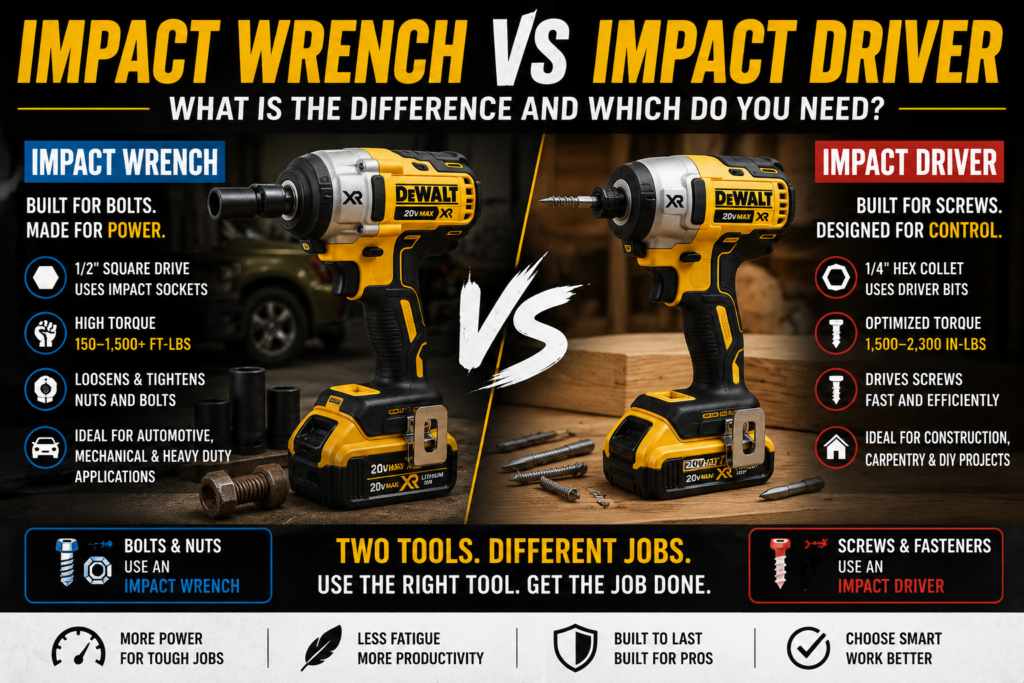
How They Both Work — The Shared Mechanism
Both tools use the same basic principle — an internal hammering mechanism that delivers rotational force in rapid bursts rather than through continuous smooth rotation. When resistance is low the tool spins freely like a standard drill. When resistance increases the hammer mechanism engages, firing rapid impacts that multiply the effective torque far beyond what the motor could deliver through continuous rotation alone.
This hammering action is what makes both tools so effective at loosening stubborn fasteners and driving against high resistance. It is also what makes them unsuitable for tasks requiring precise torque control — neither tool has a clutch.
Where They Differ — Completely Different Jobs
Impact Driver — Built for Screws and Small Fasteners
An impact driver uses a 1/4 inch hex collet — a quick-change chuck that accepts standard screwdriver bits, nut driver bits, and hex shank accessories. It is designed specifically for driving screws, self-tapping screws, and small bolts. The hex collet only accepts 1/4 inch hex shank bits — regular drill bits with round shanks do not fit.
Impact drivers deliver torque in the range of 1,500 to 2,300 in-lbs — more than enough for any screw driving application. Their compact size, light weight, and 1/4 inch hex system make them ideal for high-volume screw driving in construction, cabinetry, decking, and general assembly work.
Impact Wrench — Built for Bolts and Large Fasteners
An impact wrench uses a square drive — typically 1/2 inch, 3/8 inch, or 3/4 inch — that accepts standard impact sockets. It is designed for tightening and loosening large bolts, nuts, and threaded fasteners. The square drive system accepts impact-rated sockets in any standard size from 8mm to 36mm and beyond.
Impact wrenches deliver torque in the range of 150 to 1,500+ ft-lbs — many times more than an impact driver — making them the only practical cordless tool for tasks like removing lug nuts, tightening structural anchor bolts, and automotive repair work.
Side by Side Comparison
| Feature | Impact Driver | Impact Wrench |
|---|---|---|
| Drive type | 1/4 inch hex collet | 1/2 inch square drive (most common) |
| Accessories | Screwdriver bits, nut drivers | Impact sockets (metric and imperial) |
| Torque range | 1,500–2,300 in-lbs | 150–1,500+ ft-lbs |
| Primary use | Driving screws and small fasteners | Tightening and loosening large bolts |
| Size and weight | Compact — 2.5 to 3.5 lbs typical | Larger — 4 to 8 lbs typical |
| Can change bits | Instantly — push-pull collet | Yes — socket detent pin |
| Screw driving | ✅ Excellent | ❌ Not designed for it |
| Lug nut removal | ❌ Insufficient torque | ✅ Excellent |
| Typical price | $80–$200 | $150–$400+ |
| Who needs it | Construction, DIY, carpentry | Automotive, heavy construction, mechanical |
Torque — A Very Different Scale
The torque difference between these two tools is one of the most misunderstood aspects of choosing between them. Impact drivers and impact wrenches both measure torque — but in completely different units for a reason.
| Tool | Typical torque | Equivalent in ft-lbs | What it can handle |
|---|---|---|---|
| Impact driver (standard) | 1,825 in-lbs | ~152 ft-lbs | Screws up to 4 inch, small bolts |
| Impact driver (top end) | 2,300 in-lbs | ~192 ft-lbs | Lag screws, structural screws |
| Impact wrench (compact) | — | ~210 ft-lbs | Light automotive, small bolts |
| Impact wrench (standard) | — | ~400–600 ft-lbs | Lug nuts, structural bolts |
| Impact wrench (heavy duty) | — | ~1,000–1,500 ft-lbs | Heavy machinery, large equipment |
When You Need an Impact Driver
An impact driver is the right tool for any task involving driving or removing screws and small fasteners:
- Building a deck — hundreds of 3-inch deck screws driven quickly with minimal wrist fatigue
- Installing cabinets — driving mounting screws into studs and cabinet frames
- Framing and construction — structural screws and lag screws into timber
- Fence installation — picket screws driven consistently at speed
- General assembly — anything involving screws from 1 inch to 4 inches
- Driving self-tapping screws into metal — with appropriate bits
For a detailed guide on impact driver selection and the best models available, read our Best Impact Drivers ranking. For a comparison with standard drills, read our Impact Driver vs Drill guide.
When You Need an Impact Wrench
An impact wrench is the right tool for any task involving large threaded fasteners — bolts and nuts rather than screws:
- Changing tyres — removing and installing lug nuts quickly and safely
- Automotive repair — suspension bolts, brake caliper bolts, exhaust manifold nuts
- Heavy construction — structural anchor bolts, post base bolts, beam connections
- Equipment maintenance — servicing machinery with large threaded fasteners
- Removing seized or rusted bolts — the high torque and impact mechanism breaks loose corroded threads
Can an Impact Driver Do the Job of an Impact Wrench?
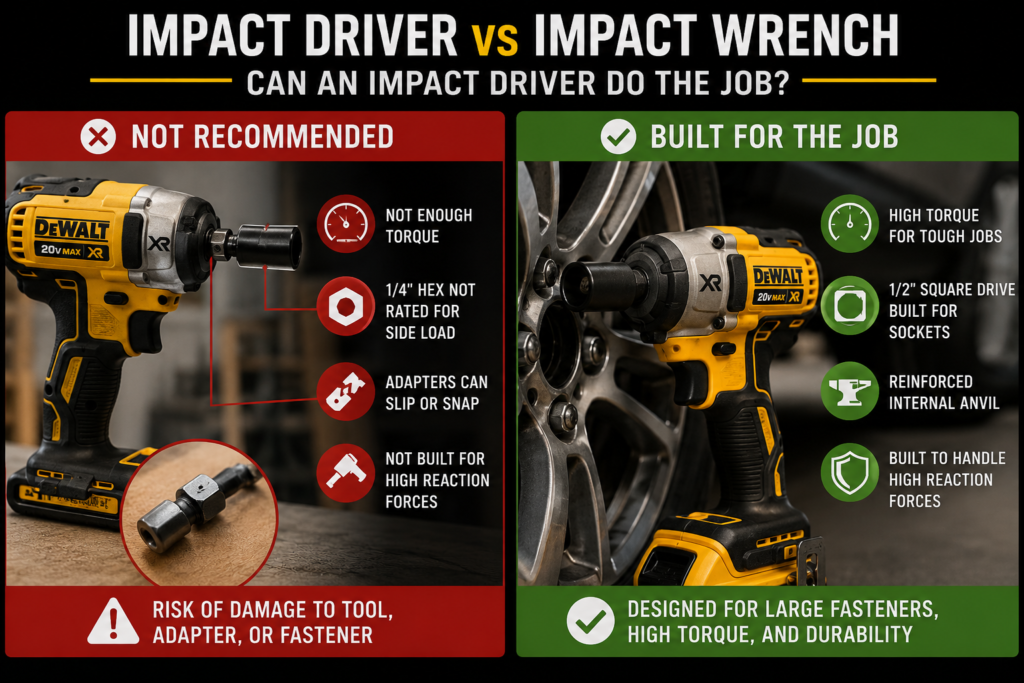
For very light bolt work — small M6 to M10 bolts with modest torque requirements — an impact driver with a hex socket adapter can work. But it is not recommended as a substitute for a proper impact wrench for several reasons:
- Impact drivers do not generate enough torque for lug nuts or structural bolts
- The 1/4 inch hex connection is not rated for the side load of socket work
- Hex socket adapters can slip or snap under high impact forces
- The impact driver body is not designed to withstand the reaction forces of large bolt work
According to Milwaukee Tool, impact wrenches are specifically engineered with heavier internal anvils and reinforced anvil shafts to handle the sustained high-torque impacts required for large fastener work — something impact drivers are not built to withstand long-term.
Can an Impact Wrench Do the Job of an Impact Driver?
Technically you can drive screws with an impact wrench using a 1/2 inch to 1/4 inch hex adapter — but it is completely impractical. The wrench is heavier, larger, harder to control in tight spaces, and has far more torque than any screw requires. You will strip or snap every screw head almost immediately.
The impact wrench is simply the wrong tool for screw driving. Both tools have their lane and neither crosses over effectively.
Pros and Cons
Impact Driver
| ✅ Pros * Lightweight and compact * Instant bit changes with hex collet * Excellent for all screw driving tasks * Wide range of bit accessories * Lower price than impact wrenches * Less wrist strain than a drill | ❌ Cons * Cannot remove lug nuts or large bolts * 1/4 inch hex only — no sockets * No clutch — can strip screws * Not suitable for precision torque work |
Impact Wrench
| ✅ Pros * Extremely high torque * Accepts full range of impact sockets * Essential for automotive and heavy work * Breaks loose seized and rusted fasteners * Available in multiple drive sizes | ❌ Cons * Too powerful for screws and small fasteners * Heavier and bulkier than impact driver * More expensive * Requires impact-rated sockets * Not suitable for finish work |
Top Models to Consider
| Tool | Model | Torque | Price |
|---|---|---|---|
| Best impact driver | DeWalt DCF787 | 1,825 in-lbs | ~$129 |
| Best pro impact driver | Milwaukee 2853-20 | 2,000 in-lbs | ~$179 |
| Best compact wrench | Milwaukee 2555-20 | 250 ft-lbs | ~$199 |
| Best mid wrench | DeWalt DCF894B | 330 ft-lbs | ~$179 |
🔧 Which Tool Do You Need? — Interactive Selector
Answer 3 quick questions about your work to get an instant personalised recommendation.
Frequently Asked Questions
Can I use regular sockets with an impact wrench?
No — always use impact-rated sockets. Regular chrome vanadium sockets are not designed to handle the shock loads from an impact wrench and can shatter under impact, creating a serious safety hazard. Impact sockets are made from thicker, more ductile steel that absorbs impact forces without cracking. They are typically black rather than chrome-finished and are clearly labelled as impact-rated.
What size impact wrench do I need for changing car tyres?
A 1/2 inch drive impact wrench with at least 250 ft-lbs of torque handles lug nuts on most passenger vehicles comfortably. For trucks and SUVs with higher torque lug nut specifications, 400 ft-lbs or more is recommended. Check your vehicle's lug nut torque specification — typically found in the owner's manual — and choose a wrench that exceeds it by a comfortable margin.
Do I need both tools or can I get by with just one?
Most DIYers and homeowners only need an impact driver — the vast majority of home projects involve screws not large bolts. An impact wrench becomes necessary if you work on vehicles, do heavy structural work, or regularly deal with large threaded fasteners. If you are unsure, start with an impact driver — it covers far more everyday tasks and is the more versatile choice for typical home and construction use.
Why does my impact driver strip screw heads?
The most common causes are using worn bits, using the wrong bit size for the screw head, or applying the tool at an angle rather than straight in line with the screw. Impact drivers deliver high torque in bursts — even a small misalignment causes the bit to skip out of the head under impact. Always use fresh, correctly sized bits and keep the tool perfectly in line with the fastener. Read our Impact Driver guide for more tips.
What is the difference between a 3/8 inch and 1/2 inch impact wrench?
The drive size determines which sockets fit and what torque the wrench can deliver. A 3/8 inch drive wrench is more compact and lighter, delivering 100 to 250 ft-lbs — suitable for light automotive work and smaller bolts. A 1/2 inch drive wrench delivers 250 to 600+ ft-lbs and accepts larger sockets, making it the standard choice for lug nuts and structural bolts. For heavy duty industrial work a 3/4 inch or 1 inch drive wrench delivers over 1,000 ft-lbs.
Is an impact wrench the same as an impact gun?
Yes — impact gun is simply an informal term for an impact wrench, particularly in automotive contexts. Air-powered impact guns have been used in tyre shops and garages for decades. Cordless impact wrenches are the battery-powered equivalent and have largely replaced air tools in many professional settings due to their convenience and portability. Both terms refer to the same tool category.