Walk into any workshop and you will find both corded and cordless tools. Ask any experienced tradesperson which is better and you will get a different answer every time. That is because there is no universal right answer — each type has genuine strengths and real limitations, and the best choice depends entirely on how and where you work.
This guide breaks down the cordless vs corded debate across every factor that actually matters — power, convenience, cost, runtime, and long-term value — so you can make the right decision for your specific situation.
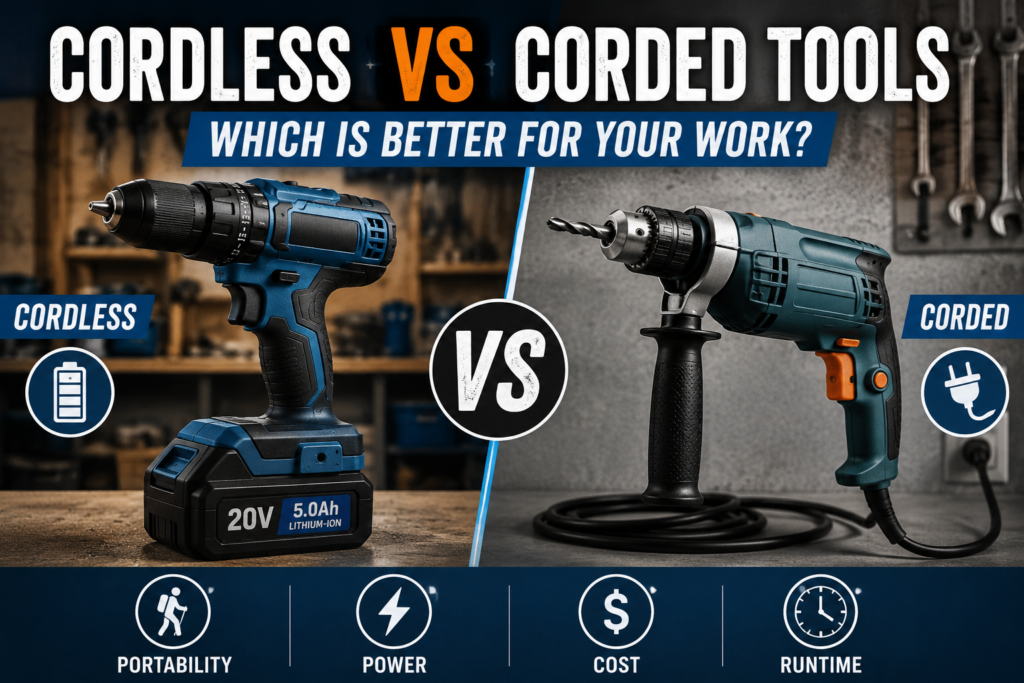
The Core Difference
The fundamental difference is simple. Corded tools draw power directly from a wall outlet through a cable. Cordless tools draw power from a rechargeable battery pack.
Everything else — the power output, the convenience, the cost, the limitations — flows from that single difference. Corded tools are permanently tethered to a power source. Cordless tools are free to go anywhere but are limited by battery capacity.
Cordless vs Corded — Full Comparison
| Feature | Cordless Tools | Corded Tools |
|---|---|---|
| Power source | Rechargeable battery | Mains electricity |
| Power output | Good — improving every year | Excellent — consistent and unlimited |
| Runtime | Limited by battery capacity | Unlimited while plugged in |
| Portability | Excellent — use anywhere | Limited by cord length and outlet access |
| Weight | Heavier (battery adds weight) | Lighter (no battery) |
| Upfront cost | Higher (tool + battery + charger) | Lower (tool only) |
| Long-term cost | Battery replacements every 3–5 years | Very low — no consumables |
| Maintenance | Battery care required | Minimal — cord care only |
| Safety | No trip hazard from cord | Cord creates trip hazard |
| Performance consistency | Decreases as battery drains | Consistent throughout use |
| Best for | Flexibility and mobility | Sustained heavy-duty work |
The Power Gap Is Closing Fast
Five years ago, corded tools had a clear and significant power advantage over cordless alternatives. That gap has narrowed dramatically in 2026.
Modern brushless cordless tools running on high-capacity batteries (5Ah and above) now match or exceed the performance of comparable corded tools in most everyday applications. According to Popular Mechanics, the performance gap between premium cordless and corded tools in categories like drills, circular saws, and impact drivers has become negligible for most users.
Where corded tools still hold a clear power advantage is in sustained heavy-duty applications — large angle grinders, table saws, heavy-duty routers, and tools that run continuously for hours. In these categories the unlimited power supply of a corded tool still makes a meaningful practical difference.
For a detailed look at how brushless motor technology has helped close this gap, read our Brushless vs Brushed Motor guide.
When Cordless Tools Are the Better Choice
Cordless tools have become the default choice for most tradespeople and DIYers in 2026, and for good reason. The convenience and flexibility advantages are substantial.
Working away from power outlets
Any outdoor work, rooftop work, work in attics or crawl spaces, or work on construction sites before electrical installation is complete — cordless tools are the only practical option. Extension cords have limits, and in many working environments they create real safety risks.
Moving between locations frequently
If you are regularly moving from room to room, floor to floor, or site to site, cordless tools eliminate the constant cord management that slows down corded work significantly.
Light to medium tasks
For drilling, driving screws, cutting timber, or running a circular saw on typical framing or decking lumber — modern cordless tools perform identically to their corded counterparts. The battery limitation simply does not matter at this level of use.
Safety-conscious environments
Cords create trip hazards, especially in busy environments with multiple workers. According to OSHA safety guidelines, trailing cords are one of the leading causes of workplace slips, trips, and falls. Cordless tools eliminate this risk entirely.
The following tool will help you make a choice.
🔧 Cordless vs Corded Tool Decision Tool
Answer these questions to find the best choice for your situation:
| Do you often work away from power outlets? | ✅ Yes → Cordless |
| Will the tool run continuously for over an hour? | ✅ Yes → Corded |
| Do you frequently move between rooms, floors, or job sites? | ✅ Yes → Cordless |
| Are you looking for the lowest upfront cost? | ✅ Yes → Corded |
| Do you already own batteries from a tool platform? | ✅ Yes → Cordless |
| Will you mostly use the tool in a fixed workshop? | ✅ Yes → Corded |
✔ Mostly “Yes” to mobility and convenience questions? → Choose Cordless
✔ Mostly “Yes” to power, runtime, and budget questions? → Choose Corded
✔ Need both flexibility and sustained power? → Use a hybrid setup with both types.
When Corded Tools Are the Better Choice
Despite the advances in cordless technology, there are specific situations where corded tools remain the superior choice.
Extended heavy-duty use
If you are running a tool continuously for two to four hours — grinding welds, routing large panels, cutting hundreds of metres of timber — a corded tool delivers consistent power without interruption. No battery management, no performance drop as the battery drains, no downtime for recharging.
Stationary workshop tools
Table saws, bench grinders, drill presses, and band saws are almost always corded. These tools are used in fixed locations and demand consistent, sustained power that battery technology cannot yet match economically.
Budget-conscious buyers
A quality corded drill costs significantly less than a quality cordless drill when you factor in the battery and charger. For someone who only occasionally needs a drill and always works near an outlet, a corded tool delivers better value per dollar.
High-demand applications
Heavy-duty angle grinding, large circular saw blades in dense hardwood, and demolition work with reciprocating saws — these applications push batteries hard and benefit from the unlimited power supply of a corded tool.
Pros and Cons Summary
Cordless Tools
| ✅ Pros * Complete freedom of movement * No cord trip hazards * Works anywhere — indoors, outdoors, remote * One battery powers multiple tools * Modern brushless models match corded power | ❌ Cons * Higher upfront cost * Limited runtime per charge * Performance drops as battery drains * Battery replacement cost every few years * Heavier due to battery weight |
Corded Tools
| ✅ Pros * Unlimited runtime * Consistent power output throughout use * Lower upfront cost * No battery replacement costs * Lighter (no battery weight) | ❌ Cons * Limited by cord length and outlet access * Cord creates trip hazard * Cannot use away from power source * Cord management slows workflow * Less convenient for mobile work |
The Hybrid Approach — What Most Professionals Do
Most experienced tradespeople do not choose one or the other — they use both strategically. The typical professional toolkit in 2026 looks like this:
| Tool category | Preferred type | Reason |
|---|---|---|
| Drill / driver | Cordless | Mobility and speed matter most |
| Impact driver | Cordless | Used constantly and in varied locations |
| Circular saw | Cordless (high capacity battery) | Mobility for framing and site work |
| Table saw / miter saw | Corded | Stationary, sustained heavy use |
| Angle grinder (light) | Cordless | Mobility for occasional grinding |
| Angle grinder (heavy) | Corded | Sustained grinding demands consistent power |
| Router / planer | Corded | High power demand, usually workshop-based |
The Verdict for 2026
For most homeowners, DIYers, and general tradespeople buying tools today — start with cordless. The convenience advantage is real and significant, modern cordless tools are powerful enough for almost everything you will encounter, and the battery ecosystem investment pays off over time as you add more compatible tools.
Add corded tools selectively for applications where sustained heavy power is genuinely needed — typically stationary workshop equipment and heavy continuous-use scenarios.
If you are building out your cordless toolkit and need help choosing specific tools, read our guides on the Best Cordless Drills Under $200, the Best Impact Drivers of 2026, and our DeWalt 20V Circular Saw Review.
Frequently Asked Questions
Are cordless tools as powerful as corded tools in 2026?
For most everyday applications, yes. Modern brushless cordless tools running on 5Ah or higher batteries deliver performance comparable to corded equivalents in drilling, driving, and cutting tasks. The gap remains meaningful only in sustained heavy-duty applications like extended grinding, large routing jobs, and stationary machinery.
How long does a cordless tool battery last per charge?
It depends heavily on the battery capacity and the intensity of use. A 2Ah battery in moderate use lasts around 20 to 30 minutes. A 5Ah battery can last 50 to 75 minutes. For detailed battery comparisons, read our DeWalt 5Ah vs 2Ah Battery guide and our 20V vs 18V Battery guide.
Is it worth buying cordless tools if I mostly work in a fixed workshop?
For stationary workshop tools like table saws and bench grinders, corded is still the better choice. But even workshop-based users benefit from cordless drills and impact drivers for assembly work, test fitting, and tasks that take you away from the bench. A mixed approach works best even in workshop settings.
Do corded tools require any maintenance?
Very little. The main maintenance tasks are keeping vents clean, checking the cord for damage, and occasionally lubricating chuck mechanisms. Unlike cordless tools, there are no batteries to maintain or replace. This makes corded tools lower maintenance overall and a good choice for tools that sit idle for long periods between uses.
Can I convert a corded tool to cordless?
Not practically. Corded and cordless versions of the same tool type are fundamentally different products designed around different power systems. Adapters that allow battery power on corded tools do exist but are inefficient and not recommended. If you need cordless capability, buying a purpose-built cordless tool is always the better approach.
Which is safer — cordless or corded tools?
Both are safe when used correctly. Corded tools introduce trip hazards from trailing cords and carry electrical shock risk if the cord is damaged. Cordless tools carry battery-related risks including overheating if damaged batteries are used. In environments with water, height work, or crowded workspaces, cordless tools are generally considered safer due to the absence of trailing cords and mains electrical exposure.
Are corded tools better for beginners?
They can be a more affordable starting point since you avoid the battery and charger cost. A corded drill or circular saw costs significantly less than a cordless kit. However, the limitations of cord length and outlet dependency can be frustrating for beginners who want flexibility. For most beginners today, a budget cordless kit like the DeWalt DCD771 kit at around $99 offers better overall value and usability than a comparable corded alternative.