DeWalt and Milwaukee are the two most dominant professional cordless tool brands in North America. Both have passionate, loyal followings. Both produce genuinely excellent tools. And both cost significantly more than budget alternatives — which means choosing between them is a real decision that affects years of tool purchases and battery investments.
This guide compares DeWalt and Milwaukee across every factor that actually matters — tool performance, battery ecosystems, price, durability, warranty, and which type of user each brand genuinely suits best. We have also included an interactive brand matcher at the end to give you a personalised recommendation based on your specific situation.
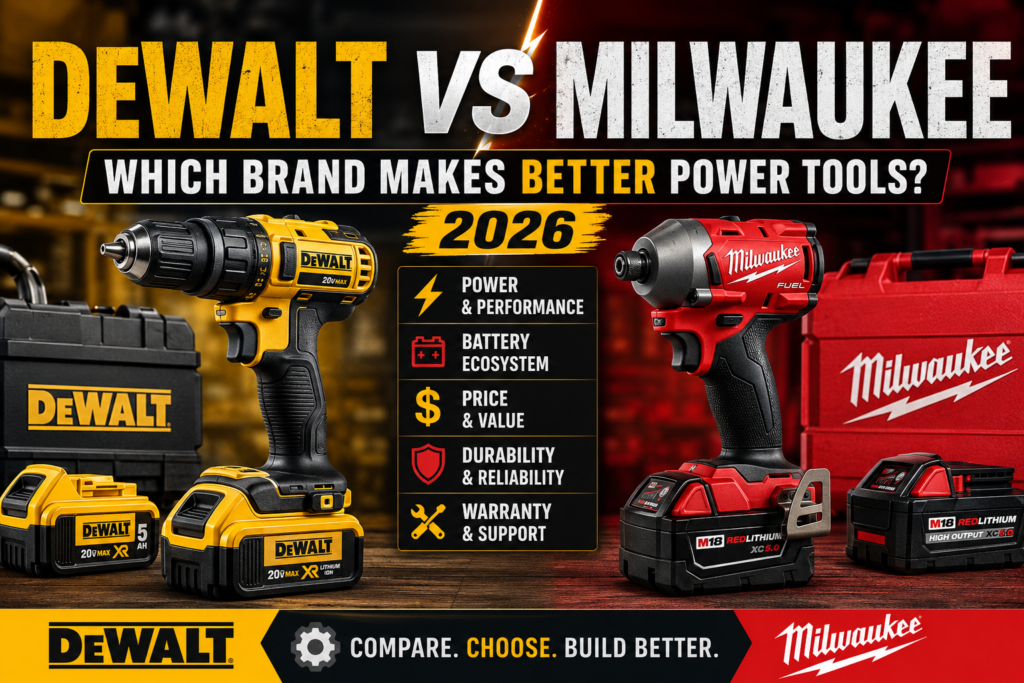
Brand Overview
DeWalt
DeWalt was founded in 1923 and is now owned by Stanley Black and Decker. It is the most widely recognised cordless tool brand in North America and is particularly strong in construction, framing, and general contracting. DeWalt’s 20V MAX platform covers over 250 tools and the brand is known for an excellent balance of power, durability, and value across its range. Its FLEXVOLT system — which switches between 20V and 60V depending on the tool — is one of the most impressive battery innovations in the cordless tool industry.
Milwaukee
Milwaukee Tool was founded in 1924 and is now owned by Techtronic Industries (TTI). It has built a reputation as the premium professional tool brand — particularly among electricians, plumbers, HVAC technicians, and other specialist trades. Milwaukee’s M18 platform covers over 200 tools and the brand consistently pushes the boundaries of cordless performance with innovations like POWERSTATE brushless motors and REDLINK PLUS electronics. Milwaukee tools generally cost more than DeWalt equivalents but deliver measurably higher performance at the top end of their range.
Head to Head — Key Drill Specs Compared
| Feature | DeWalt DCD791 | Milwaukee 2804-20 |
|---|---|---|
| Voltage | 20V MAX | 18V M18 |
| Max torque | 820 in-lbs | 1,200 in-lbs |
| Max RPM | 2,000 | 2,000 |
| Speed settings | 2 | 2 |
| Clutch settings | 15 + drill | 15 + drill |
| Weight (tool only) | 3.4 lbs | 3.6 lbs |
| Motor | Brushless | Brushless (POWERSTATE) |
| Electronics | Standard | REDLINK PLUS intelligence |
| Battery platform | 20V MAX (250+ tools) | M18 (200+ tools) |
| Tool price (approx) | ~$129 | ~$179 |
Impact Driver Comparison
| Feature | DeWalt DCF787 | Milwaukee 2853-20 |
|---|---|---|
| Max torque | 1,825 in-lbs | 2,000 in-lbs |
| Max IPM | 3,250 | 3,600 |
| Speed modes | 3 | 4 |
| Weight | 2.8 lbs | 2.6 lbs |
| Tool price (approx) | ~$129 | ~$179 |
Milwaukee consistently leads DeWalt on peak torque and IPM figures in the impact driver category. For a detailed breakdown of the best impact drivers on the market read our Best Impact Drivers of 2026 guide.
Battery Ecosystem Comparison
| Feature | DeWalt 20V MAX | Milwaukee M18 |
|---|---|---|
| Compatible tools | 250+ | 200+ |
| Battery range | 1.5Ah to 9Ah | 1.5Ah to 12Ah |
| High voltage option | FLEXVOLT 60V MAX | M18 HIGH OUTPUT |
| 2Ah battery price | ~$35 | ~$49 |
| 5Ah battery price | ~$79 | ~$99 |
| Outdoor tool range | Good | Excellent |
DeWalt batteries are consistently cheaper than Milwaukee equivalents. This matters significantly when building out a full toolkit — each battery you buy costs less, which adds up over time. Milwaukee counters this with higher capacity options (up to 12Ah) that DeWalt does not match in its standard 20V MAX range.
For a full explanation of battery voltage and capacity read our 20V vs 18V Battery guide.
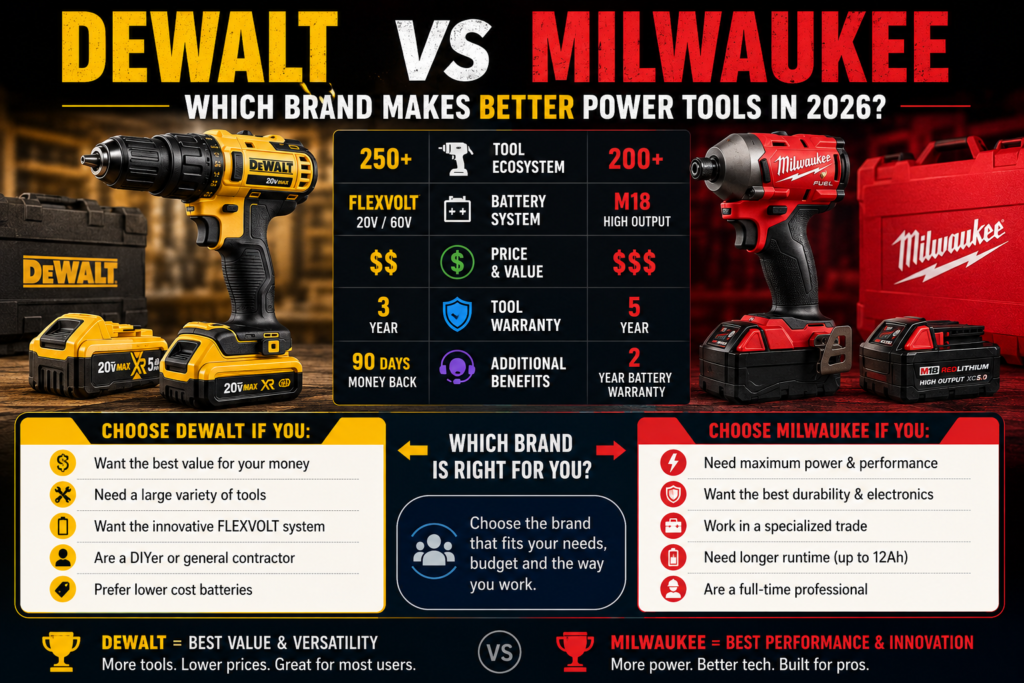
Performance — Where Each Brand Wins
Where Milwaukee Wins
Milwaukee consistently outperforms DeWalt in raw power metrics. In independent testing by Pro Tool Reviews, Milwaukee drills and impact drivers delivered higher torque figures, better performance under sustained load, and better protection against overheating under heavy professional use. The REDLINK PLUS electronics system is genuinely superior — it monitors temperature, current, and voltage in real time to prevent damage and maintain performance longer.
Milwaukee also leads in specialist trade tools. For electricians, plumbers, and HVAC technicians the M18 platform offers tools specifically designed for those trades that DeWalt simply does not match.
Where DeWalt Wins
in DeWalt vs Milwaukee, DeWalt wins on value, ecosystem size, and versatility. Its 20V MAX platform covers more tool categories than Milwaukee’s M18 at comparable price points. DeWalt batteries cost less. The entry-level DeWalt range (DCD771, DCF787) offers better value for money than Milwaukee’s equivalent entry tools.
DeWalt’s FLEXVOLT system is also a genuine innovation — a single battery that works in both 20V and 60V tools means users can run high-demand tools like table saws and miter saws from the same battery ecosystem as their standard drills and drivers.
According to This Old House, DeWalt consistently ranks higher for overall value across its range while Milwaukee ranks higher for peak professional performance.
Build Quality and Durability
Both brands build tools to survive job site conditions. Drop tests, dust exposure, and moisture resistance are standard expectations at this price point — and both brands deliver.
The distinction is in the detail. Milwaukee tools feel more premium — tighter tolerances, better grip textures, and a more solid overall feel. DeWalt tools feel robust and workmanlike — built to take punishment without feeling precious about it.
For long-term durability both brands are excellent. The limiting factor is almost always the battery rather than the tool itself — both brands’ batteries typically need replacing after 3 to 5 years of professional use.
Price Comparison Across Categories
| Tool category | DeWalt (approx) | Milwaukee (approx) | Better value |
|---|---|---|---|
| Entry drill kit | $99 (DCD771) | $149+ (M18 compact) | DeWalt |
| Mid brushless drill | $179 (DCD791 kit) | $229+ (2804 kit) | DeWalt |
| Impact driver | $129 (DCF787) | $179 (2853-20) | DeWalt |
| 2Ah battery | ~$35 | ~$49 | DeWalt |
| 5Ah battery | ~$79 | ~$99 | DeWalt |
| Pro performance | DCD999 ~$199 | 2804-20 ~$179 | Milwaukee |
Warranty and Support
| Feature | DeWalt | Milwaukee |
|---|---|---|
| Tool warranty | 3 year limited | 5 year limited |
| Battery warranty | 1 year | 2 year |
| Free service period | 1 year | Not standard |
| Money back guarantee | 90 days | Not standard |
| Service centres | Widespread | Widespread |
Milwaukee wins on warranty length — 5 years on tools vs DeWalt’s 3 years is a meaningful difference for professional users. DeWalt counters with its 90 day money back guarantee and 1 year free service period which Milwaukee does not offer as standard.
Pros and Cons
DeWalt
| ✅ Pros * Better value across most categories * Larger battery ecosystem (250+ tools) * FLEXVOLT system is genuinely innovative * Cheaper batteries * Strong entry level range * 90 day money back + 1 year free service | ❌ Cons * Lower peak torque than Milwaukee * Standard electronics vs Milwaukee’s REDLINK * Less specialist trade tool depth * Shorter warranty (3 vs 5 years) |
Milwaukee
| ✅ Pros * Higher peak torque and IPM * REDLINK PLUS electronics — best in class * 5 year tool warranty * Superior specialist trade tool range * Higher capacity batteries (up to 12Ah) * Premium build quality and feel | ❌ Cons * Premium price across all categories * More expensive batteries * Smaller overall ecosystem (200 vs 250+ tools) * No equivalent to DeWalt’s FLEXVOLT system * Less competitive at entry level |
Who Should Choose DeWalt?
- Budget-conscious buyers who want professional quality without premium prices
- General contractors and carpenters who need a broad ecosystem of tools
- Users who want the best value entry point — the DCD771 kit at $99 is unmatched
- Anyone who needs high-demand tools like table saws and miter saws — FLEXVOLT is unique
- First-time buyers building their first cordless toolkit
Who Should Choose Milwaukee?
- Electricians, plumbers, and HVAC technicians who need specialist trade tools
- Professional users who push tools hard daily and need maximum torque and durability
- Users who value the 5 year warranty and REDLINK electronics protection
- Anyone who needs the highest capacity batteries for maximum runtime
- Professionals for whom the extra cost per tool is justified by daily heavy use
🔧 Interactive Brand Matcher
Answer 4 quick questions below and get a personalised DeWalt vs Milwaukee recommendation based on your specific situation.
The Honest Verdict
If you are a professional tradesperson — especially an electrician, plumber, or anyone who runs tools hard every day — Milwaukee is worth the premium. The higher torque, better electronics, longer warranty, and deeper specialist tool range justify the extra cost for daily professional use.
If you are a serious DIYer, general contractor, or anyone who wants the best balance of performance and value — DeWalt is the smarter choice. The cheaper batteries, broader ecosystem, FLEXVOLT innovation, and competitive pricing across its range make it the better long-term investment for most users.
For a three-way brand comparison that also includes Makita, read our DeWalt vs Makita guide. For specific drill recommendations across all brands read our Best Cordless Drills Under $200 and our Complete Drill Buying Guide.
Frequently Asked Questions
Is Milwaukee better than DeWalt overall?
It depends on your use case. Milwaukee delivers higher peak performance and longer warranty periods, making it the better choice for heavy professional daily use. DeWalt delivers better value for money, a larger ecosystem, and more competitive pricing — making it the better choice for most DIYers and general contractors. Neither is objectively better — the right choice depends entirely on how you use your tools.
Are Milwaukee and DeWalt batteries interchangeable?
No. Milwaukee M18 batteries and DeWalt 20V MAX batteries use different physical connectors and charging systems and are not compatible with each other. Third-party adapters exist but are not recommended as they can damage tools and void warranties. Commit to one platform before buying your first battery.
Why is Milwaukee more expensive than DeWalt?
Milwaukee positions itself as the premium professional brand and prices accordingly. The higher cost reflects genuine advantages — higher peak torque, more advanced REDLINK electronics, longer warranty periods, and a deeper range of specialist trade tools. Whether those advantages justify the premium depends on how demanding your use case is. For occasional home use the premium is hard to justify. For daily professional use it is often worth it.
Does Milwaukee have a budget range like DeWalt's DCD771?
Milwaukee does not have a strong budget entry point equivalent to the DeWalt DCD771 at around $99. Milwaukee's entry-level tools start at around $149 for the tool only. This is one of DeWalt's clearest advantages — it serves budget buyers significantly better than Milwaukee does. According to Consumer Reports, DeWalt consistently scores higher in value-for-money assessments across its range.
Which brand has better after-sales service?
Both brands have extensive service centre networks across North America. Milwaukee's 5 year warranty is longer than DeWalt's 3 year warranty. DeWalt offers a 90 day money back guarantee and 1 year free service that Milwaukee does not. For buyers who prioritise warranty length, Milwaukee wins. For buyers who want more immediate purchase protection, DeWalt's money-back guarantee is a meaningful advantage.
Can I mix DeWalt and Milwaukee tools in the same workshop?
Yes — but you will need separate battery chargers and cannot share batteries between brands. Many professional workshops contain tools from multiple brands, with each brand's tools kept on their own charging station. The practical downside is managing two separate battery inventories. For most buyers it is more economical to commit to one brand and expand within that ecosystem over time.