DeWalt and Makita are two of the most trusted names in cordless power tools. Both have been making professional-grade drills for decades. Both have loyal followings. And both make genuinely excellent products.
But if you are buying your first cordless drill — or expanding your toolkit — you need to commit to one battery platform. Mixing brands means buying duplicate batteries, which gets expensive fast. So the question is not just which drill is better right now, but which ecosystem makes more sense for your situation long term.
This guide compares DeWalt and Makita head to head across power, battery life, build quality, price, and ecosystem — so you can make the right call before spending your money.
If you are still deciding whether you need a drill or an impact driver, read our Impact Driver vs Drill guide first. And if you want to understand the motor technology differences between models, our Brushless vs Brushed Motor guide covers everything you need to know.
Brand Overview
DeWalt
DeWalt is an American brand founded in 1923 and now owned by Stanley Black and Decker. It is one of the dominant brands on North American job sites and is particularly well known for its 20V MAX battery platform, which is one of the most widely compatible cordless systems available. DeWalt tools are known for durability, power, and a broad ecosystem that includes over 250 tools on a single battery platform.
Makita
Makita is a Japanese brand founded in 1915 and is one of the world’s largest manufacturers of power tools. It is particularly respected in Asia, Australia, Europe, and among professional tradespeople worldwide. Makita’s 18V LXT platform is the world’s largest cordless tool system, with over 300 compatible tools. Makita tools are known for their precision engineering, smooth operation, and exceptional build quality.
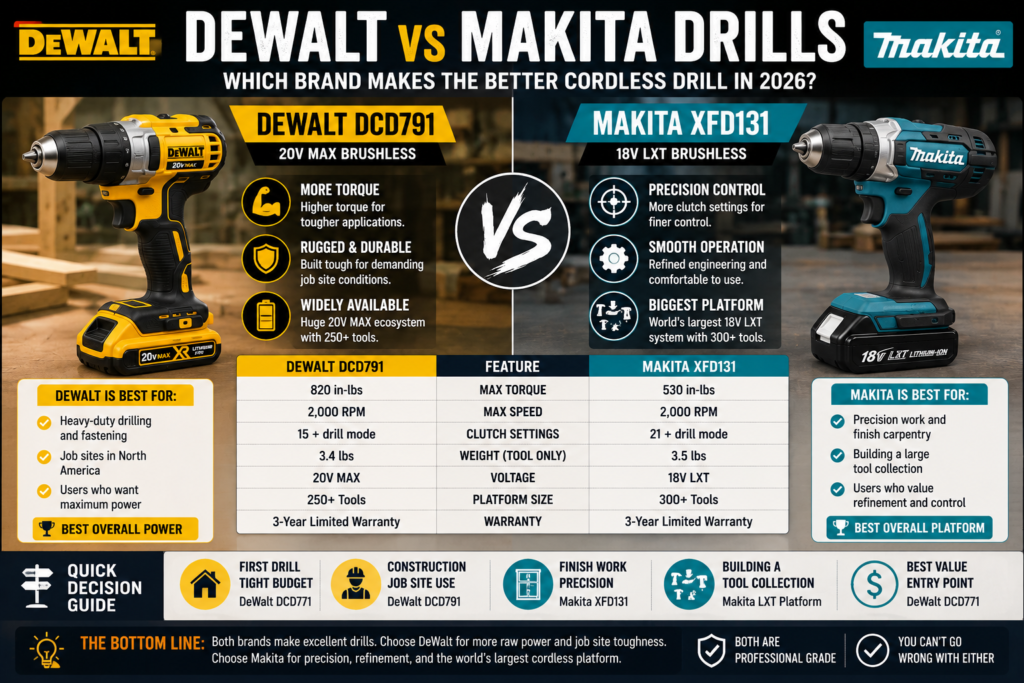
Head to Head — Key Specifications Compared
| Feature | DeWalt DCD791 (Brushless) | Makita XFD131 (Brushless) |
|---|---|---|
| Voltage | 20V MAX | 18V LXT |
| Max torque | 820 in-lbs | 530 in-lbs |
| Max RPM | 2,000 | 2,000 |
| Chuck size | 1/2 inch | 1/2 inch |
| Clutch settings | 15 + drill mode | 21 + drill mode |
| Speed settings | 2 | 2 |
| Weight (tool only) | 3.4 lbs | 3.5 lbs |
| Motor | Brushless | Brushless |
| Battery platform | 20V MAX (250+ tools) | 18V LXT (300+ tools) |
| LED light | Yes | Yes |
Power and Torque
On paper, DeWalt has a clear torque advantage. The DCD791 delivers 820 in-lbs versus Makita’s 530 in-lbs on the XFD131. That is a significant difference on a spec sheet.
In practice, the difference matters most in demanding situations — drilling large holes in hardwood, driving long screws into dense material, or working continuously without letting the tool cool down. For everyday tasks like hanging shelves, assembling furniture, or general home repairs, both drills perform identically well and you will not notice the torque gap.
According to testing by Toolbox Buzz, DeWalt consistently outperforms Makita in heavy-duty drilling and fastening tasks, while Makita holds its own in light to medium applications where its smoother operation is actually preferred by many tradespeople.
Battery Life and Runtime
Both brands use 18V/20V lithium-ion batteries (the nominal voltage difference between 18V and 20V MAX is a marketing distinction — they are electrically equivalent). Both offer batteries ranging from 1.5Ah to 6Ah or higher.
In real-world runtime tests, the results are close. Makita batteries are widely praised for their efficiency and longevity. DeWalt batteries are known for their wide availability and compatibility across a huge tool lineup.
The key difference is platform size. DeWalt’s 20V MAX system covers over 250 tools including outdoor equipment, vacuums, and lighting. Makita’s 18V LXT system is the world’s largest cordless platform with over 300 compatible tools according to Makita’s official product page. For long-term ecosystem investment, Makita’s larger platform is a genuine advantage.
Build Quality and Ergonomics
This is where opinions genuinely differ between professionals.
DeWalt tools feel robust and substantial. The grip is firm, the body is solid, and the overall impression is of a tool built to take punishment on a job site. Many contractors prefer this feel for heavy daily use.
Makita tools feel more refined. The fit and finish is tighter, the controls are smoother, and the overall engineering feels more precise. Many tradespeople — particularly in finishing, cabinetry, and electrical work — prefer Makita for tasks where control and finesse matter as much as raw power.
Neither is objectively better. It genuinely comes down to personal preference and the type of work you do most often.
Clutch Control
Makita has an advantage here. The XFD131 offers 21 clutch settings compared to DeWalt’s 15, giving you finer control over driving depth. For precision work — driving screws into cabinet faces, installing hinges, or working with delicate materials — more clutch settings means less risk of over-driving.
For most users this difference is minor. But for finish carpenters and anyone doing detailed work, Makita’s additional clutch settings are a real practical advantage.
Price and Value
| Model | Tool Only | Kit (with battery) | Value |
|---|---|---|---|
| DeWalt DCD771 (Brushed) | ~$60 | ~$99 | Best budget entry |
| DeWalt DCD791 (Brushless) | ~$129 | ~$179 | Best mid-range DeWalt |
| Makita XFD131 (Brushless) | ~$119 | ~$169 | Best mid-range Makita |
| Makita XPH12Z (Brushless) | ~$149 | ~$199 | Best hammer drill Makita |
At the mid-range brushless level, Makita is typically slightly cheaper than the DeWalt equivalent while offering comparable performance. DeWalt has the edge at the budget end with the DCD771, which is one of the most affordable quality drills available. For a full review of the DCD771, read our DeWalt DCD771 Review.
Pros and Cons
DeWalt Drills
| ✅ Pros * Higher torque on comparable models * Extremely wide battery ecosystem * Great budget entry with DCD771 * Strong job site durability * Widely available parts and service | ❌ Cons * Fewer clutch settings than Makita * Slightly heavier feel * Premium models expensive * Less refined finish than Makita |
Makita Drills
| ✅ Pros * World’s largest cordless platform (300+ tools) * More clutch settings for precision * Excellent build quality and finish * Smooth, refined operation * Strong international availability | ❌ Cons * Lower torque than DeWalt on comparable models * No strong budget entry point * Less dominant in North American market * Teal colour not for everyone |
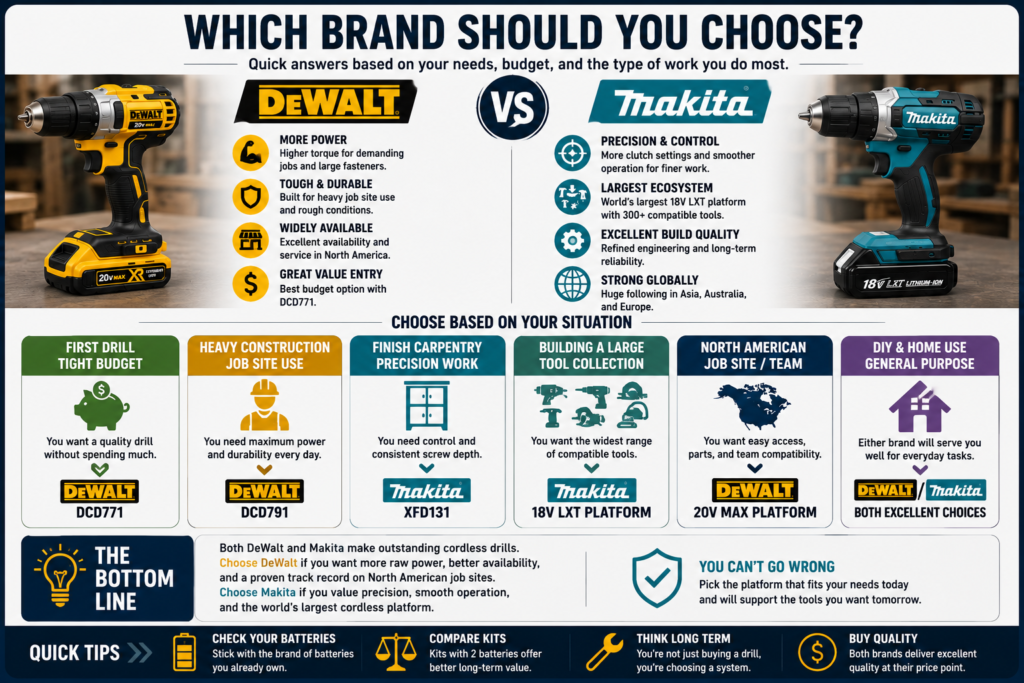
Which Brand Should You Choose?
| Your situation | Best choice |
|---|---|
| First drill, tight budget | DeWalt DCD771 |
| Heavy construction and job site use | DeWalt DCD791 |
| Finish carpentry and precision work | Makita XFD131 |
| Building a large multi-tool collection | Makita LXT platform |
| North American job site, team environment | DeWalt 20V MAX platform |
| DIY and general home use | Either — both excellent |
DeWalt vs Makita Brand Selector
What describes your situation best?
The Honest Verdict
There is no bad choice between DeWalt and Makita. Both brands produce tools that will last years with proper care and outperform budget alternatives significantly.
If raw power and ecosystem size in North America matter most, DeWalt is the safer bet. If precision, build quality, and the world’s largest cordless platform matter more, Makita edges ahead.
For most homeowners and DIYers the decision often comes down to price and what is available locally. At the mid-range brushless level both brands are closely matched in value. Pick the one that fits your budget, check which batteries are already in your toolkit, and you will not be disappointed with either.
For detailed reviews of specific models mentioned in this guide, read our Makita XFD131 Review and our DeWalt 20V Max Drill Review.
Frequently Asked Questions
Is DeWalt or Makita more reliable long term?
Both brands have excellent long-term reliability records. According to This Old House, both DeWalt and Makita consistently rank among the top performers in long-term durability testing. Makita’s brushless motors are particularly praised for longevity, while DeWalt’s robust housings hold up well to job site abuse.
Are DeWalt and Makita batteries interchangeable?
No. DeWalt 20V MAX batteries and Makita 18V LXT batteries are not compatible with each other. Each brand uses a proprietary connection system. This is one of the most important reasons to commit to one platform — once you invest in batteries, switching brands becomes expensive.
Which brand has better customer service?
DeWalt offers a three-year limited warranty, one-year free service, and a 90-day money-back guarantee on most tools. Makita offers a three-year limited warranty on tools and batteries. Both have extensive service networks, though DeWalt’s service centres are more widely distributed in North America while Makita has stronger coverage in Asia, Australia, and Europe.
Is 20V the same as 18V?
Electrically, yes. DeWalt markets its batteries as 20V MAX, which refers to the peak voltage. The nominal (working) voltage is 18V — the same as Makita’s 18V LXT batteries. This is a marketing distinction, not a meaningful performance difference. Both systems operate at the same working voltage in practice.
Which is better for a beginner — DeWalt or Makita?
For beginners on a budget, DeWalt’s DCD771 is hard to beat as a starting point. It is affordable, widely available, and performs well for everyday tasks. For beginners who want to invest in a long-term platform with room to grow, Makita’s LXT system offers the broadest range of compatible tools to expand into over time.
Do professionals prefer DeWalt or Makita?
It depends heavily on the trade and region. In North American construction, DeWalt is dominant. In finishing, cabinetry, and electrical trades globally, Makita has a very strong following. Milwaukee is also a major competitor in professional markets. There is no universal answer — preference varies significantly by region, trade, and personal experience.
Can I use a Makita battery on a DeWalt tool?
Not directly without a third-party adapter. These adapters exist but are not recommended as they can void warranties and may not deliver full performance. The safest approach is to stick within one brand’s ecosystem for all your cordless tools.