Choosing the wrong drill for a job is one of the most common mistakes DIYers and even experienced tradespeople make. Use a standard drill on concrete and you will burn out the motor. Use a heavy hammer drill for cabinet installation and you will crack the wood. Use an impact driver when you needed a drill and you will strip every screw.
The good news is that once you understand the four main types of drills and what each one is actually designed for, the decision becomes straightforward. This guide walks you through everything — drill types, key specs, and a quick interactive tool at the end to help you find the right drill for your specific project.
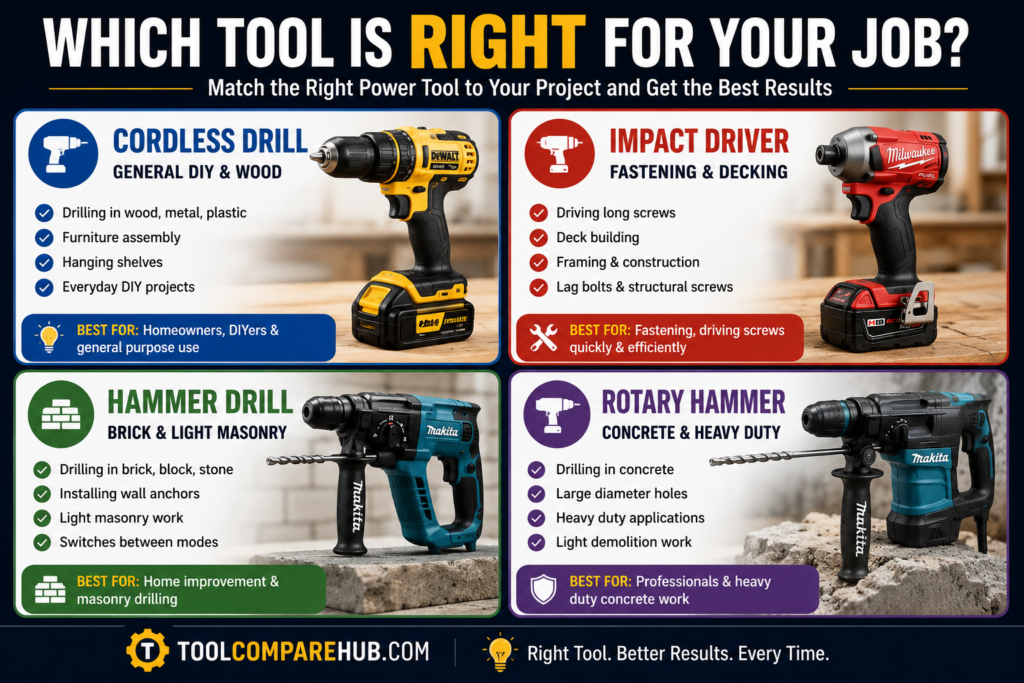
The Four Main Types of Power Drills
1. Cordless Drill / Driver
The most versatile and commonly owned drill type. A cordless drill handles both drilling holes and driving screws, with a clutch system that gives you precise control over how much torque is applied. It works on wood, metal, plastic, and drywall and is the right starting point for most homeowners and DIYers.
Best for: General home use, furniture assembly, hanging shelves, light woodworking, drilling holes up to 25mm in wood and metal.
Not ideal for: Concrete, masonry, driving hundreds of long screws quickly.
2. Hammer Drill
A hammer drill looks like a standard cordless drill but adds a percussive hammering action that pulverises material as the bit rotates. This hammering mode is essential for drilling into concrete, brick, block, and other masonry materials. Most hammer drills can switch between standard drill mode and hammer mode, making them more versatile than a standard drill.
Best for: Drilling into concrete, brick, block, and masonry. Installing anchor bolts, rawl plugs, and wall fixings into hard surfaces.
Not ideal for: Fine woodworking or precision work where vibration causes problems.
3. SDS Drill (Rotary Hammer)
An SDS drill is a step up from a hammer drill, designed for serious masonry work. It uses a special SDS bit system that allows the bit to slide back and forth independently of the chuck rotation, delivering far more impact energy than a standard hammer drill. For drilling large holes in concrete or breaking up masonry, nothing else comes close.
Best for: Heavy masonry drilling, large anchor installations, light demolition work, drilling holes larger than 13mm in concrete.
Not ideal for: Wood, metal, or precision work. Overkill for most home users.
4. Impact Driver
An impact driver is not technically a drill — it is a screw driving tool. It uses a hammering mechanism to deliver high rotational force in bursts, making it extremely efficient at driving long screws and fasteners. It cannot drill holes effectively and has no clutch, but for bulk screw driving it outperforms a standard drill significantly.
Best for: Driving long screws, deck building, framing, structural fastening, lag bolts.
Not ideal for: Drilling holes, precision screw driving, delicate materials.
For a detailed head to head between drills and impact drivers, read our Impact Driver vs Drill guide.
Drill Types at a Glance
| Drill type | Drills wood | Drills metal | Drills concrete | Drives screws | Price range |
|---|---|---|---|---|---|
| Cordless drill | ✅ Excellent | ✅ Good | ❌ No | ✅ Good | $80–$200 |
| Hammer drill | ✅ Good | ✅ Good | ✅ Good | ✅ Good | $120–$250 |
| SDS drill | ⚠️ Possible | ❌ No | ✅ Excellent | ❌ No | $150–$400 |
| Impact driver | ⚠️ Limited | ⚠️ Limited | ❌ No | ✅ Excellent | $80–$200 |
Key Specs Explained Simply
Torque (in-lbs or Nm)
Torque is the rotational force the drill applies. Higher torque means more driving and drilling power. For home DIY tasks 300 to 500 in-lbs is more than adequate. For regular hardwood drilling or professional use, look for 600 in-lbs or above. Do not over-buy on torque — too much torque without clutch control strips screws and splits wood.
RPM (Revolutions Per Minute)
RPM is how fast the chuck spins. Higher RPM is better for drilling small holes in soft materials. Lower RPM with high torque is better for driving screws. Most quality drills offer two speed settings — low speed high torque for driving, high speed low torque for drilling.
Clutch Settings
The numbered ring behind the chuck. More settings means finer torque control. For home DIY at least 15 settings is adequate. For precision work look for 21 or more. The drill symbol on the clutch ring bypasses it completely for drilling holes.
Chuck Size
1/2 inch (13mm) chuck is standard on most quality drills and accepts the widest range of bits. 3/8 inch (10mm) is smaller and lighter but limits maximum bit size. For most buyers 1/2 inch is the right choice.
Battery Voltage and Ah
18V/20V is the right voltage for most users. The Ah rating determines runtime — higher Ah means longer use between charges. For more detail read our 20V vs 18V Battery guide and our 5Ah vs 2Ah Battery comparison.
Brushless vs Brushed — Which Should You Choose?
If your budget allows, always choose brushless. Brushless motors deliver longer runtime, longer lifespan, run cooler, and adjust power output intelligently. The price premium is worth it for anyone who uses their drill regularly. For occasional light home use, a brushed motor drill at a lower price point is perfectly adequate.
For a full explanation read our Brushless vs Brushed Motor guide.
What to Look for by User Type
| User type | What you need | Recommended |
|---|---|---|
| First time buyer | Simple, affordable, reliable | DeWalt DCD771 kit ~$99 |
| Regular DIYer | Brushless, good torque, long runtime | DeWalt DCD791 or Makita XFD131 |
| Finish carpenter | Precise clutch control, smooth operation | Makita XFD131 (21 clutch settings) |
| Construction worker | High torque, durable, jobsite ready | DeWalt DCD999 or Milwaukee 2804 |
| Concrete / masonry work | Hammer mode essential | DeWalt DCD996 hammer drill |
| Budget buyer | Best value for occasional use | Ryobi PSBDD01B brushless ~$99 |
Top Brands at a Glance
According to Popular Mechanics, the most consistently recommended brands for cordless drills across all price points are DeWalt, Makita, Milwaukee, and Ryobi — in that order for professional use. For a detailed brand comparison read our DeWalt vs Makita Drills comparison.
| Brand | Known for | Battery platform | Best entry model |
|---|---|---|---|
| DeWalt | Power and durability | 20V MAX (250+ tools) | DCD771 ~$99 kit |
| Makita | Precision and build quality | 18V LXT (300+ tools) | XFD131 ~$169 kit |
| Milwaukee | Professional performance | M18 (200+ tools) | 2801-20 ~$149 tool |
| Ryobi | Value and ecosystem size | 18V ONE+ (225+ tools) | PSBDD01B ~$99 tool |
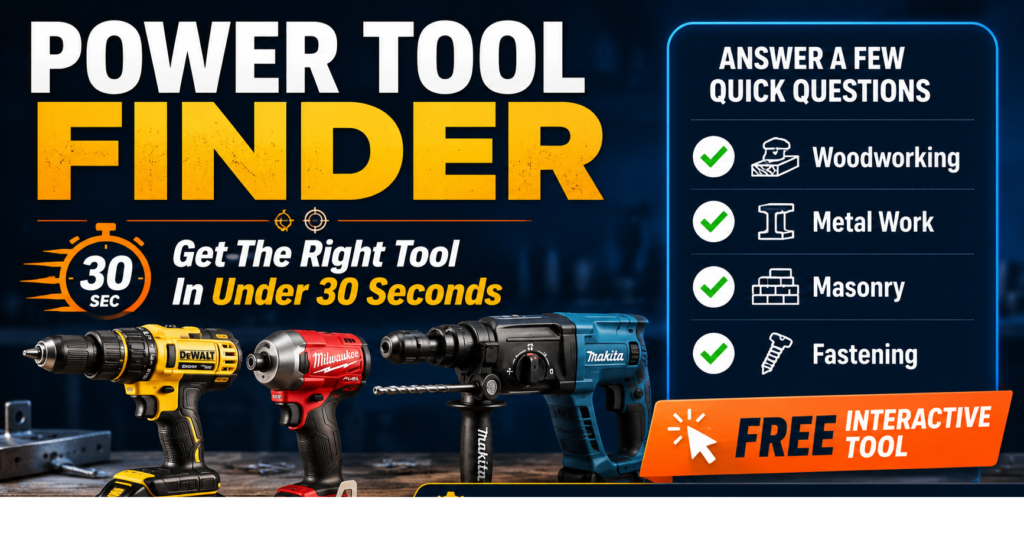
🔧 Interactive Tool — Find the Right Drill for Your Project
Answer three quick questions below and we will tell you exactly which type of drill you need and which model to consider.
🔧 Power Tool Finder
Frequently Asked Questions
What is the best drill for a complete beginner?
The DeWalt DCD771 kit is consistently recommended for beginners. It comes with two batteries and a charger for around $99, is backed by DeWalt’s excellent service network, and handles all typical home tasks without any complexity. For beginners who want to start with brushless technology, the Makita XFD131 kit at around $169 is the next best option.
Do I need a hammer drill for general home use?
Only if you regularly drill into concrete, brick, or masonry. For most home tasks — wood, drywall, metal, and tile — a standard cordless drill is more than adequate and easier to control. If you occasionally need to drill into masonry, a standard drill with a good quality masonry bit handles small holes perfectly well.
Can one drill handle all materials?
A hammer drill comes closest to being an all-round solution — it handles wood, metal, drywall, and masonry in both standard and hammer modes. For tile and very hard masonry large holes you still need specialised bits or an SDS drill. For most homeowners a standard cordless drill covers 90 percent of tasks, with a separate SDS drill hired when masonry work is needed.
How important is brand when choosing a drill?
Very important for long-term ownership. DeWalt, Makita, and Milwaukee all produce tools that last a decade or more with proper care and have extensive service networks. The battery platform you choose is equally important — once you invest in batteries, all future tool purchases should stay within that ecosystem. Read our DeWalt vs Makita comparison for a full brand breakdown.
What drill bits do I need to get started?
A basic starter set covering 1mm to 10mm HSS bits for wood and metal, plus 3 to 4 masonry bits in common sizes, handles the vast majority of home tasks. A set of screwdriver bits (Phillips, flat, Torx) is equally essential. Look for a 20 to 40 piece combination set from DeWalt or Makita for $15 to $30 — it covers everything a beginner needs.
Is it worth buying a cordless drill kit or just the tool?
For first-time buyers a kit is almost always better value. Batteries and chargers purchased separately cost nearly as much as the kit premium. For buyers already in a brand ecosystem who just need to add a tool, buying tool-only makes more financial sense. Read our full Cordless Drill Buying Guide for a complete breakdown of kit vs tool-only decisions.