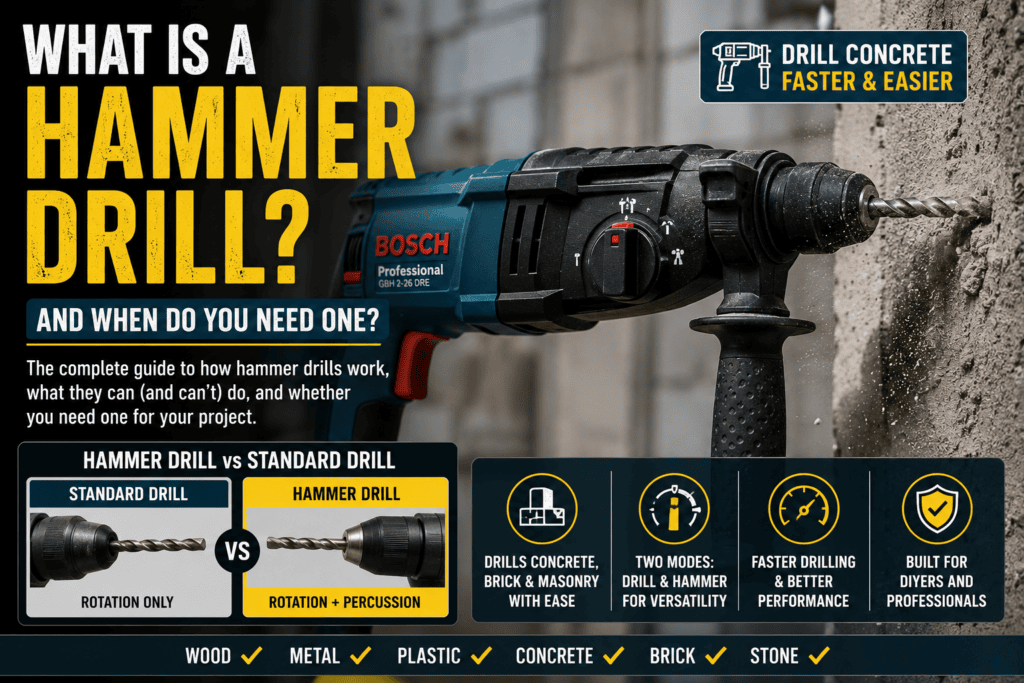
If you have ever tried drilling into concrete or brick with a standard cordless drill and made almost no progress — bit spinning, dust barely coming out, tool getting hot — you have experienced first-hand what a hammer drill is designed to solve. A standard drill rotates a bit. A hammer drill rotates a bit and simultaneously hammers it into the material with rapid percussive blows. That combination is what makes masonry drilling practical.
But hammer drills are not universally necessary, and buying one when you do not need it is wasted money. This guide explains exactly what a hammer drill does, how it differs from other drill types, and whether your projects actually require one.
How a Hammer Drill Works
A standard drill applies only rotational force to the bit. This works well in wood, metal, and plastic — materials that can be cut by a rotating sharp edge. Concrete, brick, and masonry are different. They cannot be cut by rotation alone because the aggregate and bonding materials are too hard and abrasive for a steel bit to cut through at useful speeds.
A hammer drill adds a second mechanism — percussion. Inside the tool, a cam-and-ratchet system (or in more powerful rotary hammer drills, a pneumatic piston) delivers rapid forward impacts to the bit as it rotates. These impacts physically break up and crush the material directly ahead of the bit tip while the rotation carries the crushed material out of the hole through the bit’s flutes.
The result is dramatically faster drilling in masonry — what might take a standard drill several frustrating minutes of ineffective grinding can be accomplished in 10 to 20 seconds with a hammer drill and the correct masonry bit.
Hammer Drill vs Standard Drill — Key Differences
| Feature | Standard drill | Hammer drill |
|---|---|---|
| Drill action | Rotation only | Rotation + percussion |
| Drills wood | ✅ Excellent | ✅ Excellent (in drill mode) |
| Drills metal | ✅ Good | ✅ Good (in drill mode) |
| Drills concrete/brick | ❌ Very poor | ✅ Good (in hammer mode) |
| Drives screws | ✅ Good (with clutch) | ✅ Good (in drill mode) |
| Weight | Lighter | Slightly heavier |
| Price | Lower | Slightly higher |
| Noise in use | Moderate | Louder in hammer mode |
Most quality hammer drills operate in both modes — standard drill mode for wood and metal, hammer mode for masonry. Switching between modes is typically done via a selector switch or ring on the tool body. This makes a hammer drill a more versatile tool than a standard drill for anyone who regularly works on construction and renovation projects.
Hammer Drill vs SDS Rotary Hammer — Which Is More Powerful?
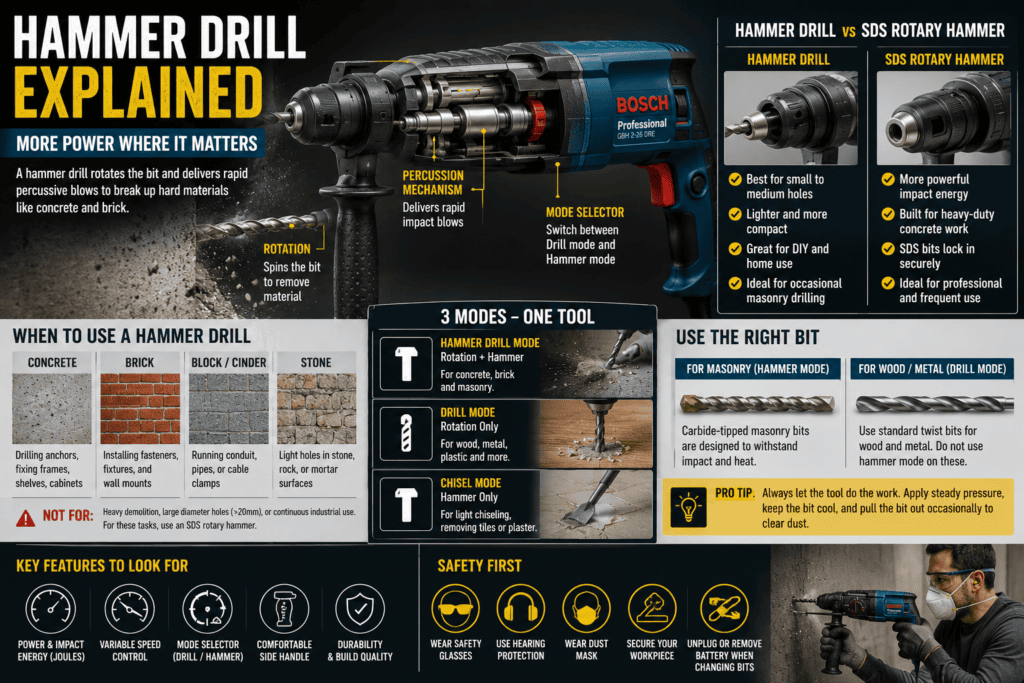
This is an important distinction that many buyers miss. A hammer drill and an SDS rotary hammer both deliver percussive action but do so very differently and at very different energy levels.
Hammer Drill
Uses a mechanical cam-and-ratchet system where two ridged plates push against each other as the chuck rotates, creating the hammering action. This delivers modest impact energy — typically 0.5 to 2 joules per blow. The bit is held rigidly in a standard 3-jaw chuck. This system works well for light to medium masonry work — wall plug holes up to about 12mm in brick and moderate concrete.
SDS Rotary Hammer
Uses a pneumatic piston mechanism that operates largely independently of the rotation. The bit fits into a special SDS chuck that allows it to slide back and forth, transmitting the full impact energy from the piston to the material. This delivers 2 to 8+ joules per blow — three to five times more energy than a standard hammer drill.
The practical difference is significant. For drilling 6mm to 10mm rawl plug holes in brick or soft concrete, a hammer drill is adequate and perfectly convenient. For drilling 16mm or larger anchor bolts into dense reinforced concrete, or for extended drilling sessions, an SDS rotary hammer is the right tool — a hammer drill will be slow, the bit will wear quickly, and the job will be frustrating.
| Factor | Hammer drill | SDS rotary hammer |
|---|---|---|
| Impact mechanism | Cam / ratchet | Pneumatic piston |
| Impact energy | 0.5–2 joules | 2–8+ joules |
| Chuck type | Standard 3-jaw | SDS-Plus or SDS-Max |
| Typical hole range | Up to 13mm in masonry | Up to 40mm+ in masonry |
| Best for | Home DIY masonry, small anchors | Trade and professional masonry, large anchors |
| Typical price | $120–$250 | $150–$400+ |
What a Hammer Drill Cannot Do
Despite its versatility, a hammer drill has real limitations worth understanding before buying:
- Cannot cut through rebar — if you hit steel reinforcing bars in concrete, the masonry bit will be destroyed. Stop and relocate the hole.
- Not suitable for tile drilling — the impact vibration that makes hammer drills effective on concrete will crack ceramic and porcelain tile. Always switch to drill-only mode (no hammer) and use a diamond tile bit for tile work.
- Not a substitute for an SDS drill in dense concrete — for large holes or extended work in hard reinforced concrete a hammer drill will be slow and quickly wear through bits. An SDS rotary hammer is the appropriate tool.
- Not a demolition tool — hammer drills are designed for drilling, not chiselling. SDS rotary hammers with a chisel bit and chisel-only mode can do light demolition. Standard hammer drills cannot.
When Do You Actually Need a Hammer Drill?
You need a hammer drill if your projects involve any of the following:
- Mounting shelves, TV brackets, or cabinets onto concrete, brick, or block walls
- Installing rawl plugs or wall anchors in masonry
- Running cables or pipes through brick or concrete walls
- Fitting door frames or window reveals into masonry openings
- Installing outdoor lighting, security cameras, or garden structures fixed to masonry
- Any task requiring holes in solid walls of a masonry-built home
You do not need a hammer drill if your projects involve only:
- Woodworking, furniture assembly, or cabinet installation
- Metal drilling or fabrication
- Drywall installation in timber-framed construction
- Projects where all fixings go into timber studs or joists
Top Hammer Drills to Consider
| Model | Voltage | Max torque | Best for | Price (approx) |
|---|---|---|---|---|
| DeWalt DCD996 | 20V MAX | 820 in-lbs | Best all-round hammer drill | ~$199 tool |
| Milwaukee 2804-20 | M18 | 1,200 in-lbs | Best torque for pro use | ~$179 tool |
| Makita XPH12Z | 18V LXT | 530 in-lbs | Best for precision and control | ~$149 tool |
| Ryobi PSBHM01B | 18V ONE+ | 600 in-lbs | Best budget option | ~$99 tool |
For a full comparison of drill brands and what each one offers across their ranges, read our DeWalt vs Makita guide and our DeWalt vs Milwaukee comparison. For understanding the right drill for every task read our complete drill selection guide.
🔨 Do You Need a Hammer Drill? — Quick Assessment
Answer three quick questions and find out whether a hammer drill is necessary for your project.
Frequently Asked Questions
Can I use a hammer drill as a regular drill?
Yes — all hammer drills have a standard drill-only mode that disables the hammer action. In this mode they work identically to a standard cordless drill for wood, metal, and screw driving. The hammer mode is simply an additional capability that you switch on when needed. This is one of the key advantages of a hammer drill over a standard drill — it covers everything a standard drill does, plus masonry work.
What bits do I need for a hammer drill?
For masonry work in hammer mode you need carbide-tipped masonry bits — the standard arrowhead-tipped bits designed for concrete, brick, and block. For wood and metal work in standard drill mode you use exactly the same HSS and wood bits as a standard drill. The hammer drill accepts all standard round-shank bits in its 3-jaw chuck. For more detail on bit selection read our Drill Bit Types guide and our Concrete vs Masonry Bit guide.
Should I leave hammer mode on all the time?
No — hammer mode should only be used when drilling into masonry. Using hammer mode in wood produces a rougher hole and unnecessary vibration. Using it in metal is ineffective and can damage the bit. Using it in tile will crack the tile. Switch to standard drill mode for all non-masonry materials and only activate hammer mode when you specifically need it for concrete, brick, or block.
How deep can a hammer drill go in concrete?
The practical depth limit for a standard hammer drill depends on the bit length and the hardness of the concrete. Standard masonry bits come in lengths from about 75mm to 400mm. For most home fixing applications — rawl plugs, shelf brackets, wall anchors — depths of 40mm to 80mm are typical and well within range. For deeper holes through concrete walls an SDS drill with long SDS bits is a more practical choice than extending standard hammer drill bits.
Is a hammer drill worth it for occasional home use?
If you own or are renovating a masonry-built home — brick walls, concrete lintels, block foundations — yes, a hammer drill is worth owning even for occasional use. The jobs it makes possible (mounting anything to masonry walls) come up regularly in home ownership, and attempting them with a standard drill is frustrating and damages bits. For timber-framed construction where all walls are drywall over studs, a hammer drill adds less value and a standard drill may suffice.