DeWalt’s FLEXVOLT system is one of the most ambitious innovations in the cordless tool industry. A single battery that automatically switches between 20V and 60V depending on which tool it is inserted into — powering everything from compact drills to full-size outdoor equipment that previously required petrol engines.
The promise is compelling. One battery platform. One charger. Tools powerful enough to replace gas. But FLEXVOLT tools and batteries cost significantly more than standard 20V MAX equivalents. The question serious buyers need to answer is whether the performance and convenience justify the premium price.
This guide examines the DeWalt FLEXVOLT outdoor tool lineup in detail — how the technology works, which tools are available, real-world performance comparisons, and an honest assessment of who should and should not invest in the FLEXVOLT system.
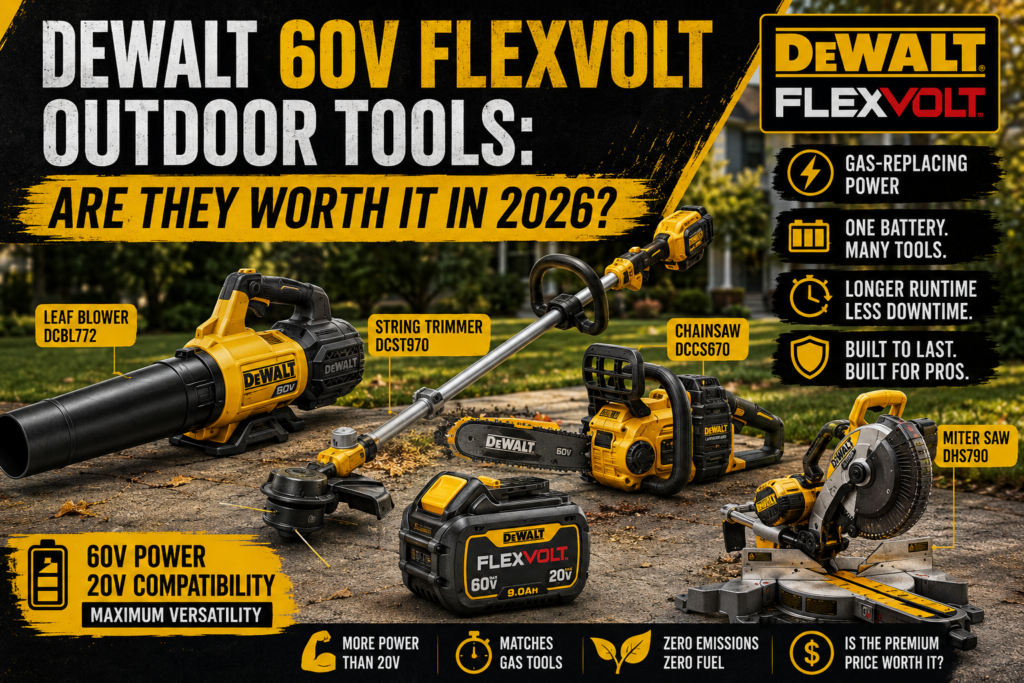
How FLEXVOLT Technology Works
The FLEXVOLT battery is an engineering achievement. Inside a standard lithium-ion battery pack the cells are arranged in a fixed configuration. DeWalt’s FLEXVOLT battery uses a switching mechanism that physically reconfigures the cell arrangement depending on the tool it is connected to.
- In a 20V MAX tool — cells connect in parallel, delivering 20V at higher capacity
- In a 60V MAX tool — cells connect in series, delivering 60V at standard capacity
- In a 120V MAX tool — two FLEXVOLT batteries connect to deliver 120V
This means one battery genuinely works across both your compact cordless tools and your high-demand outdoor equipment. According to DeWalt’s official FLEXVOLT page, the system is fully backward compatible — FLEXVOLT batteries work in every existing 20V MAX tool in the DeWalt lineup.
FLEXVOLT Battery Options
| Battery | In 20V tool | In 60V tool | Weight | Price (approx) |
|---|---|---|---|---|
| DCB606 (6Ah) | 20V / 6Ah | 60V / 2Ah | 1.9 lbs | ~$149 |
| DCB609 (9Ah) | 20V / 9Ah | 60V / 3Ah | 2.7 lbs | ~$199 |
| DCB612 (12Ah) | 20V / 12Ah | 60V / 4Ah | 3.4 lbs | ~$249 |
FLEXVOLT Outdoor Tool Lineup
1. FLEXVOLT Leaf Blower — DCBL772
The DeWalt DCBL772 is one of the most powerful handheld cordless blowers available. It delivers 600 CFM and 125 MPH — comfortably ahead of standard 20V cordless blowers and competitive with mid-range gas models.
| Spec | DCBL772 (60V) | Standard 20V blower | Mid-range gas |
|---|---|---|---|
| CFM | 600 | 350–450 | 450–600 |
| MPH | 125 | 90–110 | 120–170 |
| Runtime (6Ah) | ~25 min high / ~45 min low | ~20 min high | Unlimited |
| Tool price | ~$149 tool only | ~$79–$99 | ~$150–$250 |
2. FLEXVOLT String Trimmer — DCST970
The DCST970 uses a brushless motor and 0.095 inch line to power through overgrown grass, thick weeds, and heavy vegetation that would bog down a standard 20V trimmer. It includes a variable speed trigger and a bump-feed line advancement system.
| Spec | DCST970 (60V) | Standard 20V trimmer |
|---|---|---|
| Cut width | 15 inches | 12–13 inches |
| Line diameter | 0.095 inch | 0.080 inch |
| Runtime (6Ah) | ~35–45 min | ~20–30 min |
| Tool price | ~$129 tool only | ~$79–$99 |
3. FLEXVOLT Chainsaw — DCCS670
The DCCS670 is arguably the most impressive FLEXVOLT outdoor tool — a 16-inch bar chainsaw that genuinely competes with light gas chainsaws for firewood cutting, limbing, and small tree felling. It delivers 70 cuts per charge on a 6Ah battery and requires zero fuel, zero choke, and zero pull-cord frustration.
| Spec | DCCS670 (60V) | Light gas chainsaw |
|---|---|---|
| Bar length | 16 inch | 14–18 inch |
| Chain speed | 4,900 RPM | 5,000–6,000 RPM |
| Cuts per charge | ~70 (6Ah, 4-inch pine) | Unlimited with fuel |
| Tool price | ~$249 tool only | ~$200–$350 |
4. FLEXVOLT Miter Saw — DHS790
The DHS790 is a 12-inch dual-bevel sliding compound miter saw powered by FLEXVOLT. It delivers performance matching corded saws and is one of the most popular FLEXVOLT tools among professional carpenters who need a portable, site-ready miter saw without running an extension cord.
5. FLEXVOLT Circular Saw — DCS578
The DCS578 is a 7.25-inch circular saw that matches the performance of standard 15-amp corded circular saws. It cuts through 3-inch thick lumber at 45 degrees — a benchmark that most 20V cordless circular saws cannot achieve. For a detailed look at circular saw selection, read our Circular Saw Blade guide.
FLEXVOLT vs Standard 20V MAX — Is the Upgrade Worth It?
| Factor | Standard 20V MAX | FLEXVOLT 60V |
|---|---|---|
| Power output | Good for light to medium tasks | Excellent — matches light gas tools |
| Runtime | 20–35 min typical | 35–60 min typical |
| Battery backward compatibility | 20V MAX tools only | Both 20V and 60V tools |
| Tool cost premium | Standard pricing | 30–60% more expensive |
| Battery cost | $35–$99 (2–5Ah) | $149–$249 (6–12Ah) |
| Best for | Light to medium home tasks | Demanding tasks, large properties |
| Gas replacement? | Partial — for light gas tools | Yes — for light to mid gas tools |
Pros and Cons of FLEXVOLT Outdoor Tools
| ✅ Pros * One battery powers 20V AND 60V tools * Significantly more power than standard 20V * Genuine gas replacement for light to mid tasks * Longer runtime per charge than 20V equivalents * Backward compatible with all DeWalt 20V MAX tools * No fuel, no emissions, instant start * Professional-grade build quality | ❌ Cons * Significantly higher tool prices * FLEXVOLT batteries cost $149–$249 each * Still cannot match heavy-duty gas for large acreages * Battery is heavy at 1.9–3.4 lbs * Not worth it if you only do light occasional tasks * Higher investment risk if switching from gas |
Who Should Invest in FLEXVOLT?
FLEXVOLT is worth it if you:
- Already own DeWalt 20V MAX tools and want to expand into outdoor equipment on the same battery
- Have a medium to large yard requiring sustained high-power outdoor tool use
- Want to eliminate gas tools completely from your collection
- Use a miter saw or circular saw on site and want a corded-equivalent cordless option
- Value the convenience of one battery platform across all your tools
FLEXVOLT is not worth it if you:
- Only do occasional light yard work — standard 20V tools are sufficient
- Have a very large property — gas backpack blowers and large mowers still outperform FLEXVOLT for extended heavy use
- Are starting from zero with no existing DeWalt batteries — the entry cost is very high
- Are a purely budget-focused buyer — Ryobi 40V delivers 70 percent of the performance at half the price
🔧 FLEXVOLT Worth It? — Personal Assessment Tool
Answer 4 quick questions to get a personalised assessment of whether DeWalt 60V FLEXVOLT is the right investment for your situation.
Best Value Way to Get Into FLEXVOLT
The most cost-effective way to enter the FLEXVOLT ecosystem is to buy a combo kit that includes the battery and charger — then add additional tool-only purchases using that same battery.
| Start with | Price | What you get |
|---|---|---|
| DCBL772X1 (blower kit) | ~$299 | Blower + 6Ah FLEXVOLT battery + charger |
| Then add DCST970B (trimmer, tool only) | ~$129 | String trimmer using same 6Ah battery |
| Total for two tools | ~$428 | Two professional-grade outdoor tools + battery + charger |
That same 6Ah FLEXVOLT battery also works in every DeWalt 20V MAX tool you own — drills, impact drivers, saws, and more. For more on how the DeWalt ecosystem works across its range, read our DeWalt vs Milwaukee comparison and our DeWalt vs Makita guide.
Frequently Asked Questions
Can I use FLEXVOLT batteries in my existing DeWalt 20V MAX tools?
Yes — this is one of FLEXVOLT's most important advantages. A FLEXVOLT battery inserted into any DeWalt 20V MAX tool automatically operates at 20V, functioning as a very high capacity 20V battery. Your existing drills, impact drivers, and saws all benefit from the extended runtime of a FLEXVOLT battery without any modifications.
Can I use standard 20V MAX batteries in FLEXVOLT tools?
No — 20V MAX batteries cannot power 60V FLEXVOLT tools. The tools require the higher voltage that only FLEXVOLT batteries can provide. Standard 20V batteries are not compatible with 60V tool slots. This is the main limitation of the system — FLEXVOLT tools require FLEXVOLT batteries.
How do FLEXVOLT outdoor tools compare to EGO?
EGO's 56V platform is the closest cordless competitor to FLEXVOLT for outdoor tools. EGO's leaf blower (650 CFM) delivers more airflow than DeWalt's FLEXVOLT blower (600 CFM). However DeWalt's FLEXVOLT advantage is ecosystem integration — if you already use DeWalt power tools, FLEXVOLT batteries work across your entire collection. EGO batteries only work in EGO outdoor tools. For a full outdoor brand comparison read our EGO vs Ryobi guide.
Is FLEXVOLT powerful enough to fully replace gas outdoor tools?
For light to medium gas tools — yes. FLEXVOLT leaf blowers, string trimmers, and chainsaws genuinely match the performance of comparable light gas models for typical residential use. For professional-grade backpack blowers, large chainsaws, and ride-on mowers, gas still holds a clear advantage in sustained power and runtime. FLEXVOLT is best described as a genuine replacement for light gas tools and a partial replacement for mid-range gas equipment.
Are FLEXVOLT batteries worth the high price?
Yes — if you have multiple tools to use them with. A $149 FLEXVOLT 6Ah battery powering two outdoor tools and five indoor power tools represents excellent cost-per-tool value compared to buying separate batteries for each platform. The value proposition weakens significantly if you only have one or two FLEXVOLT tools using the battery. The more tools you own across the DeWalt ecosystem, the better the value of each FLEXVOLT battery becomes.
How long do FLEXVOLT batteries last over their lifetime?
FLEXVOLT batteries use the same lithium-ion chemistry as standard DeWalt batteries and degrade similarly with use — expect 3 to 5 years of regular use before capacity drops noticeably. Proper storage at 40 to 60 percent charge in a cool location significantly extends life. Read our complete Battery Storage guide for full details on maximising battery lifespan.