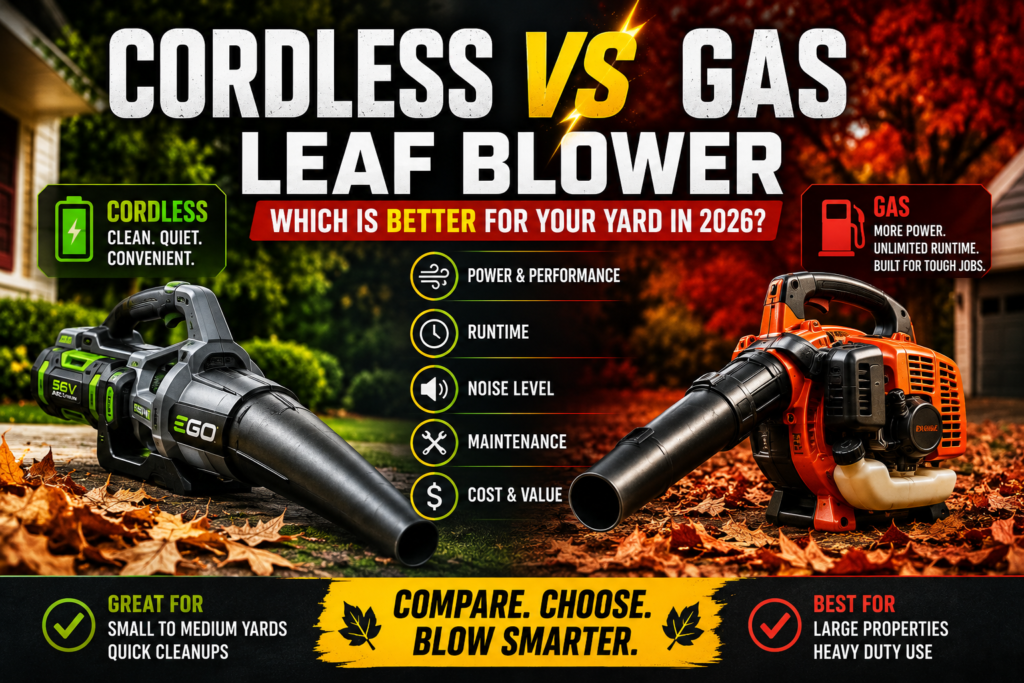
Choosing between a cordless and gas leaf blower used to be straightforward — gas for power, cordless for convenience. In 2026 that distinction has blurred significantly. Modern battery-powered leaf blowers from brands like EGO, Ryobi, and DeWalt now deliver performance that genuinely rivals many gas models, while producing zero emissions and requiring almost no maintenance. Thus, Cordless vs Gas Leaf Blower comparison is necessary to understand.
But gas still holds real advantages in specific situations — particularly for large properties, extended continuous use, and maximum blowing force. The right choice depends on your yard size, usage pattern, and priorities.
This guide compares both types across every factor that actually matters, with an interactive tool at the end to give you a personalised recommendation based on your specific situation.
How Each Type Works
Cordless (Battery) Leaf Blowers
Cordless leaf blowers are powered by rechargeable lithium-ion battery packs — typically 18V, 20V, 40V, or 56V/80V for higher-end models. The motor drives an impeller that accelerates air through the blower tube. Higher voltage batteries deliver more airflow and pressure. Modern brushless motor designs have made cordless blowers dramatically more efficient than earlier generations.
Gas Leaf Blowers
Gas leaf blowers use a two-stroke or four-stroke petrol engine to drive the same impeller mechanism. Two-stroke engines (which require mixed fuel) are lighter and more powerful for their size but louder and more polluting. Four-stroke engines run on straight petrol, are quieter and cleaner, but heavier. Gas blowers have no runtime limit — as long as you have fuel they keep running.
Full Comparison — Cordless vs Gas
| Feature | Cordless Battery | Gas |
|---|---|---|
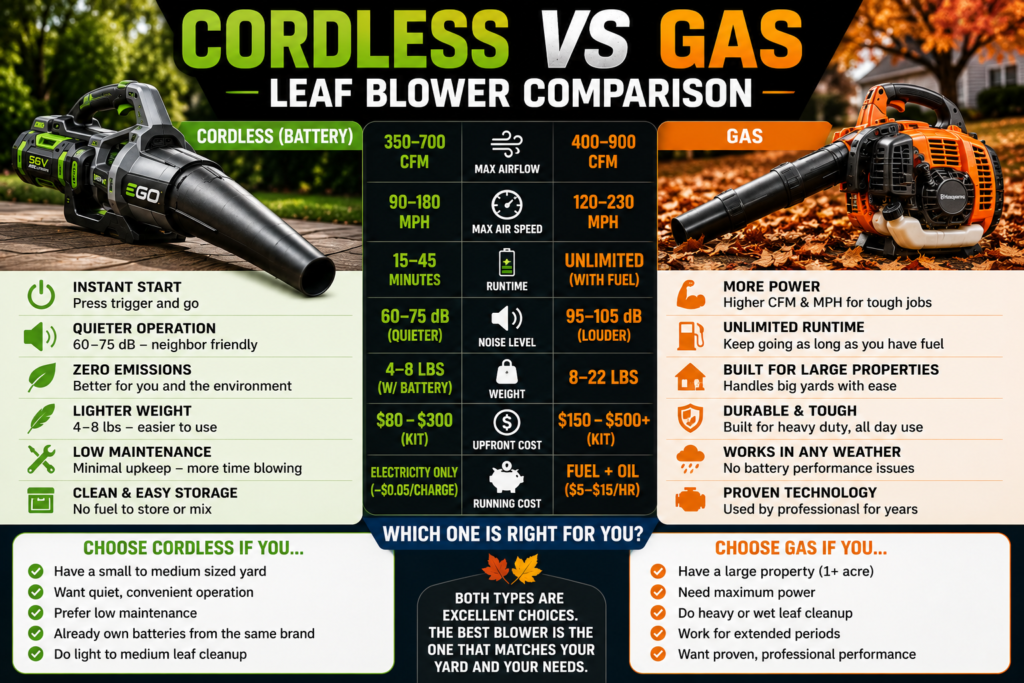
| Max airflow (CFM) | 350–700 CFM (premium) | 400–900 CFM |
| Max air speed (MPH) | 90–180 MPH | 120–230 MPH |
| Runtime | 15–45 min per charge | Unlimited (with fuel) |
| Noise level | 60–75 dB (quieter) | 95–105 dB (very loud) |
| Emissions | Zero at point of use | Significant exhaust fumes |
| Weight | 4–8 lbs (with battery) | 8–22 lbs |
| Startup | Instant — press trigger | Pull cord required |
| Maintenance | Minimal — clean vents, store battery properly | High — spark plugs, air filter, fuel mix, carburettor |
| Upfront cost | $80–$300 (kit) | $150–$500+ |
| Running cost | Electricity only (~$0.05/charge) | Petrol + oil (ongoing) |
| Storage | Easy — no fuel concerns | Must drain fuel or use stabiliser |
| Best for | Small to medium yards, convenience | Large properties, heavy debris |
Power — How Big Is the Gap in 2026?
The power gap between cordless and gas blowers has narrowed dramatically. Five years ago a $200 cordless blower was clearly outperformed by a $200 gas blower. In 2026 that is no longer consistently true.
The EGO Power+ LB6504 — one of the top-rated cordless blowers — delivers 650 CFM and 180 MPH on a 56V battery. That exceeds the output of many mid-range gas blowers. The Ryobi 40V delivers a respectable 480 CFM and 110 MPH — more than sufficient for most residential yards.
Where gas still clearly leads is at the high end — professional-grade backpack gas blowers delivering 800+ CFM and 200+ MPH move significantly more debris per minute than any cordless alternative. For clearing large acreages covered in wet, heavy leaves, gas backpack blowers remain the professional standard.
According to Consumer Reports, cordless leaf blowers now match or exceed gas models in the majority of residential use cases tested — and score significantly higher for user satisfaction due to lower noise and zero maintenance.
Noise — A Bigger Deal Than Most Buyers Realise
Gas leaf blowers typically operate at 95 to 105 decibels — louder than a motorcycle and well above the 85dB threshold where hearing protection becomes necessary according to OSHA guidelines. Many municipalities have noise ordinances that restrict gas blower use to certain hours — and some areas are moving to ban gas blowers entirely.
Cordless blowers typically operate at 60 to 75 decibels — roughly equivalent to a normal conversation or a vacuum cleaner. You can use them early in the morning or late in the evening without disturbing neighbours. No hearing protection is required for typical use durations.
For anyone in a suburban or urban environment this is not a minor advantage — it fundamentally changes when and how often you can use the tool.
Runtime — The Main Cordless Limitation
Runtime is the most significant practical limitation of cordless blowers. On a single charge:
| Battery size | Low speed runtime | High speed runtime | Approximate yard coverage |
|---|---|---|---|
| 40V 2Ah | 25–30 min | 12–15 min | Up to 2,000 sq ft |
| 40V 4Ah | 45–55 min | 20–25 min | Up to 4,000 sq ft |
| 56V 5Ah | 60–75 min | 30–40 min | Up to 6,000 sq ft |
| Gas (full tank) | 60–120 min | 30–60 min | Unlimited with fuel |
The runtime gap can be closed significantly by carrying a spare battery. Two 4Ah batteries give you effectively 90 to 110 minutes of runtime — enough for most residential properties. For a detailed look at how battery capacity affects runtime, read our Battery Runtime guide.
Maintenance — A Clear Cordless Win
Gas blower maintenance is one of the most commonly underestimated ownership costs. A properly maintained gas blower requires:
- Fresh fuel or fuel stabiliser at end of season
- Spark plug replacement annually or every 100 hours
- Air filter cleaning or replacement every season
- Carburettor cleaning if left with old fuel
- Two-stroke oil mixing for two-stroke engines
- Regular inspection of fuel lines and primer bulb
Neglect any of these and you are likely to face a blower that will not start — usually right when you need it most in autumn. The cost and time of maintenance adds up significantly over the life of a gas blower.
Cordless blowers require virtually no maintenance beyond keeping the vents clear of debris and storing the battery correctly. Read our Complete Battery Storage guide for full details on keeping your battery in peak condition.
Cost Over 5 Years — The Full Picture
| Cost category | Cordless (5 year total) | Gas (5 year total) |
|---|---|---|
| Initial purchase | $150–$300 | $200–$400 |
| Fuel / electricity | ~$5 | ~$100–$200 |
| Maintenance parts | ~$0 | ~$50–$150 |
| Battery replacement (year 4–5) | ~$60–$100 | $0 |
| 5 year total (approx) | $215–$405 | $350–$750 |
Over five years cordless is typically the cheaper option for residential users — even accounting for battery replacement. Gas becomes more cost-competitive only at the professional end where higher-output machines deliver performance that premium cordless cannot yet match.
Pros and Cons
Cordless Battery Leaf Blower
| ✅ Pros * Quiet — use any time without disturbing neighbours * Zero emissions at point of use * Instant start — no pull cord * Virtually zero maintenance * Lighter and easier to handle * Lower 5-year total cost for most users * Battery shared with other cordless tools | ❌ Cons * Limited runtime per charge * Less power than top gas models * Battery degrades over years * Performance drops as battery drains * Not ideal for very large properties |
Gas Leaf Blower
| ✅ Pros * Unlimited runtime with fuel * Maximum power for large properties * Handles wet heavy debris more effectively * No battery degradation over time * Best for large acreages and professional use | ❌ Cons * Very loud — noise ordinance issues * Significant exhaust emissions * Pull cord startup — can be difficult * Heavy — especially backpack models * Regular maintenance required * Fuel mixing for two-stroke engines * Higher long-term running cost |
Which Should You Choose?
| Your situation | Best choice |
|---|---|
| Small suburban yard under 3,000 sq ft | Cordless |
| Medium yard 3,000 to 8,000 sq ft | Cordless (40V+ with 4Ah battery) |
| Large property over 8,000 sq ft | Gas or cordless with dual batteries |
| Noise-sensitive neighbourhood | Cordless always |
| Professional landscaping use | Gas backpack blower |
| Already own cordless tool batteries | Cordless — add to your existing platform |
| Hate maintenance and just want it to work | Cordless always |
🍃 Leaf Blower Recommender — Find Your Best Match
Answer 4 quick questions to get a personalised recommendation for your yard.
How large is your yard or property?
What type of debris do you mainly clear?
How important is noise level?
How do you feel about maintenance?
Top Cordless Leaf Blower Picks for 2026
| Model | Voltage | CFM | MPH | Best for |
|---|---|---|---|---|
| EGO LB6504 | 56V | 650 CFM | 180 MPH | Best overall cordless |
| Ryobi 40V PCL970B | 40V | 480 CFM | 110 MPH | Best value cordless |
| DeWalt DCBL772 | 60V FLEXVOLT | 600 CFM | 125 MPH | Best for DeWalt ecosystem users |
| Milwaukee 2728-20 | 18V M18 | 450 CFM | 120 MPH | Best for Milwaukee ecosystem users |
If you are already in the Ryobi ecosystem, our Ryobi 40V Leaf Blower Review covers that model in full detail including a runtime estimator tool. For battery capacity guidance to maximise runtime, read our Ryobi Battery Guide.
Frequently Asked Questions
Are cordless leaf blowers powerful enough for wet leaves?
Premium 40V and 56V cordless blowers handle damp leaves well. Wet, matted, heavily compacted leaves are more challenging — high-CFM models like the EGO LB6504 at 650 CFM manage them reasonably, but a gas backpack blower still has a clear advantage with soaking wet debris. For typical autumn leaf clearing a quality 40V+ cordless blower is perfectly adequate.
How long does a cordless leaf blower battery last over its lifetime?
A quality lithium-ion battery from a reputable brand typically lasts 3 to 5 years with seasonal use before capacity degrades noticeably. Proper storage during off-season is the single most important factor — store at 40 to 60 percent charge in a cool indoor location. Read our complete Battery Storage guide for full details.
Are gas leaf blowers being banned?
In some areas yes. California has passed legislation phasing out the sale of new gas-powered outdoor equipment. Several municipalities across the US, Canada, and Europe have noise ordinances that restrict or ban gas blower use in residential areas. This trend is accelerating — investing in a quality cordless blower now future-proofs you against potential restrictions in your area.
Can I use a cordless leaf blower to clear gutters?
Yes — most cordless blowers accept gutter cleaning attachment kits (curved tubes that direct airflow into gutters from ground level). This works well for dry debris. For wet compacted gutter debris a higher-CFM model works better. Check attachment compatibility before purchasing — not all blowers accept third-party gutter kits.
Is CFM or MPH more important in a leaf blower?
Both matter but CFM (cubic feet per minute — the volume of air moved) is generally more important for moving large piles of leaves. MPH (air speed) matters more for dislodging stuck or wet debris. The best blowers score well on both. A blower with high CFM and moderate MPH is usually more practical for typical garden use than one with extreme MPH but low CFM.
Can I use my existing cordless tool batteries in a leaf blower?
If the leaf blower is from the same brand and voltage platform as your existing tools — yes. A DeWalt 20V/60V FLEXVOLT blower uses DeWalt batteries. A Ryobi 40V blower requires Ryobi 40V batteries (not compatible with Ryobi 18V ONE+). Always check voltage and brand compatibility before purchasing a blower to take advantage of batteries you already own.