Cordless leaf blowers have become the go-to choice for homeowners who want quick yard cleanup without dealing with extension cords, gasoline, or engine maintenance. Among the most popular options is the Ryobi 40V leaf blower, a battery-powered blower designed for everyday outdoor maintenance.
Whether you’re clearing leaves from a driveway, removing grass clippings after mowing, or cleaning patios and decks, the Ryobi 40V platform aims to deliver enough airflow for routine work while remaining lightweight and easy to use.
But how well does it actually perform outside the marketing materials?
This guide explains its real-world performance, battery runtime, ergonomics, limitations, and whether it’s the right cordless blower for your property.
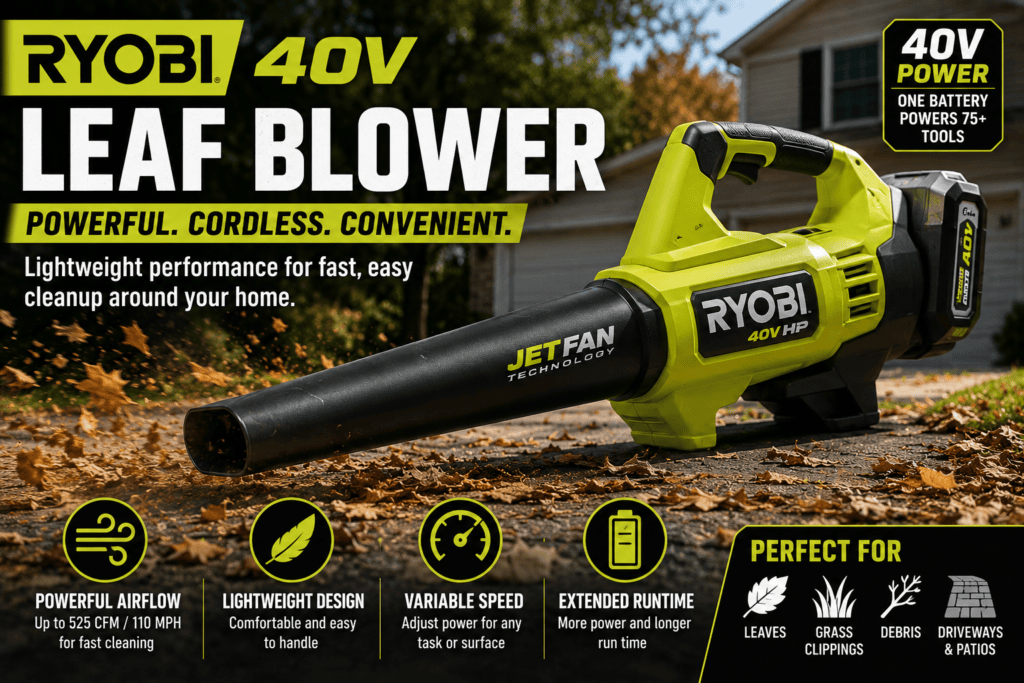
Ryobi 40V Leaf Blower Overview
The Ryobi 40V leaf blower sits in the middle of Ryobi’s outdoor power equipment lineup. It offers noticeably more power than Ryobi’s 18V models while remaining considerably lighter, quieter, and easier to maintain than traditional gas-powered blowers.
The biggest advantage is compatibility with the Ryobi 40V battery platform, allowing one battery to power multiple outdoor tools such as lawn mowers, hedge trimmers, chainsaws, string trimmers, snow blowers, and pressure washers.
For homeowners already invested in the Ryobi ecosystem, this significantly reduces long-term costs.
Unlike gas-powered blowers, the Ryobi 40V starts instantly with a trigger pull, produces no exhaust fumes, requires virtually no maintenance, and operates much more quietly.
Real-World Blowing Performance
Manufacturers typically advertise air speed (MPH) and air volume (CFM), but neither number tells the complete story.
Actual performance depends on several factors:
- Leaf condition
- Surface type
- Wind direction
- Battery charge level
- Nozzle design
- Operator technique
In everyday use, the Ryobi 40V performs very well for:
- Dry autumn leaves
- Grass clippings
- Dust and dirt
- Pine straw
- Sawdust
- Light debris on driveways
- Garage cleanup
- Sidewalk maintenance
Where performance begins to decline is with heavier materials.
Wet leaves tend to stick together and require significantly more airflow. Gravel mixed with leaves, damp pine needles, acorns, and compacted debris often require several passes instead of one.
For normal residential maintenance, however, the blower provides enough power for most homeowners.
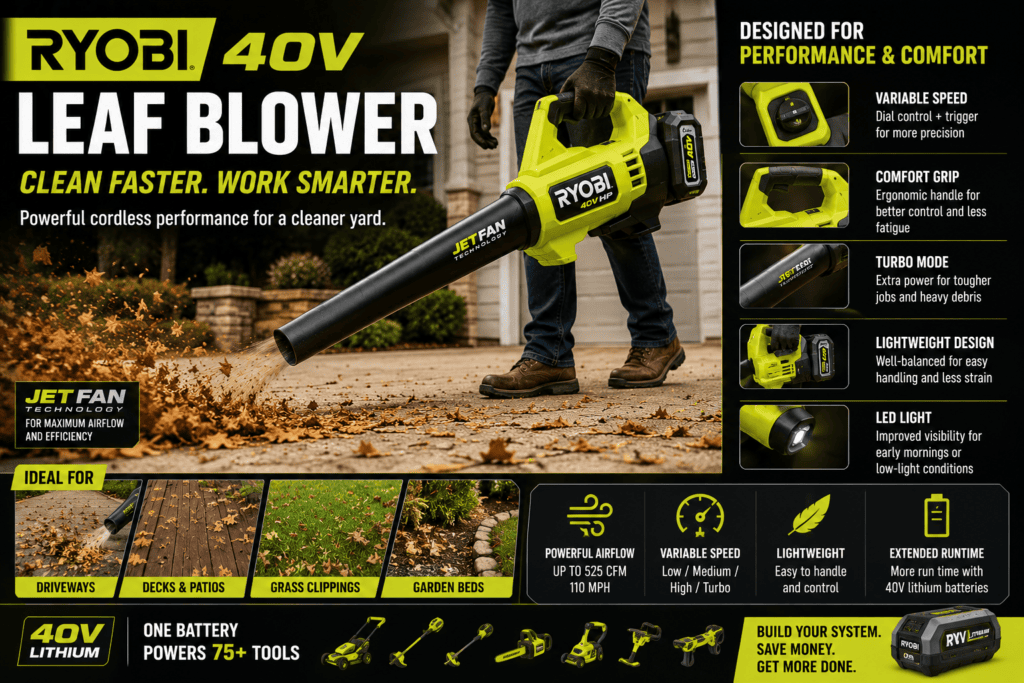
Yard Cleanup Efficiency
One advantage of battery-powered blowers is their convenience.
Instead of spending several minutes starting a gas engine, mixing fuel, or pulling a recoil cord, the Ryobi is ready immediately.
That convenience encourages frequent light cleanup instead of allowing leaves to accumulate.
Many homeowners find that using the blower for 10–15 minutes after mowing or following a windy day keeps the yard consistently clean with far less effort than seasonal deep cleaning.
Airflow Control and Speed Modes
Most Ryobi 40V leaf blowers include multiple speed settings along with a turbo mode.
Each serves a different purpose.
Low Speed
Ideal for:
- Garage floors
- Patios
- Wooden decks
- Dry leaves
- Dust removal
Low mode maximizes battery runtime while reducing noise.
Medium Speed
Suitable for everyday yard maintenance including:
- Sidewalks
- Driveways
- Landscaping beds
- Moderate leaf accumulation
This is usually the best balance between airflow and battery efficiency.
High Speed / Turbo
Turbo mode delivers maximum airflow for:
- Wet leaves
- Heavy debris
- Thick grass clippings
- Stubborn corners
- Mulch cleanup
Because power consumption increases dramatically, runtime decreases substantially.
Turbo should generally be used in short bursts rather than continuously.
Ergonomics and User Experience
One of the strongest aspects of the Ryobi 40V leaf blower is its usability.
Compared with gas-powered blowers, vibration levels are much lower.
There is:
- no pull-start mechanism,
- no engine warm-up,
- no choke adjustment,
- no fuel mixing,
- no spark plug maintenance.
Most models feature an ergonomic rubberized handle that provides a comfortable grip while reducing hand fatigue during longer cleaning sessions.
The blower is also well balanced, with the battery positioned to improve weight distribution.
Because there is no engine vibration, it feels easier to control during extended use.
This is particularly noticeable when clearing long driveways or walking around larger gardens.
Battery Runtime Expectations
Runtime varies considerably depending on:
- battery capacity,
- speed setting,
- outdoor temperature,
- amount of debris,
- blower model.
Typical expectations are:
| Battery | Low | Medium | Turbo |
|---|---|---|---|
| 2Ah | 15–25 min | 10–15 min | 6–8 min |
| 4Ah | 30–50 min | 20–30 min | 12–16 min |
| 6Ah | 45–70 min | 30–45 min | 18–24 min |
| 8Ah | 60–90 min | 40–60 min | 24–32 min |
These figures are estimates and vary depending on actual working conditions.
For larger properties, having two batteries greatly improves productivity because one battery can charge while the other is in use.
Which Battery Should You Buy?
Choosing the right battery depends on your yard size.
2Ah
Best for:
- apartments
- patios
- balconies
- very small yards
4Ah
Recommended for most homeowners.
Provides an excellent balance between:
- weight
- runtime
- affordability
6Ah
Ideal for:
- medium-sized gardens
- frequent weekly maintenance
- longer cleanup sessions
8Ah
Best suited for:
- large properties
- heavy seasonal cleanup
- users with several Ryobi 40V outdoor tools
Although heavier, it significantly reduces battery changes.
Noise Levels
Compared with gas blowers, the Ryobi 40V is much quieter.
While hearing protection is still recommended during long sessions, the reduced noise makes it more suitable for residential neighborhoods where excessive engine noise may disturb neighbors.
Maintenance Requirements
One major advantage of cordless blowers is minimal maintenance.
There are:
- no carburetors,
- no oil changes,
- no air filters,
- no fuel stabilizers,
- no spark plugs.
Routine maintenance typically involves:
- cleaning air vents,
- inspecting the nozzle,
- wiping dirt from the housing,
- storing batteries indoors,
- charging batteries correctly.
Proper battery storage can significantly extend battery lifespan.
Limitations
Although capable, the Ryobi 40V is not intended to replace commercial gas blowers.
Its main limitations include:
- reduced runtime on turbo mode,
- less power for wet leaves,
- slower clearing of heavy debris,
- plastic construction compared with commercial equipment,
- battery replacement cost after several years.
If your property exceeds one acre or regularly accumulates large amounts of wet leaves, a backpack blower or higher-powered cordless model may be more appropriate.
Who Should Buy the Ryobi 40V Leaf Blower?
The Ryobi 40V leaf blower is an excellent choice for:
- homeowners,
- DIY gardeners,
- suburban properties,
- routine lawn maintenance,
- garages,
- patios,
- driveways,
- sidewalks,
- decks.
It is less suitable for:
- commercial landscapers,
- municipal maintenance,
- large estates,
- heavy seasonal forestry cleanup.
Ryobi 40V leaf blower yard size to runtime estimator
Your yard and battery
Conclusion
The Ryobi 40V leaf blower strikes a strong balance between portability, convenience, and everyday performance. While it won't match the sustained power of professional gas blowers, it offers more than enough airflow for routine residential yard maintenance. Instant start-up, quieter operation, low maintenance, and compatibility with the Ryobi 40V battery system make it an attractive choice for homeowners looking to simplify outdoor cleanup.
For small to medium-sized properties, especially if you already own other Ryobi 40V tools, it represents a practical and cost-effective investment that can handle most weekly yard care tasks with ease.