If you have ever stood in the drill bit aisle of a hardware store looking at packs labelled “concrete bit”, “masonry bit”, “SDS bit”, and “multi-material bit” — all claiming to drill concrete — you are not alone. The terminology around masonry drilling is inconsistently used even by manufacturers, which leads to real confusion about what to buy and what will actually work.
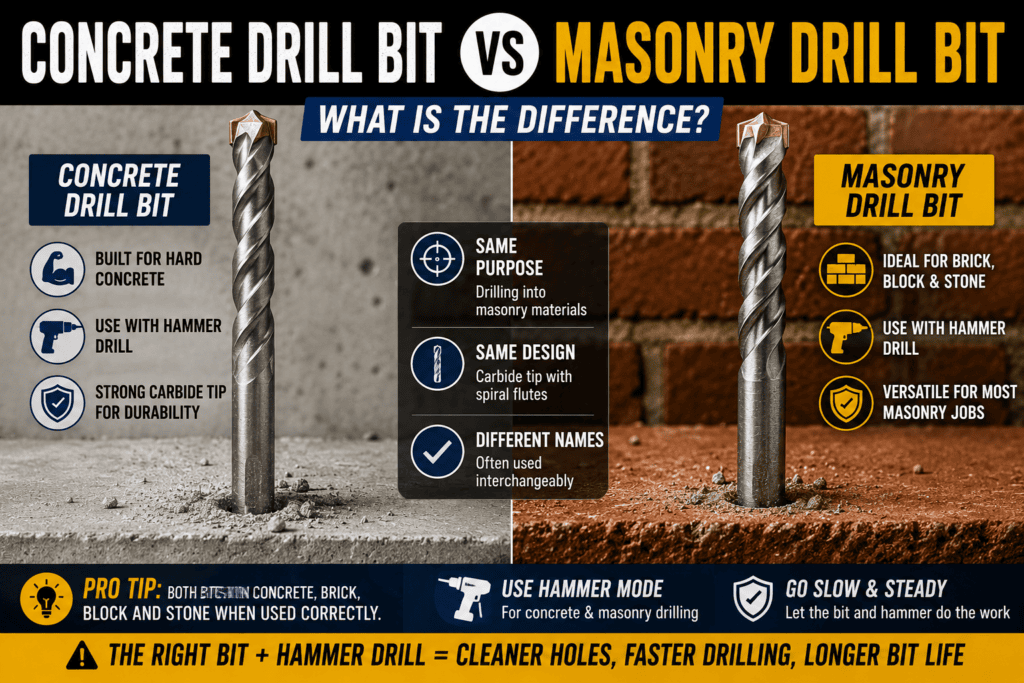
The short answer is that “concrete drill bit” and “masonry drill bit” are mostly used interchangeably to describe the same type of bit — a carbide-tipped twist bit designed for drilling into hard construction materials. But there are important distinctions within that category that directly affect whether your drilling job will succeed or fail. This guide explains everything clearly.
Are Concrete and Masonry Drill Bits the Same Thing?
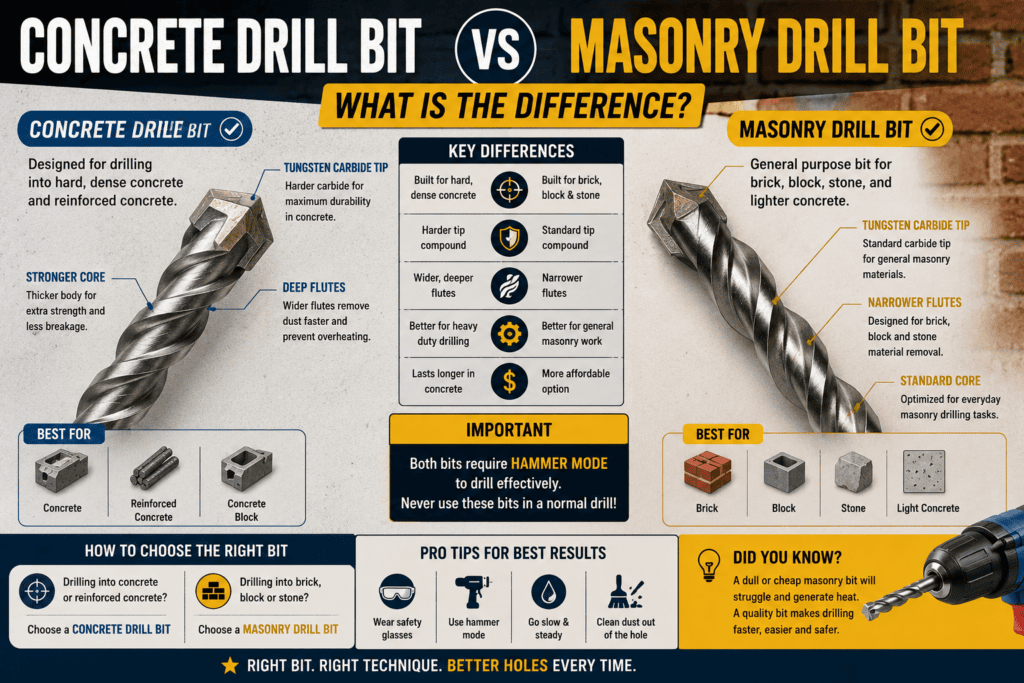
In most practical usage — yes. Both terms typically refer to a carbide-tipped drill bit with a distinctive arrowhead-shaped tungsten carbide tip brazed onto a steel shaft. These bits are designed to chip and grind through hard materials like concrete, brick, block, stone, and mortar rather than cutting through them the way a metal bit cuts steel.
The reason both names exist is partly marketing and partly tradition. “Masonry bit” is the technically correct umbrella term covering all bits designed for hard construction materials. “Concrete bit” is simply a more specific common name for bits intended for the hardest end of that range — reinforced concrete and dense concrete block. In practice both labels end up on the same style of bit in most hardware stores.
Where genuine differences exist is between the sub-categories within masonry drilling — standard carbide-tipped bits, SDS-Plus bits, SDS-Max bits, and diamond core bits. These are genuinely different tools for different situations, and the wrong choice in this category causes real problems.
How Masonry Bits Work — And Why It Matters
Wood bits and metal bits cut by slicing material away with sharp steel cutting edges. Masonry bits cannot cut concrete or brick that way — the material is too hard and abrasive. Instead masonry bits work by a combination of rotation and percussion:
- Rotation — the bit turns and the carbide tip grinds away material at the bottom of the hole
- Percussion — hammer mode delivers rapid impact blows that pulverise the material ahead of the tip
This is why you must use hammer mode when drilling into concrete or brick with a standard masonry bit. Without the hammering action the carbide tip simply grinds on the surface without making meaningful progress — the bit gets hot, the material gets polished rather than drilled, and nothing useful happens.
The only exception is tile and glazed ceramic — these require a masonry-type diamond bit but must be used without hammer mode, because the impact vibration cracks the glaze and the tile body. More on this below.
Standard Carbide-Tipped Masonry Bit
What It Looks Like
The standard masonry bit has a round steel shank, helical flutes similar to a metal drill bit, and a distinctive flattened arrowhead tip made from tungsten carbide. The tip is noticeably wider than the shank and has a wedge-shaped cutting edge visible if you look closely at the tip from above.
What It Drills
- Concrete — solid dense concrete (not reinforced — more on rebar below)
- Brick — fired clay or calcium silicate brick
- Concrete block / breeze block
- Stone — softer natural stone like limestone and sandstone
- Mortar joints
- Render and plaster over masonry
Typical Hole Sizes
Standard masonry bits are available from about 3mm up to about 16mm diameter. For holes larger than 16mm you typically need SDS bits or specialist core bits. For typical wall fixing applications — rawl plugs, anchor bolts, picture hooks, shelving brackets — sizes of 5mm to 12mm cover the vast majority of jobs.
What Drill to Use It In
Standard masonry bits with a round shank fit in any standard drill chuck — cordless hammer drills, standard drills, and corded hammer drills all accept them. The key is that the drill must have a hammer mode setting. Using a masonry bit in a drill without hammer mode is slow, ineffective, and overheats the bit rapidly.
For a guide to the difference between a standard drill and a hammer drill, see our How to Choose the Right Power Drill guide.
SDS-Plus Masonry Bits
What Makes SDS Different
SDS stands for “Slotted Drive System” — a bit shank design developed by Bosch that allows the bit to slide back and forth within the chuck rather than being gripped rigidly. This sliding action means the chuck’s hammering mechanism can drive the bit forward independently of the rotation, delivering far more impact energy than a standard hammer drill chuck can achieve.
The practical result is that an SDS-Plus drill delivers roughly 2 to 3 times more impact energy than a standard hammer drill of similar size. For drilling into hard concrete, large diameter holes, or extended drilling sessions, this makes a significant real-world difference in both speed and bit life.
SDS-Plus vs SDS-Max
| Feature | SDS-Plus | SDS-Max |
|---|---|---|
| Shank diameter | 10mm | 18mm |
| Typical hole sizes | 4mm to 40mm | 16mm to 80mm+ |
| Impact energy | Up to 5 joules | Up to 20+ joules |
| Best for | Most home and trade masonry work | Heavy construction, large anchors, demolition |
| Tool required | SDS-Plus rotary hammer | SDS-Max rotary hammer |
| Compatibility | Not compatible with standard chucks | Not compatible with SDS-Plus |
SDS-Plus is by far the more common system for most trades and serious DIY work. SDS-Max is primarily for professional construction crews drilling large-diameter anchor holes or doing demolition work.
Diamond Core Bits
Diamond core bits are cylindrical hollow cutting tools with a diamond-coated edge around the rim. Rather than drilling a solid hole they cut a circular ring through the material, leaving a solid core plug inside. They are used for large diameter holes — typically 50mm to 200mm — through concrete walls for pipes, cables, ventilation, and other service penetrations.
Diamond core drilling requires either a dedicated core drill or a rotary hammer in core drill mode. It also typically requires water cooling — a water feed system keeps the diamond tip cool and washes out the cut material. Without water cooling diamond core bits overheat rapidly.
This is a specialist tool for contractor-level work and not something most homeowners need to own — these are frequently hired rather than purchased.
Material by Material — Which Bit to Use
| Material | Best bit type | Hammer mode | Notes |
|---|---|---|---|
| Concrete (small holes under 12mm) | Carbide masonry bit | ✅ Essential | Standard hammer drill adequate |
| Concrete (large holes over 12mm) | SDS-Plus bit | ✅ Essential | Requires SDS rotary hammer |
| Brick | Carbide masonry bit | ✅ Recommended | Softer than concrete — easier |
| Block / breeze block | Carbide masonry bit | ✅ Recommended | Aggregate varies — may vary in hardness |
| Mortar joints | Carbide masonry bit | Optional | Mortar is soft — standard drill can work |
| Ceramic tile | Diamond tile bit | ❌ Never | Hammer mode cracks tile — always off |
| Natural stone | Carbide masonry or diamond | ⚠️ Carefully | Some stone cracks under impact — test first |
| Reinforced concrete (rebar present) | SDS-Plus + rebar locator | ✅ Essential | Stop immediately if you hit rebar |
The Rebar Problem
Reinforced concrete contains steel reinforcing bars (rebar) embedded within the concrete matrix. Standard masonry bits cannot cut through rebar and will be destroyed instantly on contact. SDS bits fare slightly better but are not designed to cut steel either.
If you hit rebar mid-hole the correct response is to stop immediately and relocate the hole. Do not try to force through. Options when rebar is unavoidable include:
- Using a rebar locator (electronic cover meter) to find and avoid rebar before drilling
- Drilling at an angle to miss the rebar
- Hiring a diamond core drill which can cut through both concrete and rebar
- Engaging a structural engineer if the rebar location is critical
How to Tell When a Masonry Bit Is Worn Out
Masonry bits are consumable items. The carbide tip wears down with use and the bit progressively becomes less effective. Signs of a worn masonry bit:
- Drilling significantly slower than it used to in the same material
- Bit gets very hot quickly even in hammer mode
- Hole edges are rough and ragged rather than clean
- Visible wear on the carbide tip — the flat arrowhead shape becomes rounded
- Tip changes colour from grey to blue or brown from heat
Unlike HSS metal bits, masonry bits cannot be practically resharpened at home. When the carbide tip is worn, replace the bit. Quality masonry bits from brands like Bosch, DeWalt, and Hilti last significantly longer than budget unbranded bits, making them better value over time despite the higher initial price.
🔨 Masonry Bit Selector Tool
Answer two quick questions to find the right bit and drill setting for your job. This tool will also help you to choose between concrete drill bit and masonry drill bit.
Frequently Asked Questions
Can I use a masonry bit in a standard cordless drill without hammer mode?
You can, but results will be poor in hard materials. Without hammer mode the bit can only grind material away through rotation alone, which is slow and generates a lot of heat in the bit. For soft brick and mortar a standard drill without hammer mode can work acceptably. For concrete — particularly dense or reinforced concrete — hammer mode is not optional. Without it you will make very slow progress and overheat and ruin the bit quickly.
What is the difference between a hammer drill and an SDS drill?
A hammer drill uses a cam mechanism in the standard drill chuck to create a hammering action. It delivers a relatively modest impact force — typically 0.5 to 2 joules. An SDS rotary hammer uses a completely different mechanism — a pneumatic hammering system that delivers 2 to 8+ joules — several times more energy than a standard hammer drill. The SDS bit also slides within the chuck rather than being rigidly gripped, which further improves energy transfer. For small masonry holes a hammer drill is adequate. For large holes, extended drilling in hard concrete, or professional use, an SDS drill is the right tool.
Can I use an SDS bit in a standard drill?
No. SDS-Plus and SDS-Max bits have a different shank design — slots and grooves that lock into the SDS chuck mechanism. These shanks do not fit standard 3-jaw drill chucks. You cannot use SDS bits in a standard drill, and standard round-shank masonry bits do not lock correctly into an SDS chuck without an adapter (which defeats the purpose of the SDS system).
Do I need water when drilling concrete?
Not for standard carbide masonry bits and SDS bits — these are designed for dry drilling. Water is required for diamond core drilling where the diamond tip generates significant heat during the cutting process. For standard masonry drilling, dry operation is correct. Some very hard materials benefit from occasional pausing to allow the bit to cool, but active water cooling is not needed or recommended for carbide masonry bits.
Why does my masonry bit keep stopping or stalling in concrete?
The three most common causes are: the bit tip is worn and needs replacing, the drill does not have enough hammer energy for the material (consider upgrading to an SDS drill for hard concrete), or the bit has hit aggregate — a particularly hard stone particle in the concrete mix. If the bit stalls on a hard spot, withdraw it slightly, redirect pressure, and try again. If you have hit rebar, stop and relocate. For understanding hammer vs standard drill options in more detail read our drill comparison guides.
What size masonry bit do I need for common wall fixings?
Wall plug and rawl plug sizes directly determine the required drill bit diameter. The most common sizes are 5mm (red plug), 6mm (brown plug), 7mm (yellow plug), and 10mm (blue plug). Always check the fixing manufacturer’s specification — the bit size is printed on most rawl plug packaging. Using the correct size is critical — too small and the plug does not grip the wall, too large and there is no material for the plug to expand into.