Drilling into metal is fundamentally different from drilling into wood. Metal work-hardens when overheated, dulls bits in seconds if the wrong type is used, and can grab and snap a bit instantly if technique is wrong. The bit you choose matters far more for metal drilling than for any other material.
There are four main types of metal drill bit available — HSS, cobalt, titanium coated, and carbide tipped. They look similar at a glance but perform completely differently across different metal types, thicknesses, and drilling conditions. Choosing the wrong one does not just give poor results — it destroys the bit and potentially damages your workpiece.
This guide compares all four types honestly, explains which metals each one handles well, and includes an interactive bit selector to help you pick the right bit for your specific job.
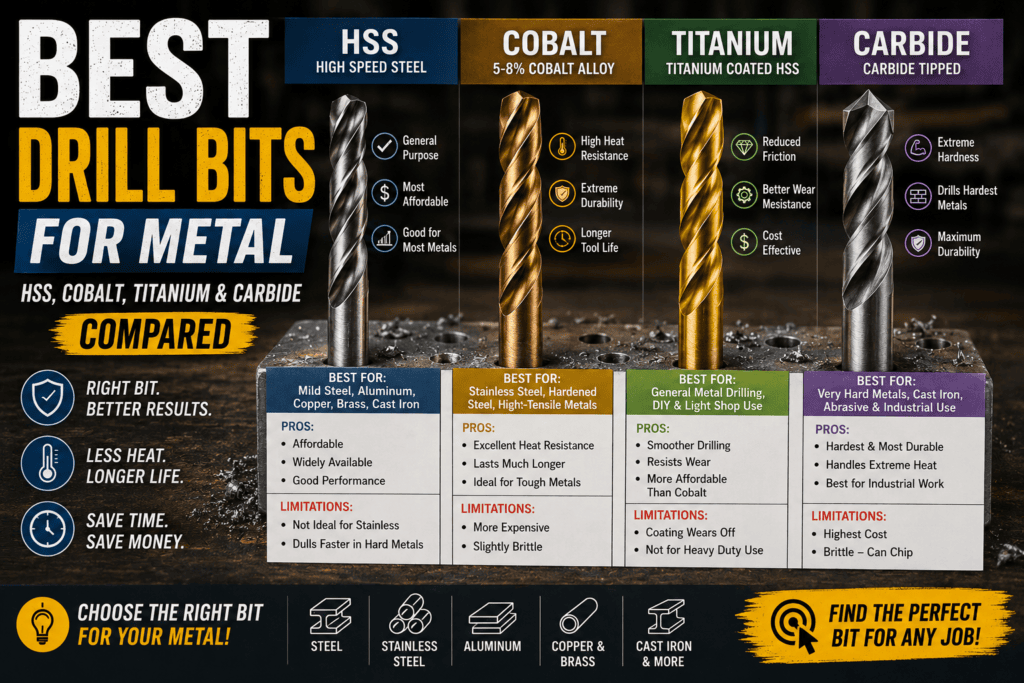
Why Metal Drilling Is Different
Three properties of metal make it significantly harder to drill than wood or masonry:
- Work hardening — some metals, particularly stainless steel, become harder at the point being cut when heat builds up. A bit that generates too much heat causes the metal directly ahead of it to harden, making the next fraction of a millimetre even harder to cut than the last. This is a self-reinforcing problem that destroys bits rapidly.
- Heat conductivity — metals conduct heat into the drill bit much more efficiently than wood. A bit that is working too fast or too hard gets extremely hot at the cutting tip within seconds, destroying its hardness and cutting ability.
- Breakthrough grab — as the bit exits the far side of thin sheet metal it can catch on the exit edge, causing the drill to grab violently and snap the bit. This is particularly dangerous with standard twist bits on sheet metal.
Understanding these three properties explains why technique — slow speed, cutting fluid, steady pressure — is just as important as bit selection for successful metal drilling.
HSS Bits — High Speed Steel
What They Are
HSS stands for High Speed Steel — an alloy of steel containing tungsten, molybdenum, chromium, and vanadium. This combination produces a steel significantly harder and more heat-resistant than ordinary tool steel, capable of cutting most common metals at the speeds a cordless drill can deliver.
HSS is the baseline standard for metal drilling. It is what most general-purpose drill bit sets contain, what the black or bright silver-coloured bits in hardware store sets are made from, and what works for the majority of everyday metal drilling tasks.
What HSS Handles Well
- Mild steel (the most common type) up to about 6mm thickness
- Aluminium and aluminium alloys
- Copper and brass
- Cast iron
- Mild steel sheet metal and tubing
- Plastic and composite materials
Where HSS Fails
- Stainless steel — work hardening destroys standard HSS bits quickly
- Hardened steel — harder than the bit itself
- High-tensile structural steel — extreme wear rate
- Sustained heavy-duty drilling — heat builds up without cutting fluid
Key Specs to Look For in HSS Bits
Quality HSS bits are marked with standards designations. Look for DIN 338 — a German standard that specifies geometry, heat treatment, and tolerances for HSS twist bits. Bits meeting DIN 338 consistently outperform cheap ungraded alternatives in both cutting performance and longevity.
The point angle also matters. Standard HSS bits have a 118-degree point angle which works well in most metals. A 135-degree split point angle is harder to grind but self-centring — it starts drilling without wandering, eliminating the need for a centre punch dimple in most cases.
Cobalt Bits — The Tough Metal Specialist
What They Are
Cobalt bits are made from HSS with 5 to 8 percent cobalt added to the alloy. The cobalt content is distributed throughout the entire bit — it is not a coating. This means cobalt bits retain their properties even after resharpening, unlike coated alternatives where the surface treatment wears away.
The cobalt addition increases hardness, heat resistance, and wear resistance significantly. A cobalt bit runs at higher temperatures without losing its cutting edge, making it the correct choice for any metal that generates high drilling heat — particularly stainless steel.
What Cobalt Handles Well
- Stainless steel — this is where cobalt is genuinely essential, not just preferable
- High-tensile steel and spring steel
- Hardened steel (within limits)
- Titanium alloys
- Inconel and other high-temperature alloys
- Everything HSS handles, but faster and with longer bit life
Where Cobalt Falls Short
- Cobalt bits are more brittle than standard HSS — they are more prone to snapping under sideways load or if drilled at an angle
- Significantly more expensive than HSS — typically 3 to 5 times the price
- Not worth the premium for occasional aluminium or mild steel drilling where standard HSS is adequate
M35 vs M42 Cobalt
Cobalt bits are graded by cobalt content. The two most common grades are:
| Grade | Cobalt content | Best for | Relative cost |
|---|---|---|---|
| M35 | 5% cobalt | Stainless steel, tough metals, regular professional use | $$ |
| M42 | 8% cobalt | Exotic alloys, hardened steel, heavy industrial use | $$$ |
For most users including professionals who regularly drill stainless steel, M35 cobalt is the right choice. M42 is overkill for anything short of industrial production drilling.
Titanium Coated Bits — The Marketing Bit
What They Are
Titanium coated bits are standard HSS bits with a titanium nitride (TiN) surface coating applied by a process called physical vapour deposition. The bright gold colour is the coating — the substrate underneath is ordinary HSS.
The titanium nitride coating reduces surface friction and increases surface hardness. This genuinely does extend bit life compared to uncoated HSS — but only modestly, and only until the coating wears off. Once the coating is worn through (which happens from normal use and especially from resharpening), the bit performs identically to standard HSS.
The Important Distinction
Titanium coated bits are frequently marketed alongside — or even confused with — cobalt bits. They are not the same thing at all:
| Feature | Titanium coated | Cobalt (M35) |
|---|---|---|
| Colour | Bright gold | Dull gold / bronze |
| Cobalt content | Zero — it’s HSS underneath | 5–8% throughout |
| Resharpenable | No — loses coating when sharpened | Yes — cobalt is throughout |
| Stainless steel | No — not suitable | Yes — designed for this |
| Lifespan vs HSS | Moderately longer | Significantly longer |
Titanium coated bits are a reasonable upgrade over bare HSS for light to moderate mild steel and aluminium drilling. They are not a substitute for cobalt when drilling stainless or tough metals.
Carbide Tipped Bits — Specialist Hardened Materials
What They Are
Solid carbide or carbide tipped bits are the hardest drill bits available for metal work. Tungsten carbide is significantly harder than any HSS or cobalt alloy, allowing it to cut materials that would destroy other bit types. The trade-off is brittleness — carbide is extremely hard but has low toughness, meaning it chips or snaps under shock loads or vibration that HSS or cobalt would survive.
When to Use Carbide for Metal
- Hardened steel and tool steel that has been heat treated beyond the reach of cobalt bits
- Cast iron (carbide handles the abrasive graphite content well)
- Metal matrix composites
- PCB and electronics drilling (solid carbide in very small sizes)
When Not to Use Carbide
Carbide bits require rigid setup — a drill press or CNC machining centre rather than a handheld drill. The brittleness that makes carbide so hard also means it shatters under the wobble and angular variation inherent in handheld drilling. Using solid carbide bits in a handheld cordless drill is almost guaranteed to snap them, often dangerously.
Full Comparison Table
| Bit type | Mild steel | Stainless | Aluminium | Hardened steel | Price |
|---|---|---|---|---|---|
| HSS | ✅ Good | ❌ No | ✅ Excellent | ❌ No | $ |
| Cobalt M35 | ✅ Excellent | ✅ Excellent | ✅ Excellent | ⚠️ Partial | $$ |
| Titanium coated | ✅ Good | ❌ No | ✅ Good | ❌ No | $–$$ |
| Carbide | ✅ Excellent | ✅ Excellent | ✅ Excellent | ✅ Excellent | $$$ |
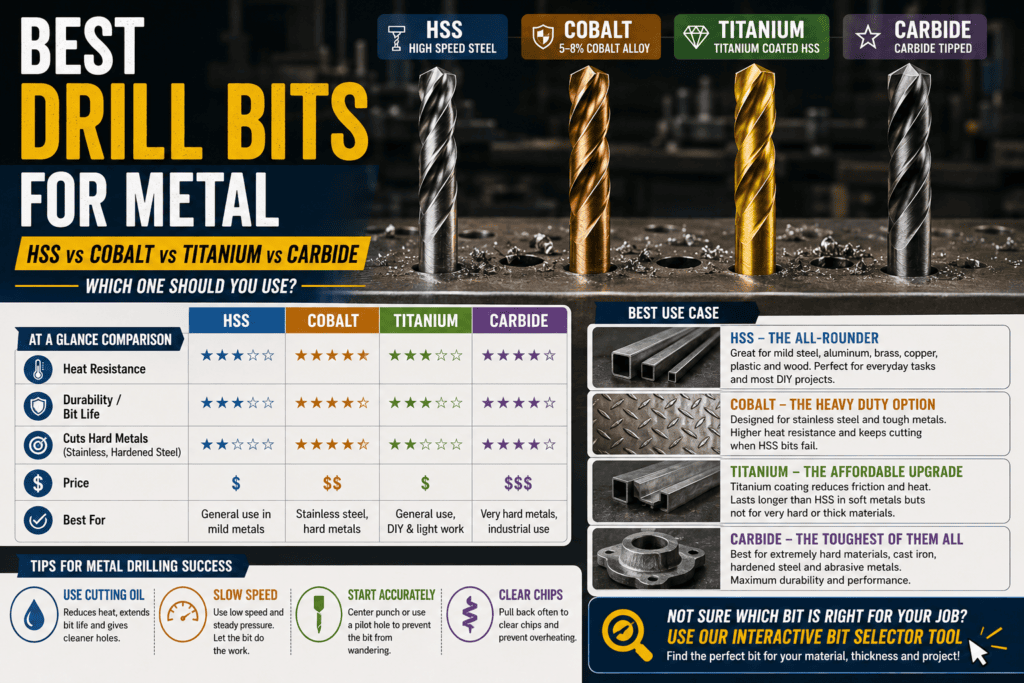
Top Recommended Sets by Use Case
| Use case | Recommended bit | Top option |
|---|---|---|
| General home DIY — mild steel, aluminium | HSS DIN 338 | DeWalt DW1361 set or Bosch BL2160 |
| Stainless steel appliances or kitchen fit-out | Cobalt M35 | Irwin Cobalt M35 set or Bosch CO2145 |
| Mixed workshop use — mainly mild steel | Titanium coated HSS | Milwaukee Thunderbolt or DeWalt titanium set |
| Sheet metal HVAC or bodywork | Step drill bit (HSS or cobalt) | Irwin Unibit or DeWalt step drill set |
| Professional daily metal fabrication | Cobalt M35 or M42 | Precision Twist or Norseman Magnum cobalt |
Essential Technique for Metal Drilling
Even the best bit fails quickly with wrong technique. These fundamentals apply regardless of which bit type you choose:
Use Cutting Fluid — Always on Steel
Cutting fluid lubricates the cutting edge and removes heat from the cutting zone. Without it, heat builds within seconds on steel, dulling or destroying the bit’s hardness. Any cutting fluid works — purpose-made cutting oil, WD-40, even a few drops of motor oil in a pinch. Apply before starting the hole and reapply every 15 to 20 seconds during extended drilling.
Go Slow on Hard Metals
High speed is the enemy of metal drilling. Switch your drill to gear 1 (low speed, high torque) for steel. For stainless steel go even slower — the slowest setting your drill has. The harder the metal the slower you need to go. Aluminium and copper tolerate higher speeds but still benefit from cutting fluid.
Use a Centre Punch
On smooth metal surfaces a bit will skate across the surface rather than engaging the material. A quick tap with a centre punch or nail creates a small dimple that holds the bit in position on entry. This is especially important with 118-degree point bits — 135-degree split point bits are self-centring and often eliminate this need.
Reduce Pressure Before Breakthrough
The moment of breakthrough — when the bit exits the far side of the material — is when grab and snapping happen. Ease off the pressure significantly as you feel the bit approaching breakthrough. Clamping a piece of scrap wood or metal behind the workpiece also helps absorb the breakthrough and prevents the bit from grabbing.
🔩 Metal Drill Bit Selector
Tell us what metal you need to drill and we will recommend the right bit type and technique instantly.
Frequently Asked Questions
Can I drill stainless steel with a regular HSS bit?
Technically yes for one or two small holes if you go very slowly with plenty of cutting fluid — but the bit will dull extremely quickly due to stainless steel’s work-hardening properties. For any regular stainless steel drilling a cobalt M35 bit is the correct choice. Using standard HSS on stainless is a reliable way to ruin bits quickly and end up with poor, unfinished holes.
Is titanium drill bit better than HSS?
A titanium coated HSS bit offers a modest improvement over uncoated HSS for mild steel and aluminium drilling — longer bit life and slightly less friction. But it is not a fundamentally different material. The underlying bit is still HSS. Once the titanium coating wears off through use or resharpening, the bit performs identically to standard HSS. For tough metals like stainless steel, titanium coated HSS fails just as quickly as uncoated HSS — cobalt is the correct choice.
How do I know if my drill bit is cobalt or just titanium coated?
Check the colour carefully. Titanium coated bits have a bright, shiny gold finish. Cobalt bits have a duller, more bronze-toned gold colour. Check the packaging for markings like “M35”, “M42”, “HSS-Co”, or “cobalt” — these confirm true cobalt content. If the packaging only says “titanium” or “TiN coated” without cobalt designation, it is a coated HSS bit regardless of the gold colour.
What speed should I use to drill mild steel?
For mild steel use the lowest speed setting on your drill — gear 1. A rough guideline from standard machining references is 60 to 90 surface feet per minute for HSS in mild steel, which translates to roughly 600 to 1,000 RPM for a 6mm bit. Most cordless drills on gear 1 fall in a suitable range. When in doubt, go slower. Heat is far more damaging than going slightly too slow.
Do I need a special drill for metal or will my cordless drill work?
A standard cordless drill works well for drilling metal up to about 10mm in thickness at home DIY scales. Use gear 1 (low speed), apply cutting fluid, and use the correct bit type. For thick structural steel or high volumes of holes in hard metals, a drill press is preferable for its rigidity and consistent drilling angle — handheld drilling introduces wobble that accelerates bit wear and risks snapping harder bit types like cobalt and carbide. For help choosing the right drill see our Complete Drill Buying Guide and our How to Choose the Right Drill guide.
What is the best drill bit for aluminium?
Standard HSS bits work very well in aluminium — it is a soft, easy-cutting material that does not require cobalt or specialist bits. The main challenge with aluminium is that it tends to stick to the bit rather than producing clean chips, which can clog the flutes. Use a fast speed (gear 2), apply a small amount of cutting oil or even a drop of WD-40, and withdraw the bit frequently to clear chips. Brad point bits also work well in aluminium for cleaner hole entry.