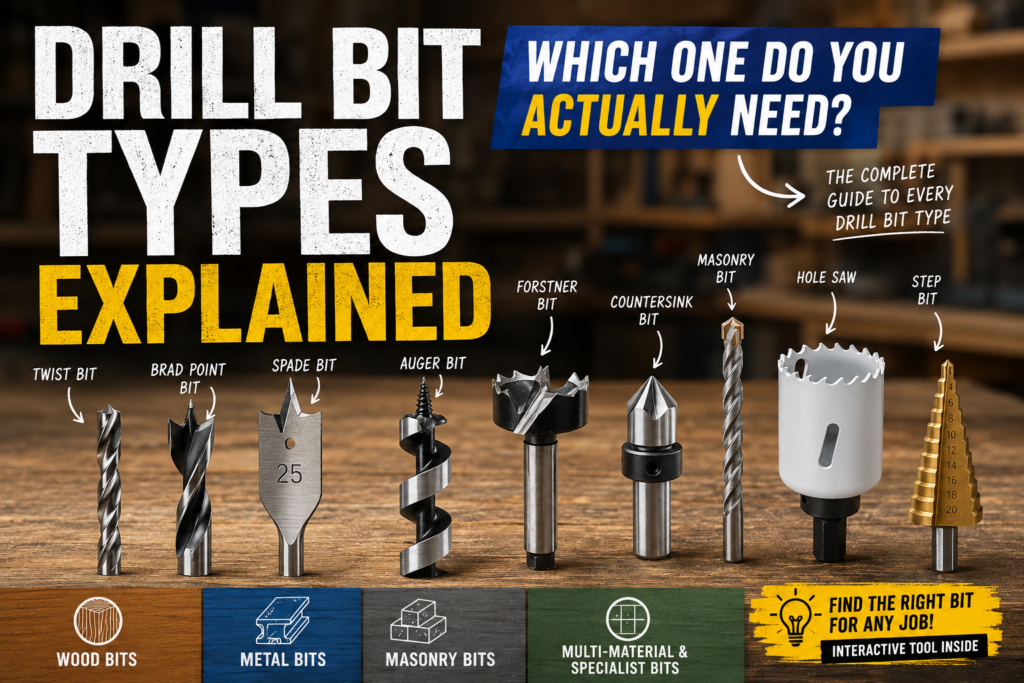
Walk into any hardware store and you will find an overwhelming wall of drill bits. Twist bits, spade bits, auger bits, brad point bits, masonry bits, hole saws, step bits, countersink bits — dozens of types in hundreds of sizes, most of them looking roughly similar unless you know what to look for.
Using the wrong drill bit does not just give you a bad hole. It ruins bits, damages materials, and in some cases creates genuine safety risks. A wood bit used on metal overheats and snaps. A masonry bit used on wood produces a ragged torn hole. A standard bit used on tile shatters the tile surface.
This guide explains every common drill bit type in plain language — what it looks like, what it is designed for, and when you should and should not use it. There is also an interactive bit finder at the end to help you identify exactly which bit you need for any job.
The Main Categories of Drill Bits
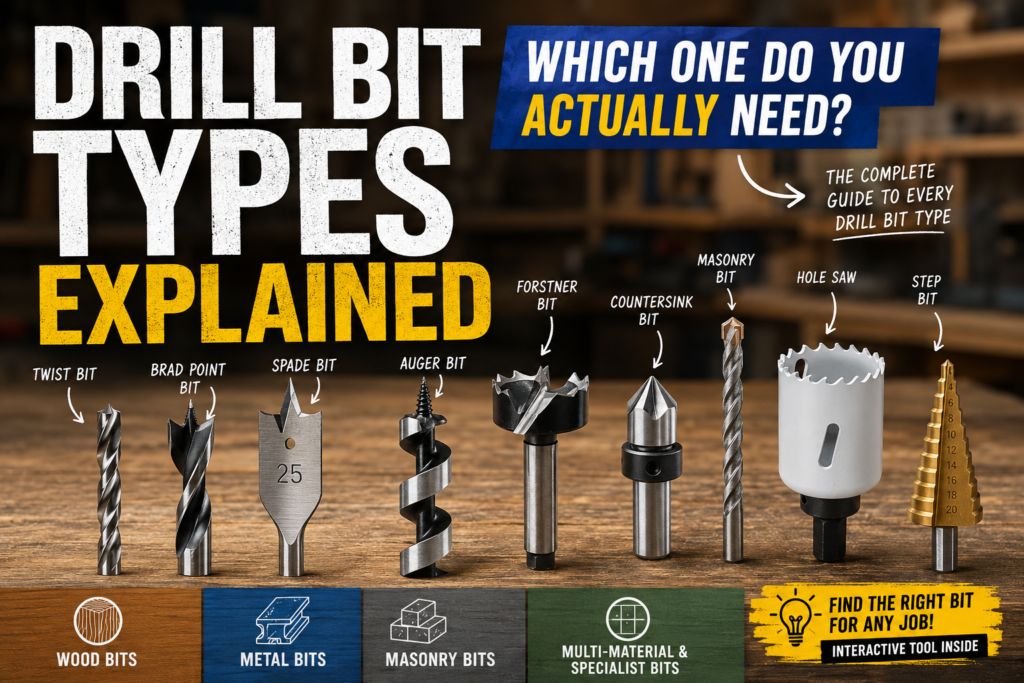
Drill bits fall into four broad categories based on what material they cut:
- Wood bits — designed for softwood, hardwood, plywood, and MDF
- Metal bits — designed for steel, aluminium, copper, and other metals
- Masonry bits — designed for concrete, brick, block, and stone
- Multi-material and specialist bits — designed for tile, glass, plastics, and mixed materials
Within each category there are multiple bit types, each optimized for specific hole sizes, depths, and quality requirements. Understanding which category you are in narrows the choice immediately.
This interactive tool will help you understand drill bit types:
Wood Drill Bits — Complete Guide
1. Twist Bit (HSS) — The All-Rounder
The standard twist bit is the most common drill bit in the world. It has a cylindrical shaft with two helical flutes that carry chips out of the hole as you drill. Made from High Speed Steel (HSS), it cuts reasonably well in wood, plastic, and soft metals.
Best for: Light drilling in softwood, plywood, plastic, and thin metal
Not ideal for: Hardwood (use brad point instead), thick metal (use cobalt), masonry (use carbide)
Sizes available: 1mm to 13mm typically
How to identify: Plain silver cylindrical bit with a simple pointed tip and spiral flutes
2. Brad Point Bit — The Wood Specialist
A brad point bit has a sharp central spur that locates precisely on the drill point before the outer cutting edges engage the wood. This prevents the bit from wandering on entry and produces clean, accurate holes with minimal tear-out on both entry and exit faces.
Best for: Any precise hole in hardwood, softwood, or plywood where clean edges matter — joinery, cabinet work, furniture making
Not ideal for: Metal (the central spur damages on contact) or masonry
Sizes available: 3mm to 25mm typically
How to identify: Distinctive sharp central point with two raised spurs on the outer edges
3. Spade Bit (Flat Bit) — The Fast Hole Maker
A spade bit has a flat paddle-shaped head with a central locating point. It cuts aggressively and removes material quickly, making it the fastest way to drill large holes in timber. The hole quality is rough compared to other bit types — the entry face is usually acceptable but exit tear-out is significant without a backing board.
Best for: Large holes in timber where speed matters more than finish quality — running cables and pipes through studs and joists
Not ideal for: Visible joinery work, hardwood (tends to split), metal, or masonry
Sizes available: 12mm to 38mm typically
How to identify: Flat paddle shape with a pointed centre tip and two cutting edges
4. Auger Bit — The Deep Hole Expert
An auger bit has a large helical screw at the tip that pulls the bit into the wood, and aggressive flutes that clear chips efficiently. This self-feeding action makes auger bits ideal for drilling deep holes in timber without the bit binding or clogging.
Best for: Deep holes in timber — running electrical cables through wall studs, drilling through multiple timbers in one pass, log construction
Not ideal for: Precision work (the self-feeding action makes depth control difficult), metal, or masonry
Sizes available: 12mm to 38mm typically, in extra-long lengths
How to identify: Distinctive screw-threaded tip and wide helical flutes designed for aggressive chip clearance
5. Forstner Bit — The Flat Bottom Specialist
A Forstner bit cuts a clean, flat-bottomed hole with no through-exit if desired. It is guided by its circular rim rather than a central point, which allows it to cut overlapping holes, angled holes, and holes at the edge of a board — tasks impossible with other bit types.
Best for: Furniture making, cabinet hinges (the standard 35mm hinge cup hole requires a Forstner bit), clean flat-bottomed holes, overlapping holes
Not ideal for: Deep holes (chip clearance is poor), metal, or masonry
Sizes available: 10mm to 80mm typically
How to identify: Large circular saw-toothed rim with a small central point and flat cutting face
6. Hole Saw — The Large Hole Cutter
A hole saw is a cylindrical saw blade mounted on a central drill bit arbor. It cuts large circular holes by sawing around the perimeter, leaving a disc of waste material inside the cylinder. Unlike spade bits, hole saws cut holes up to 100mm or more and can be used in doors, walls, and thin sheet materials.
Best for: Cutting large holes in doors for locks and handles, ceiling holes for downlights, and any hole too large for a spade bit
Not ideal for: Deep holes, material thicker than the hole saw depth, masonry (use diamond hole saws instead)
Sizes available: 25mm to 120mm+ typically
How to identify: Cylindrical cup with saw teeth around the rim and a central pilot drill bit
Metal Drill Bits — Complete Guide
7. HSS Twist Bit — Standard Metal Drilling
The same HSS twist bit used for wood also works on metal — particularly aluminium, copper, brass, and mild steel. For metal use the key differences in technique are lower speed, more pressure, and cutting fluid to prevent overheating.
Best for: Aluminium, copper, brass, mild steel in smaller diameters (under 8mm)
Not ideal for: Stainless steel, hardened steel, or large diameter holes in thick steel
8. Cobalt Bit — The Tough Metal Specialist
Cobalt bits are made from high speed steel with 5 to 8 percent cobalt added. This produces a significantly harder, more heat-resistant bit that maintains its cutting edge far longer than standard HSS in difficult metals. The cobalt content gives these bits a distinctive gold or bronze colour.
Best for: Stainless steel, hardened steel, cast iron, and any tough metal that destroys standard HSS bits quickly
Not ideal for: Wood (no advantage over cheaper HSS), masonry
How to identify: Gold or bronze coloured HSS twist bit — look for “Co” or “Cobalt” marking
9. Titanium Coated Bit — The Marketing Bit
Titanium coated bits are standard HSS bits with a titanium nitride (TiN) surface coating that reduces friction and increases surface hardness. They last longer than uncoated HSS in some applications but are significantly less effective than solid cobalt bits for tough metals. The bright gold colour makes them easy to identify — and easy to be misled by.
Best for: Light to medium metal drilling where a modest improvement over standard HSS is useful
Important note: Once the titanium coating wears off (which happens quickly with sharpening), the bit performs identically to standard HSS. Do not confuse titanium-coated bits with cobalt bits — they are very different products.
10. Step Drill Bit — Thin Sheet Metal Essential
A step drill bit has a cone shape with a series of stepped cutting diameters. A single bit drills holes from 4mm up to 32mm or more, stepping up through each diameter. It is essential for sheet metal work because it exits cleanly without grabbing or tearing the thin material the way standard twist bits do on breakthrough.
Best for: Drilling multiple sizes in thin sheet metal, plastic, and thin timber without changing bits
Not ideal for: Thick material, deep holes, hardwood
How to identify: Distinctive stepped cone shape — unmistakable
Masonry Drill Bits — Complete Guide
11. Carbide Tipped Masonry Bit
The standard masonry bit has a tungsten carbide tip brazed onto a steel shank. The carbide tip is far harder than the aggregate in concrete and harder than brick, allowing it to chip its way through masonry materials. Masonry bits are designed to be used in hammer mode — the hammering action breaks up the material while the rotation clears chips.
Best for: Concrete, brick, block, and stone. The standard choice for wall fixing holes, anchor installations, and any masonry drilling task
Not ideal for: Wood or metal (the flat carbide tip produces poor holes in these materials), reinforcing steel (rebar)
How to identify: Distinctive arrowhead-shaped carbide tip, usually a different colour from the steel shank
12. SDS Plus and SDS Max Bits
SDS bits are masonry bits with a special shank designed for SDS rotary hammer drills. The SDS shank has slots that lock into the SDS chuck, allowing the bit to slide back and forth (delivering the hammer blow) while remaining locked rotationally. This delivers far more impact energy than a standard hammer drill and makes SDS the only practical choice for large masonry holes and extended concrete drilling.
Best for: Large masonry holes (over 12mm diameter), extended drilling in hard concrete, anchor installations in structural concrete
Not ideal for: Standard cordless drills (they require a dedicated SDS drill)
How to identify: Distinctive SDS shank with slots and grooves — different from all standard bits
Specialist and Multi-Material Bits
13. Diamond Tile Bit
Diamond tile bits have a cylindrical or spear-shaped tip coated with industrial diamond particles. They cut ceramic, porcelain, and glass by grinding rather than cutting — the diamond particles scratch through the material rather than slicing it. Critical: never use hammer mode with tile bits — the vibration cracks the tile. Keep the bit wet during drilling.
Best for: Ceramic tile, porcelain tile, glass, natural stone
Not ideal for: Any other material
14. Glass and Tile Spear Bit
A spear-point bit (also called a glass bit) has a spear-shaped tungsten carbide tip designed for glass and ceramic. It cuts by scoring the surface rather than drilling through it. Less effective on hard porcelain than diamond bits but works well on standard ceramic and glass.
Best for: Standard ceramic tiles and glass
15. Countersink Bit
A countersink bit drills a conical recess at the surface of a hole so that a countersunk screw head sits flush with or below the surface. Most countersink bits include a standard twist bit in the centre that drills the clearance hole simultaneously with the countersink recess.
Best for: Wood screws that need to sit flush — cabinet making, furniture, general woodwork
16. Self-Centering (Vix) Bit
A self-centering bit has a spring-loaded outer sleeve that automatically centres the bit in a pre-drilled hole or in the centre of a hinge screw hole. When pressed into a cup or recess the sleeve retracts and the bit drills in exactly the right position without marking out.
Best for: Drilling pilot holes for hinge screws, handle fixings, and any application where the bit must locate in a specific pre-defined position
Quick Reference — Bit Type by Material
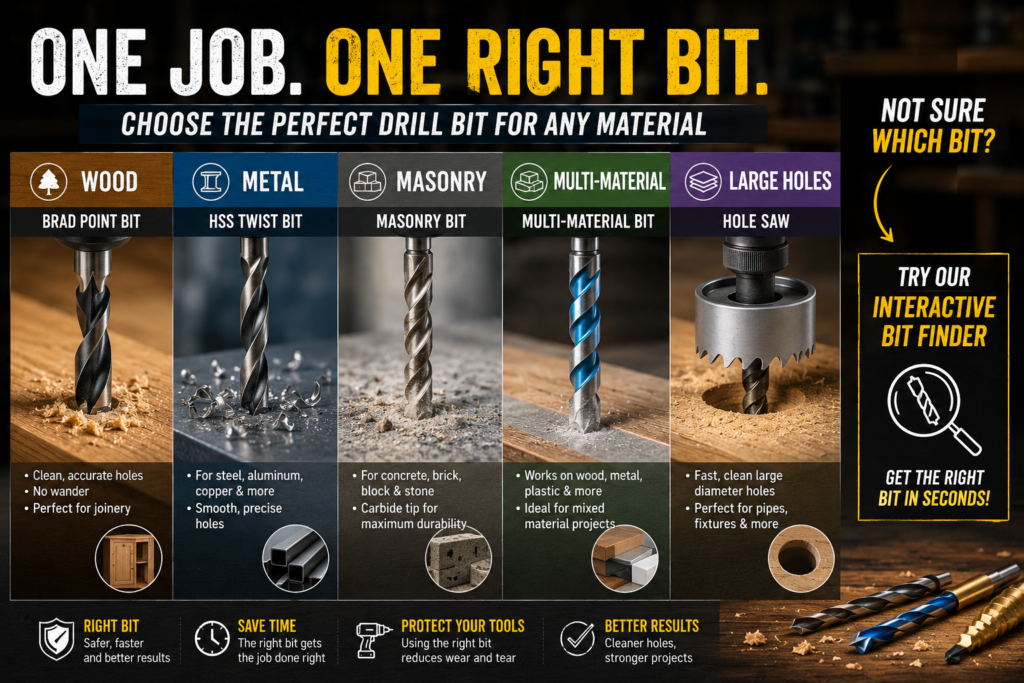
| Material | Small holes (under 10mm) | Large holes (over 10mm) | Never use |
|---|---|---|---|
| Softwood | HSS twist or brad point | Spade, auger, or Forstner | Masonry bits |
| Hardwood | Brad point | Forstner | Spade (splits), masonry |
| Plywood / MDF | Brad point or HSS | Hole saw or Forstner | Masonry bits |
| Mild steel | HSS twist | HSS twist (slow) or hole saw | Wood or masonry bits |
| Stainless steel | Cobalt + cutting fluid | Cobalt + cutting fluid | Standard HSS, titanium coated |
| Sheet metal | Step drill bit | Step drill or hole saw | Standard twist (grabs on breakthrough) |
| Concrete / brick | Carbide masonry + hammer mode | SDS bit + SDS drill | Any non-masonry bit |
| Ceramic tile | Diamond tile bit (no hammer) | Diamond hole saw | HSS, masonry — will crack tile |
| Glass | Diamond or spear-point bit | Diamond hole saw | Any standard bit |
🔩 Drill Bit Finder — Which Bit Do You Need?
Select your material and task below to get an instant recommendation for the right drill bit type.
Drill Bit Materials — What the Bit Itself Is Made From
Beyond the shape of the bit, the material it is made from determines how hard it cuts and how long it lasts:
| Material | Hardness | Best for | Colour |
|---|---|---|---|
| High Speed Steel (HSS) | Good | Wood, plastic, soft metals | Silver / grey |
| Titanium coated HSS | Good+ | Light metal, wood | Bright gold |
| Cobalt (HSS-Co) | Excellent | Stainless, hardened steel | Dull gold / bronze |
| Carbide tipped | Very high | Masonry, concrete, brick | Grey tip, silver shaft |
| Diamond | Hardest | Tile, glass, stone | Grey / silver with visible grit |
For guidance on what to do when drill bits keep breaking read our Drill Bit Breaking guide. For understanding the right drill settings for different materials read our Torque vs Speed guide. For choosing the right drill to use with these bits read our Complete Drill Buying Guide.
Frequently Asked Questions
Can I use wood drill bits on metal?
Standard HSS twist bits work on both wood and soft metals. However bits specifically designed for wood — brad point bits, spade bits, and auger bits — should not be used on metal. The specialised geometry that makes them effective on wood is damaged almost instantly by metal contact. For metal use, stick to HSS twist bits, cobalt bits, or step drill bits depending on the metal type.
What is the difference between HSS and cobalt drill bits?
Both are made from high speed steel but cobalt bits contain 5 to 8 percent cobalt which makes them significantly harder and more heat resistant. Standard HSS bits soften and dull rapidly in tough metals like stainless steel. Cobalt bits maintain their cutting edge far longer. The trade-off is cost — cobalt bits are typically 3 to 5 times more expensive than standard HSS. For regular steel and aluminium HSS is adequate. For stainless steel cobalt is essential.
Why does my drill bit wander when I start drilling?
The most common cause is starting the hole without a centre punch mark. On smooth hard surfaces — metal, tile, hardwood — the bit tip slides across the surface rather than engaging the material. A quick tap with a nail or centre punch creates a small dimple that holds the bit on entry. For wood, brad point bits with a sharp central spur self-locate without needing a centre punch.
Can I use the same drill bit for wood and concrete?
No. Wood bits and masonry bits are completely different tools designed for completely different cutting mechanisms. Masonry bits chip through hard aggregate using carbide tips in hammer mode. Wood bits slice through fibres with sharp steel edges in rotation mode. Using a wood bit on masonry destroys the bit almost instantly. Using a masonry bit on wood produces a rough torn hole and can crack delicate timber.
What drill bit do I need for ceramic tiles?
A diamond-tipped tile bit is the correct choice for ceramic and porcelain tiles. Critical points: disable hammer mode completely (vibration cracks tiles), keep the bit cool with water during drilling, start at low speed, and apply only light steady pressure. Standard HSS bits will skate across the glazed surface and masonry bits will crack the tile due to the impact mechanism.
How do I know when a drill bit needs replacing?
Signs of a dull bit include: the drill slowing significantly under normal pressure, smoke or burning smell, rough or torn hole edges instead of clean cuts, the bit squeaking during drilling, or visible damage to the cutting edges. Small HSS bits under 4mm are generally not worth resharpening — replace them. Larger cobalt and HSS bits can be resharpened with a bench grinder or dedicated bit sharpener if you have the skill. For more detail read our Drill Bit Breaking and Dullness guide.