If you have been shopping for cordless tools, you have almost certainly come across both 18V and 20V batteries. DeWalt sells 20V MAX. Makita sells 18V LXT. Milwaukee sells 18V M18. Ryobi sells 18V ONE+.
So why does DeWalt say 20V when everyone else says 18V? Are DeWalt tools more powerful? Is 20V actually better than 18V? And most importantly — does any of this actually matter when you are choosing tools?
This guide answers all of those questions clearly and honestly, without the marketing language that makes this topic more confusing than it needs to be.
The Short Answer
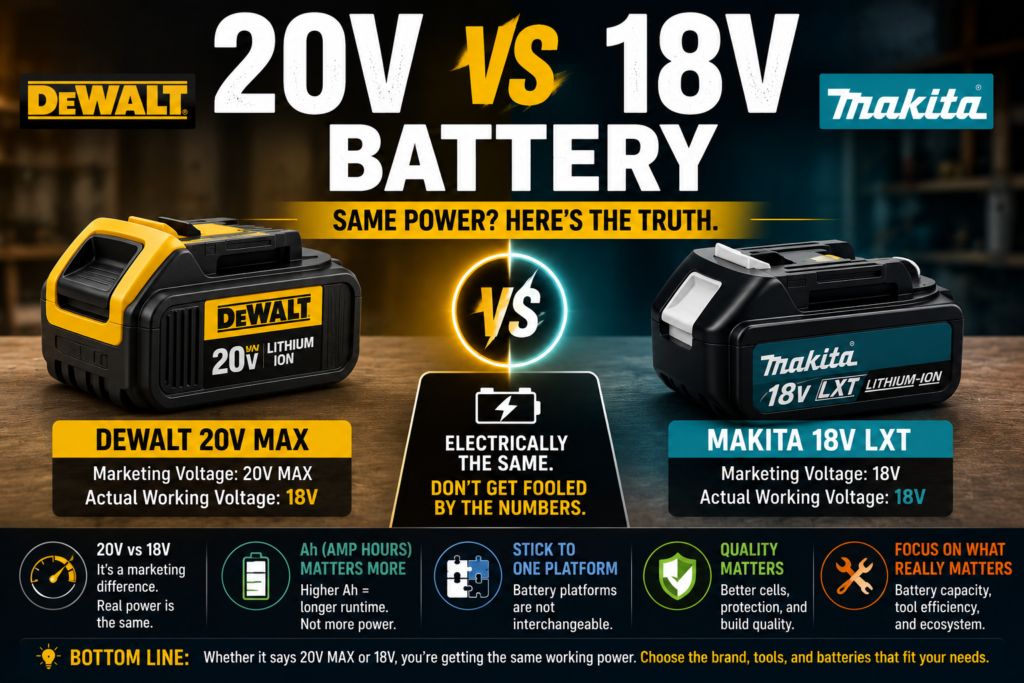
20V MAX and 18V are the same thing electrically. There is no meaningful performance difference between a DeWalt 20V MAX battery and a Makita 18V LXT battery of the same capacity. The voltage labeling difference is a marketing decision, not an engineering one.
Here is why.
How Lithium-Ion Battery Voltage Actually Works
A lithium-ion battery cell has two voltage ratings:
- Peak voltage — the maximum voltage when the battery is fully charged
- Nominal voltage — the average working voltage during normal discharge
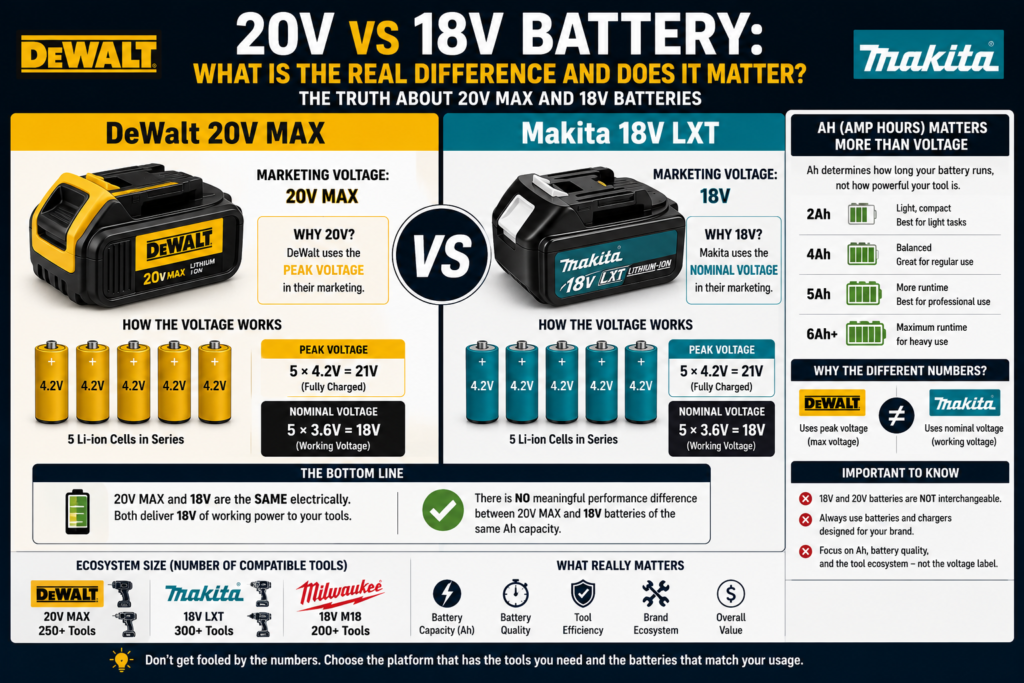
A standard lithium-ion cell has a peak voltage of 4.2V and a nominal voltage of 3.6V. A five-cell battery pack — which is what most 18V/20V tool batteries use — therefore has:
- Peak voltage: 5 × 4.2V = 21V
- Nominal voltage: 5 × 3.6V = 18V
DeWalt chose to market its batteries using the peak voltage (rounded down to 20V MAX). Makita, Milwaukee, Ryobi, and most other brands chose to use the nominal voltage (18V). According to the UL Safety Standards, the nominal voltage is the more accurate representation of real-world operating performance.
The result is two different numbers describing the same electrical reality. A DeWalt 20V MAX battery and a Makita 18V LXT battery of identical cell count and capacity will deliver the same working voltage to their respective tools.
20V vs 18V — Direct Comparison
| Feature | DeWalt 20V MAX | Makita 18V LXT | Milwaukee 18V M18 |
|---|---|---|---|
| Marketing voltage | 20V MAX | 18V | 18V |
| Actual nominal voltage | 18V | 18V | 18V |
| Peak voltage | 20V | 21.6V | 20V |
| Cell chemistry | Lithium-ion | Lithium-ion | Lithium-ion |
| Compatible tools | 250+ DeWalt tools | 300+ Makita tools | 200+ Milwaukee tools |
| Cross-brand compatible | No | No | No |
Does Ah (Amp Hours) Matter More Than Voltage?
Yes — significantly more. While the voltage debate between 18V and 20V is largely meaningless, the Ah rating of your battery makes a real, practical difference to runtime.
Ah stands for amp hours and measures how much energy the battery stores. A higher Ah rating means more energy stored, which means longer runtime per charge. It does not affect the power or torque of the tool — it only affects how long the tool runs before needing a recharge.
| Battery capacity | Typical runtime | Weight | Best for |
|---|---|---|---|
| 1.5Ah | 15–20 min moderate use | Lightest | Light tasks, tight spaces |
| 2Ah | 20–30 min moderate use | Light | Home DIY and occasional use |
| 4Ah | 40–60 min moderate use | Medium | Regular DIY and light pro use |
| 5Ah | 50–75 min moderate use | Heavy | Professional daily use |
| 6Ah+ | 60–90+ min moderate use | Heaviest | Heavy professional use |
For a detailed breakdown of the 2Ah vs 5Ah decision specifically for DeWalt batteries, read our DeWalt 5Ah vs 2Ah Battery Comparison. And for guidance on Ryobi battery compatibility, see our Ryobi 18V Battery Guide.
What About 12V and 40V Batteries?
Not all cordless tools use 18V/20V batteries. Here is how the main voltage tiers compare:
| Voltage tier | Best for | Examples |
|---|---|---|
| 12V | Ultra-compact tools, light tasks | DeWalt XTREME 12V, Makita 12V MAX |
| 18V / 20V | General purpose — drills, saws, drivers | DeWalt 20V MAX, Makita 18V LXT |
| 40V | Heavy outdoor tools, large equipment | Ryobi 40V, Makita 40V XGT |
| 60V / FLEXVOLT | High-demand professional tools | DeWalt FLEXVOLT 60V MAX |
For most homeowners and DIYers, 18V/20V is the right voltage tier. It offers the best balance of power, battery availability, and tool selection. The 40V tier is worth considering if you do a lot of outdoor work — the Ryobi 40V Leaf Blower is a good example of where the extra voltage delivers real runtime benefits for demanding outdoor tasks.
Can You Use 18V Batteries in 20V Tools?
No — not without an adapter. DeWalt 20V MAX batteries and Makita 18V LXT batteries use different physical connectors and are not interchangeable. Third-party adapters exist but are not recommended as they can damage tools, void warranties, and in some cases create safety risks.
According to Popular Mechanics, the safest and most practical approach is always to stick within one brand’s battery ecosystem and invest in quality batteries from that brand rather than mixing platforms.
Battery Runtime Estimator
Select your tool type
Select battery capacity
How to Choose the Right Battery for Your Tools
Once you have committed to a platform, choosing the right battery comes down to three questions:
1. How long do you need to run the tool?
For occasional home tasks lasting under 30 minutes at a time, a 2Ah battery is perfectly adequate. For longer sessions or professional use, 4Ah or 5Ah is more practical.
2. How important is weight?
Higher Ah batteries are heavier. A 5Ah battery is noticeably heavier than a 2Ah battery. For overhead work or extended use, the extra weight of a larger battery can cause fatigue. Consider carrying two smaller batteries and rotating them rather than one heavy battery.
3. How many tools share the battery?
If you have multiple tools sharing a battery platform, investing in higher Ah batteries makes more sense because they keep all your tools running longer between charges. One 4Ah battery shared between three tools is more practical than three 2Ah batteries.
Pros and Cons of Each Voltage Platform
| ✅ DeWalt 20V MAX * Huge ecosystem — 250+ tools * Wide availability in North America * Strong budget entry point * FLEXVOLT backward compatible * Well-priced replacement batteries | ✅ Makita 18V LXT * World’s largest platform — 300+ tools * Excellent battery efficiency * Strong global availability * Dual-port charger options * Long-proven battery reliability |
The Bottom Line
The 20V vs 18V debate is one of the most misunderstood topics in the cordless tool world. The answer is simple: they are the same voltage in practice. DeWalt uses peak voltage in its marketing. Everyone else uses nominal voltage. Neither approach is wrong — they are just different ways of presenting the same number.
What actually matters when choosing a battery platform is the size of the ecosystem, the availability of replacement batteries, and the Ah capacity that matches your usage pattern. Focus on those three things and ignore the voltage label entirely.
For more guidance on choosing specific tools within these platforms, read our DeWalt vs Makita Drills comparison and our reviews of the DeWalt DCD771 and Makita XFD131.
Frequently Asked Questions
Is 20V stronger than 18V?
No. Despite the higher number, 20V MAX batteries operate at the same nominal voltage as 18V batteries — 18V. DeWalt labels its batteries using peak voltage while other brands use nominal voltage. The actual working power delivered to the tool is identical between a DeWalt 20V MAX and a Makita 18V LXT battery of the same capacity.
Why did DeWalt choose to call it 20V instead of 18V?
DeWalt chose to market the peak voltage of its batteries rather than the nominal voltage. This was a marketing decision made around 2011 when they relaunched their cordless line. The US Federal Trade Commission later required DeWalt to add the word MAX to the label to clarify that 20V refers to the maximum rather than operating voltage.
Can I charge a DeWalt 20V battery with an 18V charger?
Only if it is a DeWalt charger designed for 20V MAX batteries. You cannot use a Makita 18V charger on a DeWalt 20V battery or vice versa — the connectors are physically incompatible and the charging electronics are brand-specific.
Does a higher voltage battery last longer?
Voltage does not determine runtime — Ah capacity does. A 20V 2Ah battery and an 18V 2Ah battery of the same quality will run for approximately the same amount of time. To get longer runtime, increase the Ah rating, not the voltage.
What is FLEXVOLT and is it worth it?
FLEXVOLT is DeWalt’s high-voltage battery system that switches between 20V and 60V depending on the tool it is connected to. It is backward compatible with all DeWalt 20V MAX tools. FLEXVOLT is worth it for users who need high-demand tools like circular saws, miter saws, and table saws while still wanting compatibility with their existing 20V MAX lineup.
Is a 5Ah battery better than a 2Ah battery?
It delivers more runtime but also weighs more and costs more. Whether it is better depends on your use case. For occasional home tasks a 2Ah is lighter and perfectly adequate. For extended professional use a 5Ah or higher is a better investment. Read our full DeWalt 5Ah vs 2Ah Battery Comparison for a detailed breakdown.
Are third-party batteries safe to use?
Some are, some are not. Reputable third-party brands like Powerextra and Vanon make compatible batteries that work adequately for light use. However, premium brands like DeWalt, Makita, and Milwaukee build their batteries with protection circuits that prevent overcharging, overheating, and over-discharge. Using unverified third-party batteries can reduce tool performance, damage the tool, and in rare cases create safety risks. For professional tools, always use the manufacturer’s own batteries.