Hammer drill and impact driver — both tools deliver some form of impact force, both are cordless, and both look similar enough that buyers regularly confuse them. But they do completely different things and are built for completely different jobs. Hammer drill vs impact driver: Using one where you need the other will either produce poor results or not work at all.
This guide explains exactly what each tool does, where each one excels, where each one fails, and how to decide which one belongs in your collection — or whether you actually need both.
The Core Difference in One Sentence: Hammer Drill vs Impact Driver
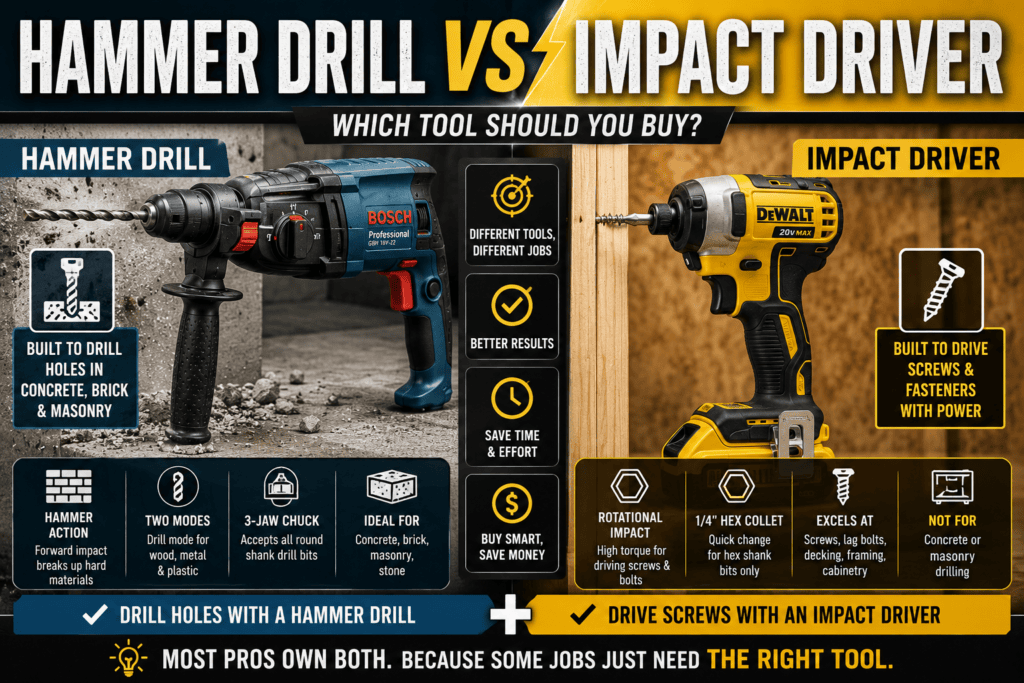
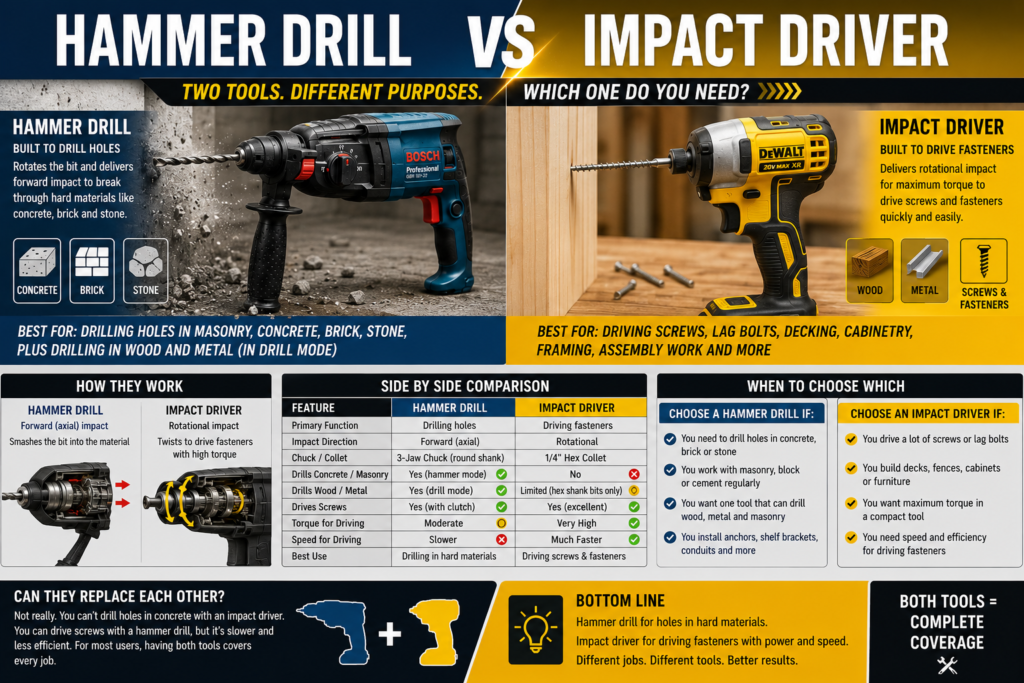
A hammer drill drills holes in masonry by rotating and hammering forward into the material. An impact driver drives screws and fasteners by rotating and hammering rotationally to generate high torque. The direction of the impact is different — forward for hammer drills, rotational for impact drivers — and this determines everything about what each tool can and cannot do.
What a Hammer Drill Does
A hammer drill is primarily a drilling tool. It uses a rotating bit combined with a rapid forward percussive action to pulverise and chip through hard materials like concrete, brick, and masonry. The hammer action is what makes masonry drilling practical — without it, a standard drill makes almost no progress in hard concrete.
Most hammer drills operate in two modes:
- Drill mode — standard rotation only, for wood, metal, and plastic
- Hammer mode — rotation plus forward percussion, for concrete, brick, and masonry
The chuck on a hammer drill is a standard 3-jaw chuck that accepts any round-shank bit. For masonry work it needs carbide-tipped masonry bits. For wood and metal it uses the same HSS and wood bits as any standard drill. The clutch system allows controlled screw driving too, though it is less efficient than an impact driver for high-volume screw work.
For a full explanation of how hammer drills work and when you need one, read our What Is a Hammer Drill guide.
What an Impact Driver Does
An impact driver is a fastening tool. It is specifically designed to drive screws, bolts, and other fasteners quickly and with high torque. Its internal mechanism delivers rotational impacts — rapid bursts of hammering force in the rotational direction — that multiply the effective torque far beyond what a smooth-rotation drill can achieve.
The chuck on an impact driver is a 1/4 inch hex collet — a quick-release system that accepts only bits and accessories with a 1/4 inch hex shank. Standard round-shank drill bits do not fit. This limits the impact driver to fastening tasks and a narrow range of drilling accessories designed specifically for hex-shank use.
Impact drivers are not designed for drilling holes in any material. Technically you can drill small holes with hex-shank drill bits in an impact driver, but the impact mechanism creates shock loads that standard drill bits are not designed to handle — they break quickly. An impact driver is a driving tool, not a drilling tool.
Side by Side Comparison
| Feature | Hammer Drill | Impact Driver |
|---|---|---|
| Impact direction | Forward (axial) | Rotational |
| Chuck type | Standard 3-jaw (keyless) | 1/4 inch hex collet |
| Drills wood | ✅ Yes — drill mode | ⚠️ Limited (hex shank bits only) |
| Drills concrete/masonry | ✅ Yes — hammer mode | ❌ No |
| Drives screws | ✅ Yes — with clutch | ✅ Excellent — its primary job |
| Drives lag bolts | ⚠️ Slow | ✅ Excellent |
| Typical torque | 400–1,200 in-lbs | 1,500–2,300 in-lbs |
| Wrist fatigue | Moderate | Low — impact absorbs reaction |
| Size and weight | Larger and heavier | Compact and lighter |
| Typical price | $120–$250 | $80–$200 |
Where Each Tool Clearly Wins
Hammer Drill Wins — Masonry Work
There is no competition here. If you need to drill into concrete, brick, block, or stone — for wall anchors, pipe penetrations, structural fixings, or any masonry application — you need a hammer drill. An impact driver cannot do this job at all. The forward percussion that makes hammer drills effective in masonry is completely absent in an impact driver whose impacts are entirely rotational.
Impact Driver Wins — High Volume Screw Driving
For driving screws — particularly long screws, deck screws, lag bolts, and structural fasteners — an impact driver is dramatically more efficient than a hammer drill. The rotational impact mechanism delivers far more torque than a hammer drill’s smooth rotation, and because the impact absorbs most of the reaction force internally, wrist fatigue is minimal even after hundreds of screws. Building a deck, installing fencing, or assembling timber frames becomes significantly faster with an impact driver than with a hammer drill in drill mode.
Hammer Drill Wins — Precision Drilling
For drilling accurate holes in wood or metal the hammer drill in drill mode is significantly more controllable than an impact driver. The 3-jaw chuck accepts a full range of bit sizes, the clutch system prevents over-drilling, and the smooth rotation produces cleaner holes. For cabinetry, joinery, or any precision work a hammer drill in standard drill mode is the better tool.
Impact Driver Wins — Tight Spaces
Impact drivers are typically shorter and lighter than hammer drills. This compact form factor makes them significantly easier to use in confined spaces — inside cabinets, along skirting boards, in roof spaces, and anywhere a full-size drill cannot reach comfortably. The 1/4 inch hex collet also allows very rapid bit changes without a chuck key or twisting motion.
The Confusion — Why People Mix Them Up
Both tools make noise. Both deliver some kind of impact. Both are sold as cordless tools in similar size and price ranges. This surface similarity leads to a common misconception that they are interchangeable — they are not.
The confusion is compounded by the fact that some manufacturers market their hammer drills as “hammer drill/drivers” — meaning they can also drive screws in standard drill mode. This is true, but it does not make them equivalent to a dedicated impact driver for fastening work. The clutch-controlled smooth rotation of a hammer drill in drive mode is less efficient and more prone to stripping screws than a dedicated impact driver’s rotational impact mechanism.
Similarly some impact drivers are marketed as “drill/driver” combinations because they can drill small holes with hex-shank bits. Again technically true, but using standard round-shank bits requires an adapter and the impact mechanism is genuinely hard on bits not designed for it.
Who Should Buy a Hammer Drill Only
- Homeowners who primarily hang things on masonry walls and do occasional general DIY
- Anyone renovating a brick or concrete building who needs to regularly drill into walls
- Buyers who want one versatile tool that covers drilling in all materials including masonry
- Anyone who already has a separate impact driver and needs masonry capability added
Who Should Buy an Impact Driver Only
- Construction workers, carpenters, and tradespeople who drive hundreds of screws daily
- Deck builders, fence installers, or anyone doing high-volume structural fastening
- Anyone who already has a standard drill and primarily needs faster, easier screw driving
- Buyers working in timber-framed construction with no masonry drilling requirement
Who Should Buy Both
- Serious DIYers and renovators who do a range of projects including both masonry and woodwork
- Professional tradespeople who need both masonry capability and high-volume fastening
- Anyone building a complete tool collection from scratch — the combination of hammer drill and impact driver covers the vast majority of all drilling and fastening tasks
Many brands offer these two tools as a combo kit sharing the same battery platform, which reduces the overall cost significantly. For the best combo kit options read our Best Cordless Drills guide and our Best Impact Drivers ranking.
Top Picks — Hammer Drills
| Model | Max torque | Price | Best for |
|---|---|---|---|
| DeWalt DCD996 | 820 in-lbs | ~$199 | Best all-round hammer drill |
| Milwaukee 2804-20 | 1,200 in-lbs | ~$179 | Best for professional use |
| Ryobi PSBHM01B | 600 in-lbs | ~$99 | Best budget option |
Top Picks — Impact Drivers
| Model | Max torque | Price | Best for |
|---|---|---|---|
| DeWalt DCF787 | 1,825 in-lbs | ~$129 | Best value overall |
| Milwaukee 2853-20 | 2,000 in-lbs | ~$179 | Best professional torque |
| Ryobi PSBID01B | 1,800 in-lbs | ~$99 | Best budget brushless |
🔧 Hammer Drill or Impact Driver? — Find Your Answer
Answer three questions about your work and get a personalised recommendation.
Frequently Asked Questions
Can an impact driver drill into concrete?
No. An impact driver delivers rotational impacts to drive fasteners — the impact force is entirely in the rotational direction. Drilling concrete requires forward percussion — hammering the bit into the material. An impact driver produces no forward percussion whatsoever. Using an impact driver on concrete with a masonry bit will make virtually no progress and will rapidly damage both the bit and the tool.
Can a hammer drill replace an impact driver?
Partially. A hammer drill in standard drill mode with a screwdriver bit can drive screws. But it is significantly slower than a dedicated impact driver for high-volume fastening, more prone to stripping screw heads due to the absence of the rotational impact mechanism, and causes more wrist fatigue because all the reaction force transfers to the user rather than being absorbed internally. For occasional screw driving a hammer drill is adequate. For regular or professional fastening work a dedicated impact driver is noticeably more efficient.
Which is better for a first-time buyer — hammer drill or impact driver?
It depends entirely on your walls and your projects. If you live in a masonry-built home with brick or concrete walls, a hammer drill is the more immediately useful first tool — you will need it every time you hang something on the walls. If you live in a timber-framed home with drywall and your projects involve woodwork and assembly, an impact driver paired with a standard cordless drill is more useful. If budget allows, a combo kit giving you both is the most practical starting point for most homeowners.
Is a hammer drill the same as an SDS drill?
No — both deliver hammer action but at very different energy levels. A standard hammer drill uses a cam-and-ratchet mechanism delivering 0.5 to 2 joules per blow. An SDS rotary hammer uses a pneumatic piston delivering 2 to 8+ joules — three to five times more energy. For typical home masonry work a standard hammer drill is sufficient. For large-diameter holes or extended professional concrete work an SDS drill is the appropriate tool. Read our complete hammer drill guide for a full explanation of these differences.
Do hammer drills and impact drivers use the same batteries?
If both tools are from the same brand and the same voltage platform — yes. A DeWalt 20V MAX hammer drill and a DeWalt 20V MAX impact driver share the same batteries and charger. This is one of the main advantages of staying within one brand's ecosystem — batteries are interchangeable across all tools in that voltage range. Mixing brands is not possible as battery connectors are not compatible between manufacturers. For battery platform guidance read our 20V vs 18V Battery guide.