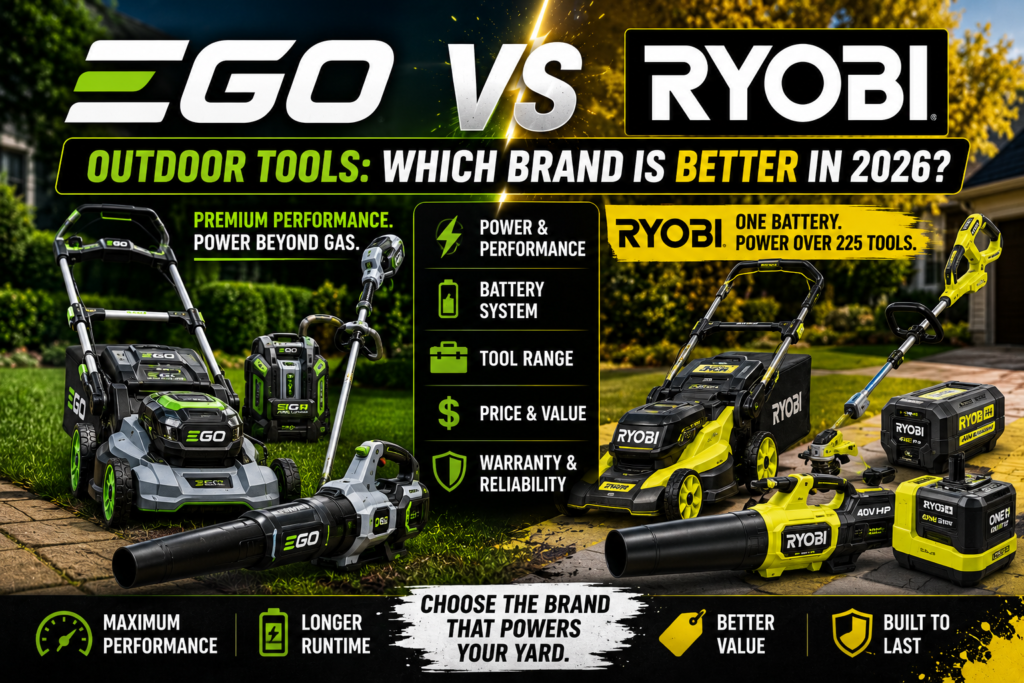
EGO and Ryobi are two of the most popular battery-powered outdoor tool brands available today. Both target homeowners who want to escape gas-powered tools — but they approach the market very differently. EGO positions itself as the premium performance alternative to gas. Ryobi positions itself as the most affordable way to build a complete cordless outdoor tool collection.
The result is two brands that compete for the same buyers but offer genuinely different value propositions. Choosing between them is not just about picking a leaf blower or a lawn mower — it is about committing to a battery platform that will power your entire outdoor tool collection for years.
This guide compares EGO and Ryobi across power, battery systems, tool range, price, and long-term value — with an interactive brand matcher at the end to give you a personalised recommendation.
Brand Overview
EGO Power+
EGO Power+ is a brand of Chervon, a Chinese power tool manufacturer founded in 1993. EGO launched in 2014 with a specific mission — to prove that battery-powered outdoor tools could match or exceed gas performance. Its 56V ARC Lithium battery platform is purpose-built for outdoor tools and delivers some of the highest output numbers in the cordless outdoor category. EGO tools are significantly more expensive than Ryobi but are consistently rated among the best performing cordless outdoor tools available.
Ryobi
Ryobi is owned by Techtronic Industries (TTI) — the same parent company as Milwaukee and AEG. Ryobi has been making power tools since 1943 and is one of the most widely recognised value tool brands globally. Its outdoor tool range runs on the 40V and 18V ONE+ battery platforms. The 40V platform is specifically for outdoor tools and offers a huge range at competitive prices. Ryobi’s biggest advantage is ecosystem size — with over 225 ONE+ tools and a growing 40V outdoor range, it offers more compatible tools than any other battery platform.
Try this tool to make decision.
Battery Platform Comparison
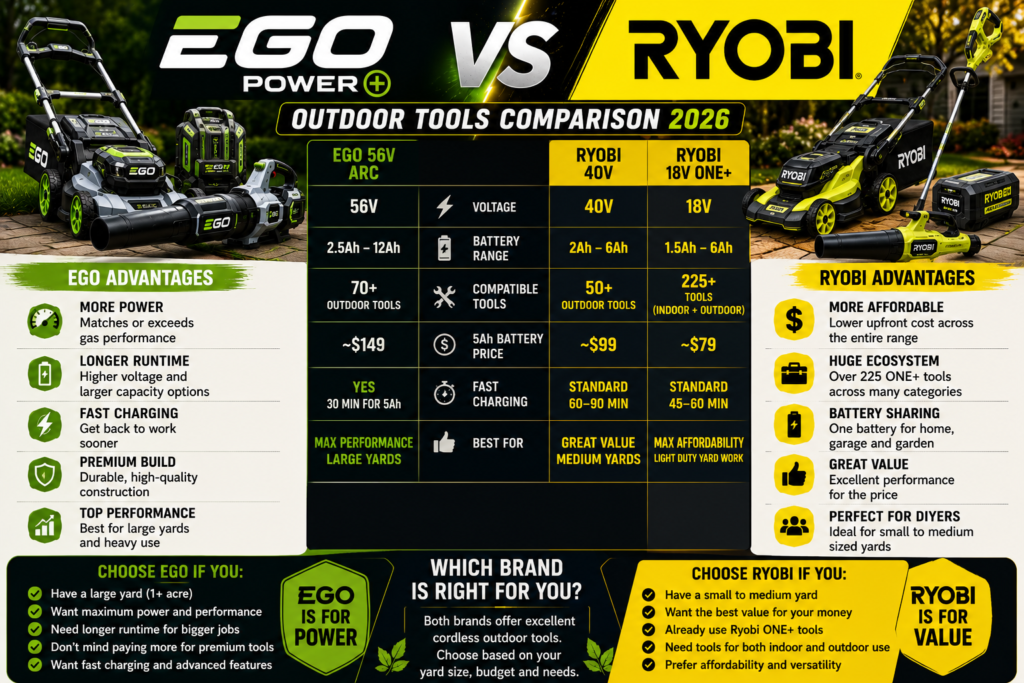
| Feature | EGO 56V ARC | Ryobi 40V | Ryobi 18V ONE+ |
|---|---|---|---|
| Voltage | 56V | 40V | 18V |
| Battery range | 2.5Ah to 12Ah | 2Ah to 6Ah | 1.5Ah to 6Ah |
| Compatible tools | 70+ outdoor tools | 50+ outdoor tools | 225+ tools (indoor + outdoor) |
| 5Ah battery price | ~$149 | ~$99 | ~$79 |
| Fast charging | Yes — 30 min for 5Ah | Standard — 60–90 min | Standard — 45–60 min |
| Cross-platform use | EGO tools only | Ryobi 40V tools only | Ryobi 18V ONE+ tools only |
Head to Head — Key Tool Comparisons
Leaf Blowers
| Model | CFM | MPH | Runtime (4Ah) | Price (tool only) |
|---|---|---|---|---|
| EGO LB6504 | 650 CFM | 180 MPH | ~45 min | ~$149 |
| Ryobi 40V PCL970B | 480 CFM | 110 MPH | ~35 min | ~$99 |
Winner: EGO — 35 percent more CFM and 64 percent more MPH is a meaningful real-world performance advantage. EGO handles wet leaves and heavy debris noticeably better.
Lawn Mowers
| Model | Cut width | Runtime | Self-propelled | Price (kit) |
|---|---|---|---|---|
| EGO LM2135SP | 21 inches | ~60 min | Yes | ~$549 |
| Ryobi RY401170 | 20 inches | ~40 min | Yes | ~$349 |
Winner: EGO on performance, Ryobi on value — EGO covers more area per charge and handles thick grass better. Ryobi is $200 cheaper and perfectly adequate for average residential lawns.
String Trimmers
| Model | Cut width | Runtime | Line diameter | Price (tool only) |
|---|---|---|---|---|
| EGO ST1521S | 15 inches | ~45 min | 0.095 inch | ~$129 |
| Ryobi RY40250 | 15 inches | ~30 min | 0.080 inch | ~$99 |
Winner: EGO — thicker line, longer runtime, and more cutting power through dense grass and weeds. Ryobi is adequate for light trimming work.
Where EGO Wins
EGO wins on almost every performance metric. Its 56V platform delivers more power, longer runtime per charge, and faster recharging than Ryobi's 40V system. According to independent testing by Consumer Reports, EGO lawn mowers and leaf blowers consistently outperform Ryobi equivalents in power output and runtime tests.
EGO's 56V ARC Lithium batteries also charge faster — a 5Ah battery reaches full charge in approximately 30 minutes with EGO's rapid charger versus 60 to 90 minutes for comparable Ryobi 40V batteries. For users who run tools hard and need quick turnarounds between charges this is a meaningful practical advantage.
Where Ryobi Wins
Ryobi wins decisively on price, ecosystem size, and value. Entry-level Ryobi outdoor kits cost 30 to 50 percent less than comparable EGO kits. Ryobi batteries are significantly cheaper to purchase and replace. And the Ryobi 18V ONE+ platform — with 225+ compatible tools covering both indoor and outdoor use — offers unmatched ecosystem versatility. One battery powers your drill, impact driver, circular saw, and your leaf blower.
For users who already own Ryobi ONE+ tools, adding 40V outdoor tools means managing two separate battery systems. This is a genuine limitation compared to platforms that cover both power tools and outdoor tools with the same battery.
Price Comparison
| Tool | EGO price | Ryobi price | Saving with Ryobi |
|---|---|---|---|
| Leaf blower kit | ~$249 | ~$149 | ~$100 |
| Lawn mower kit | ~$549 | ~$349 | ~$200 |
| String trimmer kit | ~$199 | ~$149 | ~$50 |
| 5Ah battery | ~$149 | ~$99 | ~$50 |
| Full 3-tool kit total | ~$997 | ~$647 | ~$350 |
Pros and Cons
EGO Power+
| ✅ Pros * Best-in-class cordless outdoor performance * 56V delivers near-gas power on most tools * Rapid charging — 5Ah in ~30 minutes * Quiet operation vs gas alternatives * Strong build quality and durability * Excellent warranty support | ❌ Cons * Significantly more expensive than Ryobi * Batteries cost more to buy and replace * Smaller overall tool range than Ryobi * No indoor power tool compatibility * Premium price hard to justify for light use |
Ryobi 40V
| ✅ Pros * Significantly cheaper tools and batteries * Huge 40V outdoor tool range * 18V ONE+ platform covers indoor tools too * World's largest cordless tool ecosystem * Adequate performance for most home users * Easy to find at major retailers everywhere | ❌ Cons * Lower performance than EGO across all tools * 40V and 18V batteries not cross-compatible * Slower charging than EGO * Struggles more with heavy wet debris * Build quality below EGO at comparable price |
Who Should Choose EGO?
- Users who want the closest cordless alternative to gas performance
- Anyone with a medium to large yard who needs maximum runtime and power
- Users who can afford the higher upfront cost and want to keep it long term
- Anyone who values fast charging — EGO's rapid charger is genuinely impressive
- Users who prioritise outdoor tools specifically and do not need indoor tool compatibility
Who Should Choose Ryobi?
- Budget-conscious buyers who want to build a complete outdoor tool collection affordably
- Users with small to medium yards where Ryobi's performance is fully adequate
- Anyone already in the Ryobi ONE+ ecosystem who wants outdoor tools from the same brand
- First-time cordless outdoor tool buyers who want the lowest barrier to entry
- Anyone who wants the widest possible range of compatible tools on one platform
🌿 EGO vs Ryobi Brand Matcher
Answer 4 quick questions to get a personalised recommendation for your outdoor tool needs.
The Honest Verdict
EGO is the better tool. There is no honest way around that — it outperforms Ryobi on every power and runtime metric that matters. If performance is your priority and budget is not a major constraint, EGO is worth the premium.
But Ryobi is the better value. For most homeowners with average-sized yards doing typical garden maintenance, Ryobi 40V tools perform the job perfectly well at significantly lower cost. The $350 saving on a three-tool kit is real money that could buy an extra battery, a fourth tool, or simply stay in your pocket.
For more guidance on outdoor power tools read our detailed Ryobi 40V Leaf Blower Review and our comparison of Cordless vs Gas Leaf Blowers. For battery guidance across platforms read our Ryobi 18V Battery Guide and our Battery Storage guide.
Frequently Asked Questions
Are EGO and Ryobi batteries interchangeable?
No. EGO 56V batteries and Ryobi 40V batteries use different connectors and charging systems and are completely incompatible. Even within Ryobi, the 18V ONE+ batteries and 40V batteries are not interchangeable — they are separate platforms. Always confirm battery compatibility before purchasing additional tools for your collection.
Is EGO worth the extra cost over Ryobi?
For heavy users with medium to large yards — yes. The performance gap is real and the fast charging is genuinely useful. For light users with small yards who mow and blow a few times a month — probably not. Ryobi delivers 80 percent of EGO's performance at 60 percent of the price for typical residential tasks.
Which brand has better warranty support?
EGO offers a 5 year tool warranty and 3 year battery warranty when you register products. Ryobi offers a 3 year tool warranty and 3 year battery warranty on most 40V products. EGO's longer tool warranty is a meaningful advantage given the higher upfront investment. Both brands have good customer service reputations according to Trustpilot user reviews.
Can I use Ryobi 40V batteries in a Ryobi 18V ONE+ tool?
No — the 40V and 18V ONE+ platforms are separate and incompatible. Ryobi has not created a unified platform across voltages. If you want one battery to power all your Ryobi tools you would need to choose either 18V ONE+ (which covers mostly indoor tools and some light outdoor) or 40V (outdoor-focused). Many Ryobi users maintain both systems separately.
How long do EGO and Ryobi batteries last over their lifetime?
Both use lithium-ion cells and degrade similarly with use. Expect 3 to 5 years of regular seasonal use before capacity noticeably drops. EGO's slightly more sophisticated battery management electronics may give a marginal lifespan advantage. Proper storage at 40 to 60 percent charge in a cool location significantly extends life for both — see our complete Battery Storage guide for full details.
Which brand is better for a large yard over half an acre?
EGO is the clear recommendation for large properties. Its higher CFM output, longer runtime per charge, and rapid 30-minute charging make it far more practical for extended sessions on large areas. At half an acre or more a single Ryobi 40V battery may not complete the job without a recharge pause, whereas EGO with a 7.5Ah or larger battery can typically cover the area in one charge.