Most people buy a pressure washer and never think twice about the hose that comes with it — until it bursts, kinks constantly, or they find they cannot reach the far end of their driveway. A pressure washer hose is not a universal accessory. The diameter, length, pressure rating, and material of the hose all affect how well your machine performs and how safe it is to operate.
This guide covers everything you need to know about pressure washer hoses — from understanding PSI ratings and diameter sizing to choosing the right length for your property and knowing when a replacement hose is necessary.
Why the Hose Matters More Than Most Buyers Realise
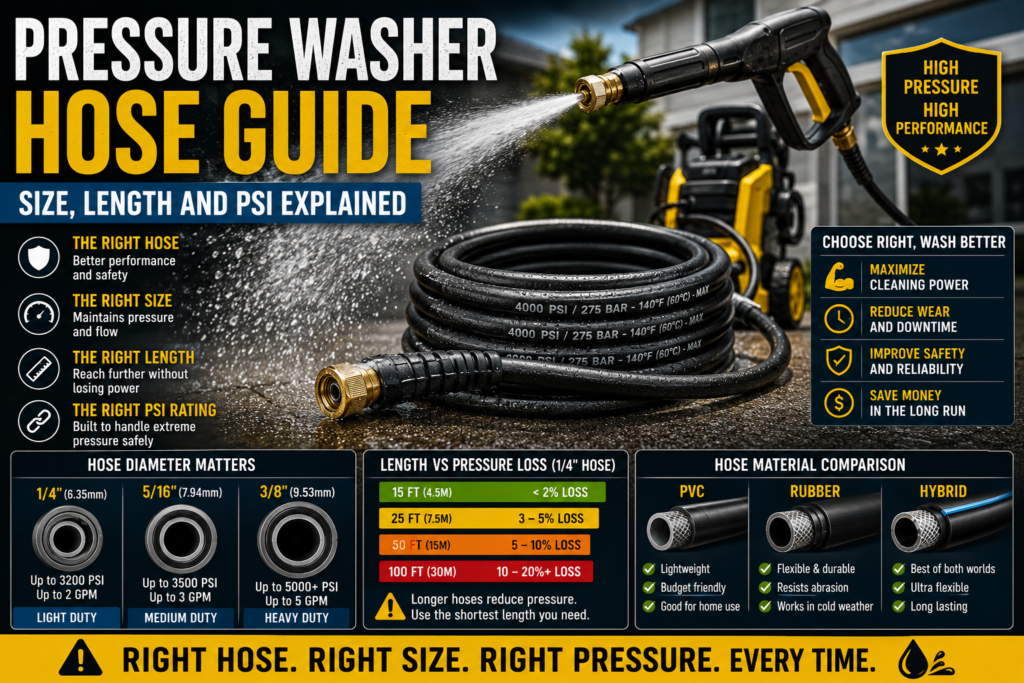
A pressure washer generates high-pressure water flow — typically between 1,000 and 4,000 PSI depending on the machine. That pressure must travel from the pump through the hose to the nozzle without significant loss. A hose that is too narrow, too long, or rated below the machine’s output pressure causes three real problems:
- Pressure drop — the further water travels through a narrow hose, the more pressure is lost to friction. A hose that is too long or too narrow for the machine significantly reduces cleaning performance at the nozzle end.
- Safety risk — a hose rated below the machine’s PSI output can fail catastrophically under pressure. High-pressure water injection injuries are serious medical emergencies. Always use a hose rated above your machine’s maximum pressure.
- Kinking and wear — cheap or inappropriately sized hoses kink repeatedly during use, causing internal damage that weakens the hose wall over time.
Pressure Washer Hose Diameter — What Size Do You Need?
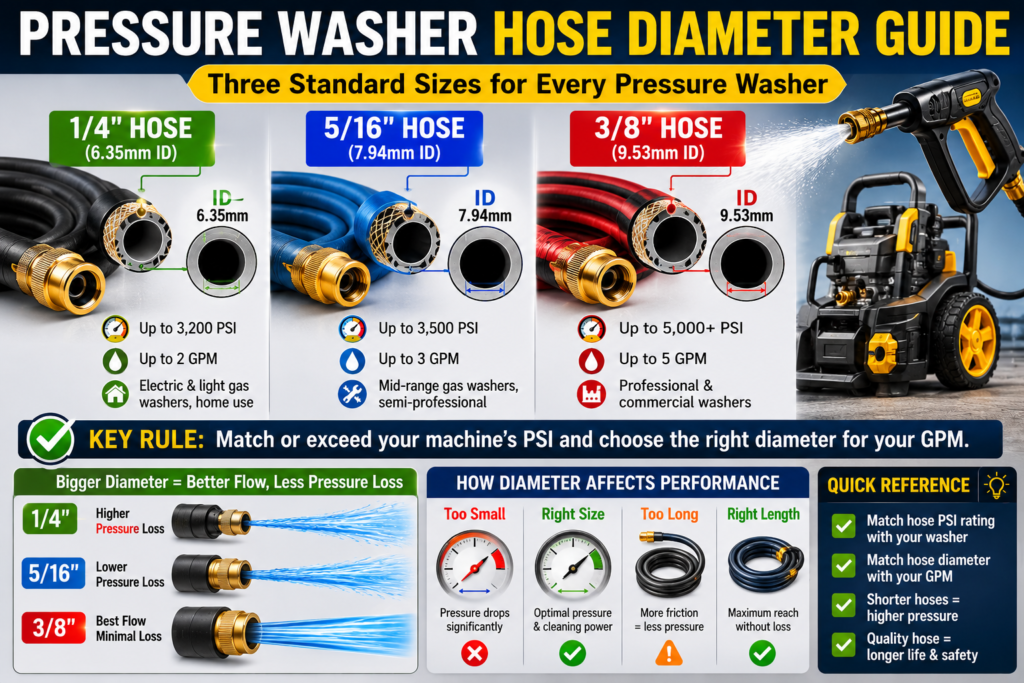
Hose diameter is measured as the internal diameter (ID) — the size of the passage the water flows through, not the outer diameter of the hose itself. Three sizes cover almost all consumer and professional pressure washer applications:
| Internal diameter | Typical PSI range | Flow rate (GPM) | Best for |
|---|---|---|---|
| 1/4 inch (6.35mm) | Up to 3,200 PSI | Up to 2 GPM | Electric and light gas washers, home use |
| 5/16 inch (7.94mm) | Up to 3,500 PSI | Up to 3 GPM | Mid-range gas washers, semi-professional |
| 3/8 inch (9.53mm) | Up to 5,000+ PSI | Up to 5 GPM | Professional and commercial washers |
The key rule is to match or exceed the machine’s rated PSI with the hose’s rated pressure, and to match the hose diameter to the machine’s flow rate (GPM). Using a 1/4 inch hose on a machine rated for 3 GPM will cause significant pressure loss at the nozzle and strain the pump.
Hose Length — How Long Do You Actually Need?
More length sounds better until you realise that every metre of hose adds friction and reduces pressure at the nozzle. The relationship between hose length and pressure drop depends on the diameter, flow rate, and the hose material, but as a general rule:
| Hose length | Approx pressure drop (1/4″ hose) | Best suited to |
|---|---|---|
| 15 feet (4.5m) | Minimal — under 2% | Small patios, cars, bins |
| 25 feet (7.5m) | Low — 3–5% | Average driveway, standard garden |
| 50 feet (15m) | Moderate — 8–12% | Large driveway, two-storey cleaning |
| 100 feet (30m) | Significant — 20–30% | Large properties — upgrade to 5/16″ or 3/8″ |
The practical advice is to buy the shortest hose that comfortably reaches your furthest cleaning point without having to move the machine repeatedly. Adding extension hoses is always possible but each connection is a potential weak point and adds further pressure loss.
Estimating the Right Length for Your Property
- Apartment or small terrace — 15 to 25 feet is typically enough for car, patio, and wheelie bin cleaning
- Average suburban home — 25 to 50 feet covers most driveways, patios, and garden paths without moving the machine
- Large property or commercial use — 50 to 100 feet, but upgrade to 5/16 inch or 3/8 inch diameter to maintain pressure over the extra length
PSI Rating — The Most Important Safety Specification
Every pressure washer hose has a maximum working pressure (MWP) and a burst pressure rating. The MWP is the maximum continuous pressure the hose is designed to operate at safely. The burst pressure is typically 3 to 4 times the MWP — the point at which the hose physically fails.
According to OSHA guidelines on hydraulic tools and high pressure equipment, always use hoses rated at least 25 percent above the machine’s maximum operating pressure. This safety margin accounts for pressure spikes that occur when the trigger is released and pressure momentarily builds in the line.
| Machine type | Typical output PSI | Minimum hose MWP |
|---|---|---|
| Light electric (home use) | 1,000–1,800 PSI | 2,500 PSI minimum |
| Mid electric / light gas | 1,800–2,500 PSI | 3,000 PSI minimum |
| Mid gas (home/semi-pro) | 2,500–3,200 PSI | 4,000 PSI minimum |
| Professional gas | 3,200–4,000+ PSI | 5,000 PSI minimum |
Hose Material — Rubber vs PVC vs Polyurethane
Three main materials are used in pressure washer hoses, each with different characteristics for flexibility, durability, weight, and price:
PVC (Polyvinyl Chloride)
PVC hoses are the lightest and cheapest option. They are found on most entry-level electric pressure washers as the included hose. PVC is adequate for light home use in mild conditions but becomes stiff and difficult to handle in cold weather, kinks more readily than rubber, and has a shorter service life under regular use. In temperatures below 5°C, PVC hoses become significantly rigid and prone to cracking.
Best for: Occasional light use, indoor or mild-climate storage, budget-conscious buyers
Avoid if: You use your washer regularly, store it outdoors, or work in cold conditions
Rubber
Rubber hoses are heavier than PVC but significantly more flexible, durable, and temperature-resistant. They remain flexible in cold conditions down to around -20°C, resist abrasion and UV degradation better than PVC, and typically last significantly longer under regular use. Most professional pressure washers use rubber hoses. The trade-off is weight — a 50-foot rubber hose is noticeably heavier than its PVC equivalent.
Best for: Regular use, outdoor storage, cold-climate use, professional applications
Avoid if: Weight is a concern for overhead or two-storey cleaning work
Polyurethane
Polyurethane hoses represent a middle ground — lighter than rubber, more flexible than PVC, and more resistant to kinking than both. They are the premium choice for users who want the flexibility and low weight of PVC with better durability and cold-weather performance closer to rubber. Polyurethane hoses cost more than both PVC and rubber but are increasingly the preferred choice for quality aftermarket replacement hoses.
Best for: Users who prioritise flexibility and light weight without sacrificing durability
| Material | Flexibility | Durability | Cold weather | Weight | Price |
|---|---|---|---|---|---|
| PVC | Poor when cold | Fair | Stiffens below 5°C | Light | $ |
| Rubber | Excellent | Excellent | Flexible to -20°C | Heavy | $$ |
| Polyurethane | Excellent | Very good | Good to -10°C | Light-medium | $$$ |
Fittings and Connectors
Pressure washer hose fittings are not universal. The two most common connector systems are:
- M22 threaded connector — a 22mm metric thread used on most consumer gas and electric pressure washers from brands like Karcher, Sun Joe, and most North American brands. Available in two internal bore sizes — 14mm and 15mm — which are not interchangeable despite looking similar.
- Quick-connect fittings — push-and-click connectors used on many electric washers for tool-free hose changes. Convenient but brand-specific in many cases.
Always check the connector type on your machine before buying a replacement or extension hose. An M22-14 fitting will not thread correctly onto an M22-15 port even though both are technically M22. If in doubt, take the old hose or a photo of the connector to the hardware store rather than guessing.
Signs Your Hose Needs Replacing
- Visible cracks, splits, or bulging in the hose wall
- Leaking at the fittings or along the hose body
- Kinking that does not recover — permanent kinks weaken the hose wall
- Significant pressure loss compared to when the machine was new
- Hose becomes brittle, stiff, or develops surface cracking — common in aged PVC
A hose showing any of these signs should be replaced before further use. A burst high-pressure hose is a safety hazard — the pressurised water stream from a failed hose can cause serious injection injuries.
🔧 Pressure Washer Hose Selector
Enter your machine’s details and property size below to get a personalised hose recommendation.
Frequently Asked Questions
Can I use any pressure washer hose with any machine?
No. You need to match three things: the PSI rating (hose must exceed machine’s max PSI), the diameter (must suit the machine’s GPM flow rate), and the connector type (M22-14, M22-15, or quick-connect). Getting any of these wrong either reduces performance, causes leaks, or in the case of an undersized PSI rating, creates a safety risk.
Can I join two hoses together to get more length?
Yes, using a pressure washer hose connector or coupler. However each connection adds a potential leak point, and the combined pressure drop of two hoses can significantly reduce cleaning performance. If you regularly need more than 50 feet of hose, consider upgrading to a 5/16 inch or 3/8 inch diameter hose to compensate for the pressure loss over distance.
Does a longer hose reduce pressure?
Yes — friction between the water and the inner hose wall reduces pressure over distance. The effect is more pronounced in narrower hoses and at higher flow rates. For most home users with machines under 2,500 PSI and hoses under 50 feet the pressure loss is acceptable. For professional machines or very long runs, upgrading to a larger diameter hose minimises this loss.
What is the difference between M22-14 and M22-15 fittings?
Both are M22 metric thread fittings but with different internal bore sizes — 14mm and 15mm respectively. They use the same thread pitch and will physically connect to each other, but the different bore diameter means flow restriction and potential leaking at the connection. Always match your hose fitting to the exact specification on your machine — check the machine manual or measure the existing fitting before buying.
How do I stop my pressure washer hose from kinking?
Three approaches help. First, upgrade from PVC to rubber or polyurethane — both resist kinking significantly better. Second, use a hose reel to store the hose in large loops rather than tight coils — tight storage causes memory kinking. Third, allow the hose to warm to room temperature before use in cold weather — cold PVC kinks almost immediately under pressure.
Are electric pressure washer hoses different from gas washer hoses?
The connector types may differ but the fundamental specifications — diameter, PSI rating, and material — apply equally to both. Electric washers typically operate at lower PSI (1,000 to 2,000 PSI) and use smaller diameter hoses (1/4 inch). Gas washers operate at higher PSI and flow rates and typically need larger diameter hoses for best performance. Always check your specific machine’s specifications rather than assuming hoses are interchangeable between electric and gas machines.