Getting a perfectly straight cut from a circular saw is one of the most useful skills in any workshop — and one of the most frustrating to achieve without the right setup. Freehand circular saw cuts almost always drift. The question is which solution is right for you: a circular saw guide rail system clamped to your workpiece, or a dedicated track saw that locks onto a purpose-made rail?
Both approaches solve the same problem — keeping the saw on a perfectly straight line for the entire length of the cut. But they do it differently, cost different amounts, and suit different users. This guide compares both systems honestly so you can make the right choice for your budget and your work.
The Problem Both Systems Solve
A circular saw is a powerful, versatile tool — but it is inherently difficult to guide in a perfectly straight line freehand. The saw’s base plate rests on the workpiece, the blade is offset from the edge of the base plate, and any slight drift in hand pressure or body position sends the cut off line. Over a two-metre sheet of plywood even a skilled user freehand cutting will typically drift by several millimetres.
For rough framing cuts this rarely matters. For joinery, furniture, flooring, and any work where cut accuracy affects the final fit, that drift is unacceptable. Both guide systems solve this by giving the saw a rigid reference edge to run against.
Option 1 — Circular Saw with a Guide Rail
What It Is
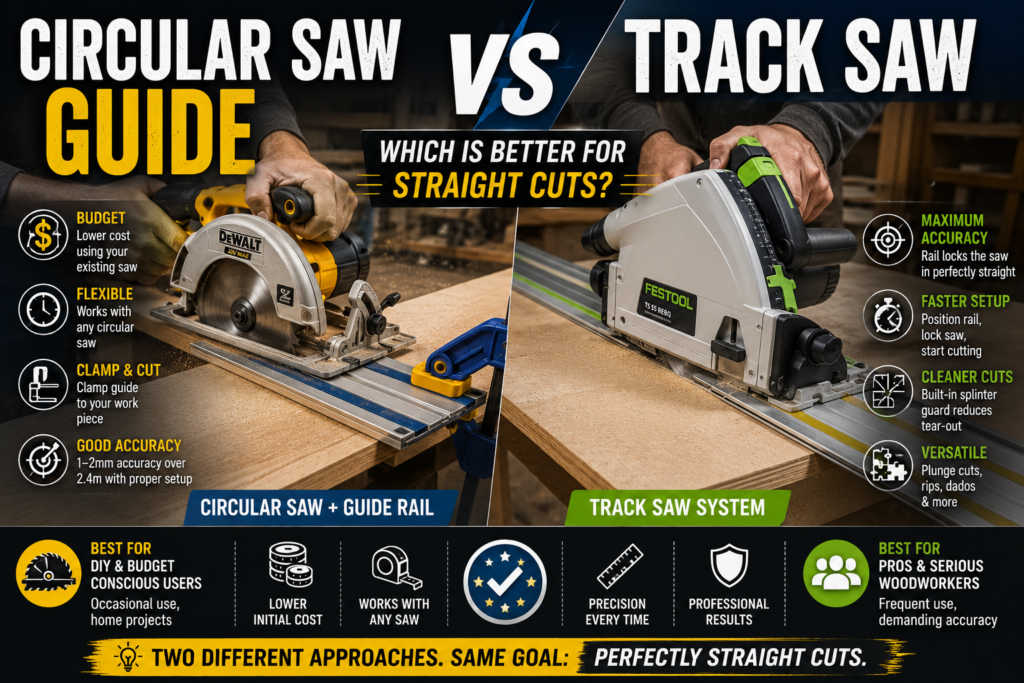
A circular saw guide rail (also called a straight edge guide or saw guide) is a straight, rigid bar that you clamp to your workpiece. The base plate of your circular saw runs along the edge of the guide, keeping the blade parallel to the guide for the entire cut length. The guide can be a purpose-made aluminium extrusion, a length of straight timber, or a manufactured guide system from brands like Kreg, Makita, or DeWalt.
How to Set It Up
Setting up a guide rail requires knowing your saw’s offset — the distance from the edge of the base plate to the blade. You position the guide at that offset distance from your intended cut line, clamp it firmly at both ends, and run the saw along it. The process takes 2 to 5 minutes per cut for an inexperienced user and under a minute once you know your saw’s offset by heart.
For a detailed step-by-step guide to this process including an interactive offset calculator, read our How to Cut Perfectly Straight with a Circular Saw guide.
Accuracy
With a properly clamped straight edge guide, a circular saw can achieve accuracy of 1 to 2mm over a 2.4 metre cut — adequate for most joinery and furniture work. The limiting factors are guide straightness (a bent or bowed guide produces a curved cut) and how firmly the guide is clamped (a shifting guide ruins the cut).
Cost
A basic aluminium straight edge guide costs $20 to $60. A premium manufactured guide system with stops and measuring scales costs $60 to $150. Your existing circular saw does all the cutting — there is no additional tool cost.
Limitations
- Setup time for each cut is significant — clamp, measure, recheck, unclamp after
- For multiple parallel cuts you must reposition and re-clamp each time
- Accuracy depends heavily on guide straightness and clamping quality
- Tear-out on the cut face can be significant without an anti-splinter strip
- The saw can tip slightly off the guide if base plate pressure is uneven
Option 2 — Track Saw
What It Is
A track saw (also called a plunge-cut saw or guide rail saw) is a circular saw specifically designed to run in a dedicated aluminium guide rail. The base plate has a groove that locks precisely onto the rail, preventing any sideways movement whatsoever. The rail itself typically has rubber anti-slip strips on the underside that grip the workpiece firmly without clamping in many cases.
Track saw systems are available from Festool, Makita, DeWalt, Bosch, and Kreg among others. The saw and rail are proprietary — a Festool saw only runs on Festool rails, a Makita saw only on Makita rails. Most systems allow rails to be joined end-to-end for cuts longer than a single rail length.
How It Works
Unlike a circular saw with a guide rail where the base plate runs alongside the guide, a track saw’s base plate locks into the rail from above. The rail sits directly on the cut line — an anti-splinter strip on the edge of the rail marks exactly where the blade will cut. You position the rail on your cut line, the rubber grips hold it in place (or you use one clamp for long cuts), and the saw locks into the rail and cannot deviate.
Accuracy
Track saws are significantly more accurate than circular saws with guide rails. The locked groove connection between saw and rail eliminates the possibility of the base plate drifting away from the guide. According to independent testing by Fine Woodworking, premium track saw systems consistently achieve accuracy within 0.5mm over 2.4 metre cuts — matching table saw accuracy for most practical applications.
Cost
Track saw systems are a significant investment. Entry-level systems (Kreg, basic Makita) start at around $300 to $400 for saw and rail. Premium systems (Festool, Mafell) cost $600 to $1,200 or more. The rail itself is an additional purchase — a 1.4 metre rail typically costs $80 to $200 depending on brand.
Advantages Over Guided Circular Saw
- Faster setup — position rail on cut line, one clamp or none, cut
- Higher accuracy — locked groove eliminates base plate drift entirely
- Anti-splinter strip produces cleaner cut edges, especially in plywood
- Plunge cut capability — start a cut mid-panel without an entry notch
- Rails join together for cuts longer than rail length
- Consistent repeatable performance across many cuts
Limitations
- High upfront cost — saw and rail together cost significantly more than a guide rail accessory
- Proprietary system — rails only work with compatible saws from the same brand
- Saw is dedicated to track use — less versatile than a standard circular saw for rough work
- Additional rails needed for very long cuts — an added cost
Direct Comparison Table
| Factor | Circular saw + guide rail | Track saw system |
|---|---|---|
| Accuracy | 1–2mm over 2.4m | 0.3–0.5mm over 2.4m |
| Setup time per cut | 2–5 minutes | 30–60 seconds |
| Entry cost | $20–$150 (guide only) | $300–$1,200 (saw + rail) |
| Tear-out on plywood | Moderate without scoring | Minimal — anti-splinter strip |
| Plunge cut capability | ❌ No | ✅ Yes |
| Works with existing saw | ✅ Yes | ❌ New saw required |
| Rail flexibility | Any straight edge works | Brand-specific rails only |
| Best for | Occasional cuts, budget buyers | Regular sheet cutting, professional use |
Who Should Use a Circular Saw with a Guide Rail
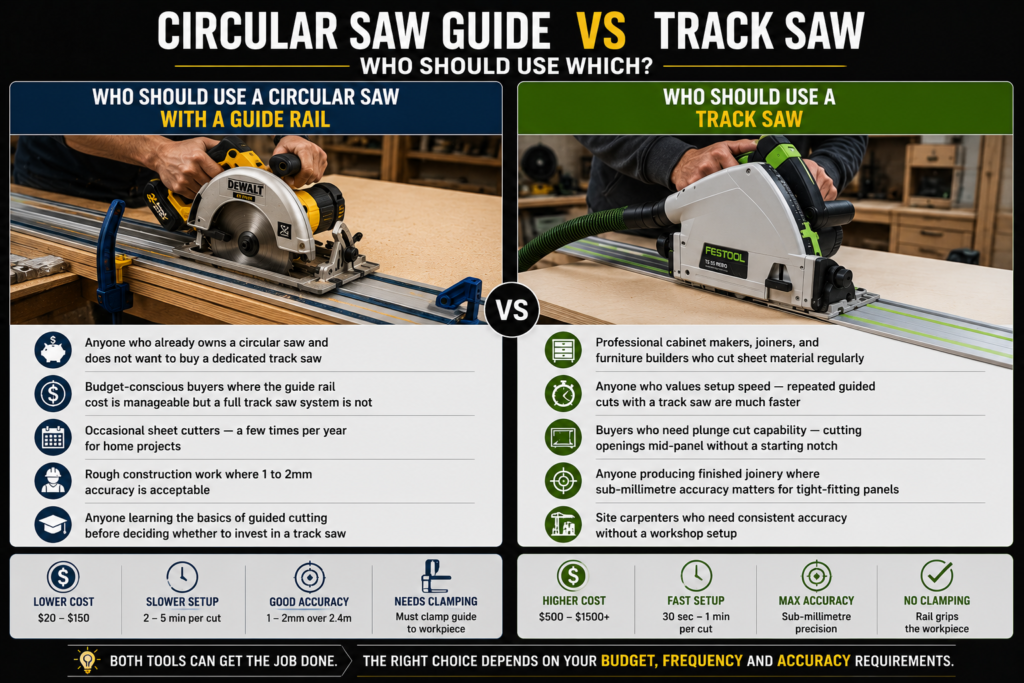
- Anyone who already owns a circular saw and does not want to buy a dedicated track saw
- Budget-conscious buyers where the guide rail cost is manageable but a full track saw system is not
- Occasional sheet cutters — a few times per year for home projects
- Rough construction work where 1 to 2mm accuracy is acceptable
- Anyone learning the basics of guided cutting before deciding whether to invest in a track saw
Who Should Use a Track Saw
- Professional cabinet makers, joiners, and furniture builders who cut sheet material regularly
- Anyone who values setup speed — repeated guided cuts with a track saw are much faster than clamping and repositioning a guide rail
- Buyers who need plunge cut capability — cutting openings mid-panel without a starting notch
- Anyone producing finished joinery where sub-millimetre accuracy matters for tight-fitting panels
- Site carpenters who need consistent accuracy without a workshop setup
The Kreg Rip-Cut — A Middle Ground Option
Worth mentioning separately: the Kreg Rip-Cut is a purpose-made ripping guide that attaches to your existing circular saw’s base plate and rides along the edge of the workpiece to produce parallel rip cuts at a consistent width. It costs around $40 and handles ripping tasks — cutting boards to a consistent width — very well without a full guide rail. For cross-cutting (cuts across the width of a panel) it is less useful since it requires a straight board edge to reference against.
The Kreg Accu-Cut guide rail system is a step up — a full-length aluminium rail with clamps that works with any circular saw and costs around $70 to $100. It is a practical middle ground between a basic clamped straight edge and a full track saw system.
🪚 Which System Is Right for You? — Interactive Selector
Answer three questions about your work and budget to get a personalised recommendation.
Frequently Asked Questions
Can I use any circular saw with a track saw rail?
No. Track saw rails are proprietary systems — a Festool rail only works with Festool track saws, a Makita rail with Makita track saws. The groove in the saw base plate and the profile of the rail are matched specifically to each brand's system. Some third-party adapters claim cross-compatibility but these are generally not reliable for accurate work. If you are buying a track saw system, commit to one brand's ecosystem.
Is a track saw more accurate than a table saw?
For breaking down large sheet materials, a premium track saw system is comparable in accuracy to a table saw and often more practical because the saw comes to the work rather than the work going to the saw. Full 2.4 metre sheets of plywood are awkward and potentially dangerous to handle on a table saw alone. For repeat precise cuts of smaller pieces a table saw with a quality fence is typically more consistent and faster.
What is the best affordable track saw system?
The Makita SP6000J1 track saw with Makita guide rail is the most consistently recommended value option — around $350 to $400 for saw and rail. It delivers accuracy close to Festool at roughly half the price. The Kreg Accu-Cut system paired with a quality circular saw is a good budget alternative at around $70 to $100 for the guide rail used with your existing saw.
Do I need a track saw if I already have a table saw?
For most workshop users with a table saw, a track saw is not essential but is very useful for breaking down full sheets before they go to the table saw. Feeding a full 2.4 × 1.2 metre sheet of plywood into a table saw solo is physically difficult and potentially unsafe. Breaking it down first with a track saw into manageable panels, then refining those panels on the table saw, is a much more practical and safer workflow.
What is the offset on a circular saw and why does it matter for guide rails?
The offset is the distance from the left edge of your saw's base plate to the blade. When positioning a guide rail for a circular saw, you place the guide at the offset distance from your intended cut line — so the blade cuts exactly on the line while the base plate runs against the guide. Each saw model has a different offset, which is why you must measure your specific saw before setting up a guide. Our Circular Saw Straight Cutting guide includes an interactive calculator to find and use your offset correctly.