Most cordless tool batteries die long before they should. Not because of heavy use — but because of poor storage. Leaving a battery fully charged for months, storing it in a hot garage, or letting it drain completely before putting it away are all habits that quietly destroy lithium-ion cells from the inside out.
The good news is that proper battery storage is simple once you know what to do. This guide covers everything — the science behind why storage conditions matter, exact temperature and charge level recommendations, long term storage protocols, and a quick interactive battery health checker to assess the current condition of your batteries.
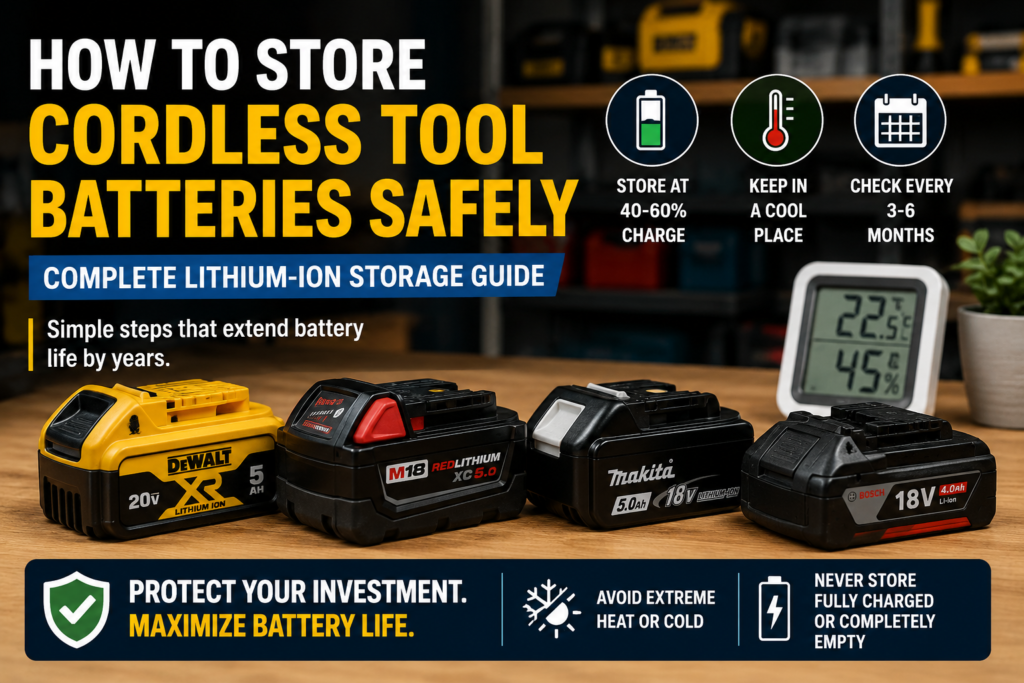
Let’s begin with the following tool:
🔋 Battery Storage Health Checker
Answer the questions below to get a personalised assessment of your current battery storage habits and specific recommendations to improve them.
Why Storage Conditions Matter So Much
Lithium-ion batteries degrade through two main processes — cycling (charging and discharging) and calendar aging. Calendar aging happens even when a battery is sitting unused. Temperature and state of charge during storage are the two biggest factors that control how fast calendar aging occurs.
According to Battery University, a lithium-ion battery stored at 40 percent charge and 25°C loses approximately 4 percent capacity per year. The same battery stored fully charged at 40°C loses up to 35 percent capacity in a single year. That is the difference between a battery lasting 8 years and one lasting less than 3 — purely from storage conditions.
The Three Golden Rules of Lithium-Ion Battery Storage
Rule 1 — Store at 40 to 60 Percent Charge
This is the most important rule. A fully charged lithium-ion battery is under chemical stress. The high voltage state accelerates degradation of the cathode material over time. A fully discharged battery is equally damaging — if left completely flat for extended periods, individual cells can drop below their minimum voltage threshold and become permanently damaged or impossible to recharge.
The sweet spot is 40 to 60 percent charge — roughly half full. At this state the battery voltage is in the middle of its range, minimising stress on the chemistry in both directions. Most major tool manufacturers including DeWalt and Makita explicitly recommend storing batteries at partial charge for this reason.
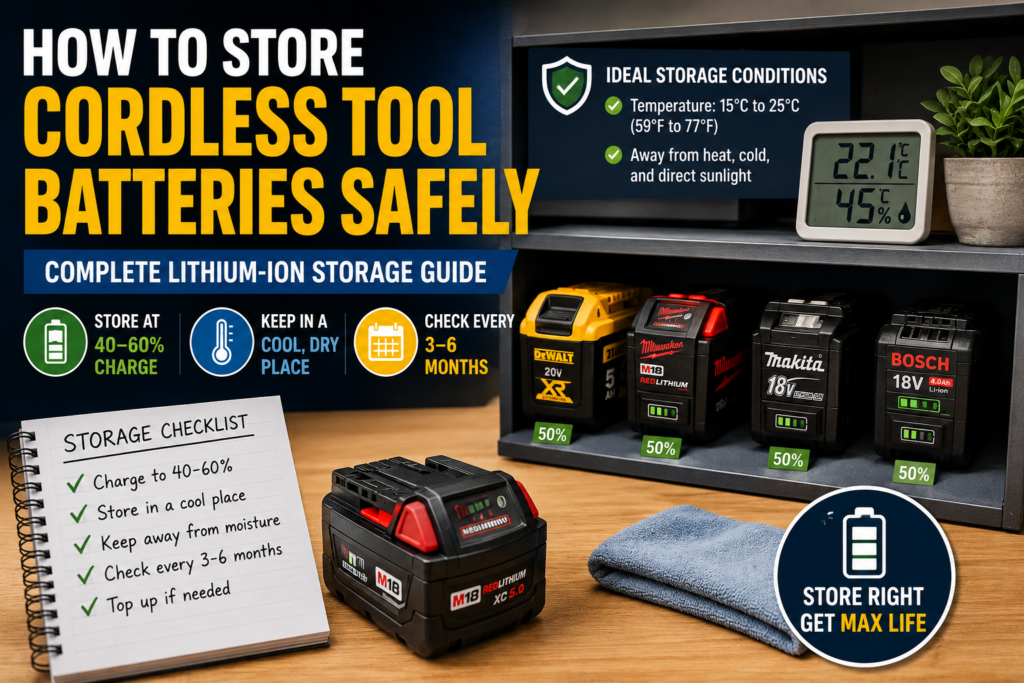
Rule 2 — Store at 15°C to 25°C (59°F to 77°F)
Temperature is the second most critical factor. Heat accelerates every chemical reaction inside a lithium-ion cell — including the unwanted ones that degrade capacity. Cold slows these reactions down, which is why some manufacturers recommend refrigerator storage for very long term storage (though this requires moisture protection and is rarely practical for tool batteries).
For practical purposes, store batteries in a cool indoor location — a climate-controlled room, a cool basement, or an insulated cabinet. Avoid:
- Hot garages in summer (temperatures can exceed 50°C / 122°F)
- Car boots or vehicle storage in warm weather
- Locations near boilers, water heaters, or heat sources
- Direct sunlight exposure
Rule 3 — Check and Top Up Every 3 to 6 Months
Even at partial charge, lithium-ion batteries slowly self-discharge over time. A battery left in storage for 12 months without attention may have discharged below its safe minimum voltage, causing permanent cell damage. Check stored batteries every 3 to 6 months and top up to 40 to 60 percent if the charge has dropped significantly.
Storage Conditions and Their Impact on Battery Life
| Storage condition | Annual capacity loss | Expected lifespan impact |
|---|---|---|
| 40% charge, 25°C — ideal | ~4% | Excellent — maximum lifespan |
| 100% charge, 25°C | ~20% | Noticeably shortened |
| 40% charge, 40°C (hot garage) | ~15% | Significantly shortened |
| 100% charge, 40°C — worst case | ~35% | Severely shortened — avoid |
| 0% charge, any temperature | Permanent damage risk | Cell damage — may not recover |
Short Term vs Long Term Storage
Short Term Storage (Days to Weeks)
If you are between projects and will be using the batteries again within a few weeks, minimal special preparation is needed. Simply leave the battery at whatever charge it has (as long as it is not fully flat), store it indoors away from heat and direct sunlight, and it will be fine. The degradation from short term storage at any reasonable charge level is negligible.
Medium Term Storage (1 to 3 Months)
For batteries that will sit unused for a month or two — for example, seasonal outdoor tools in winter — take these steps:
- Discharge or charge to approximately 50 percent (two out of four LED indicators on most batteries)
- Store indoors in a cool, dry location
- Check charge level once during the storage period and top up if significantly depleted
Long Term Storage (3 Months or More)
For extended storage — tools that will not be used for an entire season or longer — follow this protocol:
- Charge battery to exactly 50 percent
- Clean the battery contacts with a dry cloth
- Store in original packaging or a plastic case to protect contacts
- Place in a cool, dry indoor location — ideally between 15°C and 20°C
- Check and top up to 50 percent every 3 months without fail
- Never store for more than 6 months without a maintenance charge
Brand-Specific Storage Recommendations
| Brand | Recommended charge for storage | Temperature range | Check interval |
|---|---|---|---|
| DeWalt | 50% (2 of 4 LEDs) | 4°C to 40°C | Every 6 months |
| Makita | 40–60% | 0°C to 40°C | Every 6 months |
| Milwaukee | 30–50% | 10°C to 30°C | Every 3 months |
| Ryobi | 40–60% | 0°C to 45°C | Every 6 months |
Common Battery Storage Mistakes
❌ Storing on the Charger Indefinitely
Many people leave batteries on the charger between uses thinking this keeps them ready. Modern smart chargers do prevent active overcharging through trickle charge circuits — but leaving a battery at 100 percent charge continuously still causes faster degradation than storing at 50 percent. Remove batteries from chargers once full.
❌ Storing in a Hot Garage or Vehicle
A garage in summer can easily reach 50°C to 60°C on hot days. At these temperatures lithium-ion degradation accelerates dramatically. A battery stored in a hot vehicle boot for a summer season can lose 20 to 30 percent of its capacity permanently. Always bring batteries indoors during hot weather storage.
❌ Running Completely Flat Before Storage
Storing a battery at zero charge is one of the most damaging things you can do to it. If a lithium-ion cell drops below approximately 2.5V per cell it can suffer permanent chemical damage that prevents it from accepting a charge again. Always store with at least 30 to 40 percent charge remaining.
❌ Ignoring Physical Damage
A cracked housing, swollen casing, or damaged contacts is not just a storage problem — it is a safety issue. According to UL safety guidelines, damaged lithium-ion batteries should never be stored or used. A swollen battery in particular indicates internal gas buildup and should be removed from service immediately and taken to a proper recycling facility.
❌ Mixing New and Old Batteries on the Same Charger
While most chargers handle this safely, repeatedly charging significantly degraded batteries alongside newer ones can stress charger electronics over time. Keep track of battery age and replace significantly degraded batteries rather than continuing to cycle them.
Safe Battery Storage Checklist
| Storage factor | Do this | Avoid this |
|---|---|---|
| Charge level | 40–60% (half full) | 100% or 0% |
| Temperature | 15–25°C (cool indoor room) | Hot garage, car, direct sunlight |
| Humidity | Dry location | Damp basements, outdoor sheds |
| Protection | Original case or plastic container | Loose with metal tools or objects |
| Check interval | Every 3–6 months | Leaving unchecked for over 6 months |
| Damaged batteries | Dispose at recycling facility | Continue storing or using |
How to Tell if a Battery Has Been Damaged by Poor Storage
Signs that poor storage conditions have already damaged a battery:
- Significant capacity loss — runtime is noticeably shorter than when the battery was new
- Slow charging — takes much longer to reach full charge than it used to
- Rapid self-discharge — a fully charged battery loses charge within days of sitting unused
- Excessive heat during use — battery gets noticeably hot during normal operation
- Visible swelling — any bulging or deformation of the battery casing is a safety issue requiring immediate disposal
- Refusal to charge — battery does not respond to the charger or charger light flashes an error
For more detail on battery lifespan and runtime, read our How Long Does a Cordless Drill Battery Last guide and our DeWalt 5Ah vs 2Ah Battery Comparison.
Disposing of Old Batteries Safely
Lithium-ion batteries should never be thrown in household rubbish. They are classified as hazardous waste and must be disposed of at a proper recycling facility. Most major hardware stores — including Home Depot, Lowes, and Bunnings — accept old tool batteries for recycling at no charge. Many tool manufacturers also run their own take-back programmes.
The Call2Recycle programme maintains a searchable directory of battery drop-off locations across North America. Enter your postcode to find the nearest facility. Proper disposal prevents the toxic materials in lithium-ion cells from entering landfill and reduces fire risk from damaged batteries in household waste.
Frequently Asked Questions
Can I store lithium-ion batteries in a refrigerator?
Technically yes — cool temperatures slow calendar aging and some manufacturers mention refrigerator storage for very long term periods. However for most tool users this is impractical and introduces moisture risk when the cold battery warms up to room temperature. A cool indoor room at 15–25°C is sufficient and far more practical. If you do use refrigerator storage, seal the battery in a moisture-proof bag and allow it to reach room temperature completely before charging or using.
Is it safe to store batteries near flammable materials?
No. Lithium-ion batteries carry a small but real fire risk if damaged, short-circuited, or improperly stored. Never store batteries near flammable liquids, paper, or other combustible materials. Store in a non-flammable container where possible — a metal box or a purpose-built battery storage bag provides an additional layer of protection against fire spread if a battery does fail.
How do I know what charge level my battery is at?
Most tool batteries have a built-in LED charge indicator — press the button on the battery and count the LEDs. One LED of four typically indicates approximately 25 percent, two LEDs approximately 50 percent, three LEDs approximately 75 percent, and four LEDs approximately 100 percent. For storage you want two LEDs showing — approximately 50 percent charge.
Can extreme cold permanently damage a battery?
Cold slows lithium-ion chemistry but does not permanently damage it in the same way heat does. A battery stored in freezing temperatures will show reduced capacity when cold but typically recovers its full capacity once warmed to room temperature. The risk with cold storage is condensation when the battery warms up — moisture on or inside contacts can cause corrosion. Always allow a cold battery to reach room temperature naturally before charging or using.
Should I remove batteries from tools when storing them?
Yes, always for any storage longer than a few days. Leaving a battery inserted in a tool allows small standby currents to slowly drain it. Over weeks or months this can bring the battery below its safe minimum voltage. Remove batteries from all tools before storage, check charge level, adjust to 40–60 percent if needed, and store separately in a cool dry location.
How long can I store a lithium-ion battery before it goes bad?
With proper storage conditions — 40–60 percent charge, cool temperature, checked every 3–6 months — a quality lithium-ion battery can be stored for 2 to 3 years with minimal capacity loss. Without proper conditions — left fully charged in a hot garage with no attention — the same battery may be significantly degraded within 12 months. Storage conditions make a far bigger difference than most users realise.
Are some brands' batteries better for long term storage?
Premium brands like DeWalt, Makita, and Milwaukee build more sophisticated battery management electronics into their batteries that help regulate storage conditions and prevent deep discharge. Budget and third-party batteries often lack these protection circuits, making them more vulnerable to degradation during storage. For long term storage quality branded batteries hold up significantly better than budget alternatives. For guidance on choosing between battery sizes read our 20V vs 18V Battery guide and our Ryobi 18V Battery Guide.