One of the most common frustrations in any workshop is figuring out exactly which drill bit size you need. The packaging on a box of screws might say “use a 1/8 inch pilot bit.” Your drill bit set is labelled in millimeters. A friend tells you to use a “number 7 bit” for a 1/4-20 tap. None of these numbers obviously relate to each other unless you have a conversion reference in front of you, thus requiring drill bit size chart explained.
This guide brings together every common drill bit sizing system used today — fractional inch, metric, wire gauge numbers, and letter sizes — along with the pilot hole sizes you need for common wood screws and machine screw taps. There is also an interactive size lookup tool below so you can convert between systems instantly to help you understand Drill Bit Size Chart.
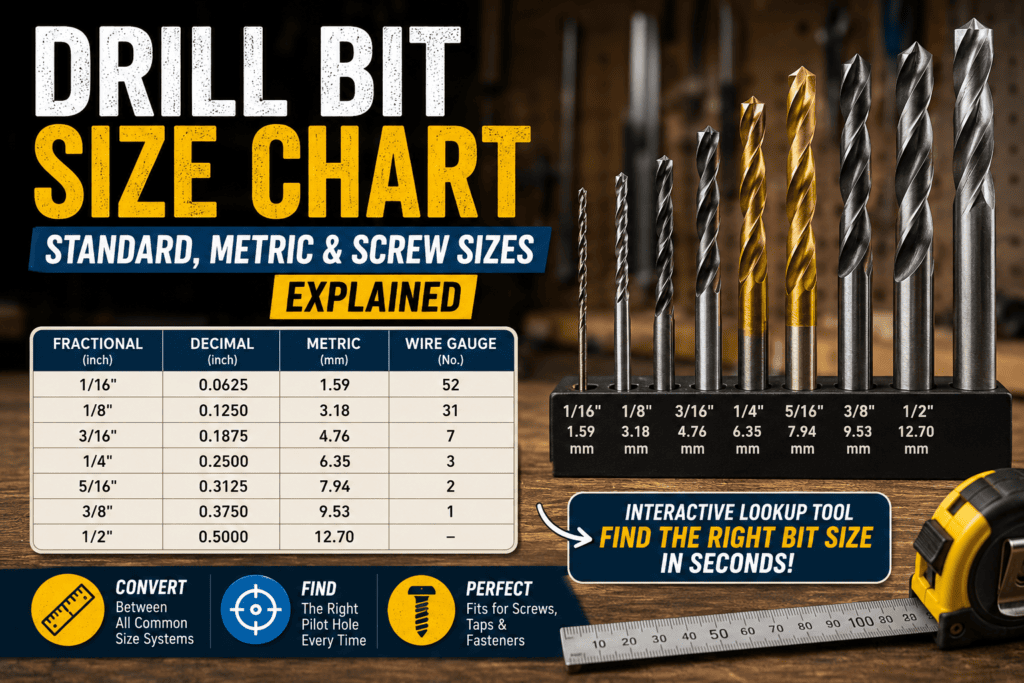
Why Drill Bits Use Different Sizing Systems
Drill bit sizing did not develop as one unified system — it evolved from several separate industrial traditions that are all still in everyday use:
- Fractional inch sizes — the traditional US system, used for most general-purpose woodworking and metalworking bits (1/16″, 1/8″, 1/4″, etc.)
- Metric sizes — used worldwide outside the US, and increasingly common even in US tool sets (1mm, 2mm, 3mm, etc.)
- Wire gauge numbers — a numbered system (No. 1 through No. 80) originally developed for sizing wire, later adopted for small drill bits used in tap pilot holes and sheet metal work
- Letter sizes — a system using letters A through Z for bit sizes that fall between the largest wire gauge sizes and the smallest fractional sizes
The practical result is that a single physical bit diameter might be referred to by up to four different names depending on which set you bought it from or which country’s standard the manual was written for. This is precisely why a conversion reference is essential rather than optional, via Drill Bit Size Chart.
Common Confusion Points
Wire Gauge Numbers Go Backwards
This catches almost everyone the first time. Wire gauge bit numbers run in reverse — a larger number means a smaller bit. A No. 80 bit is the smallest drill bit in the system (0.0135 inch) while a No. 1 bit is one of the largest (0.228 inch). This is the opposite of how most people intuitively expect a numbered system to work.
Letter Sizes Continue Where Numbers Stop
Once wire gauge numbers reach their largest practical size (No. 1 at 0.228″), the letter system takes over and continues upward. Letter “A” (0.234″) is slightly larger than No. 1, and the letters continue up to “Z” (0.413″), at which point fractional inch sizing resumes for larger bits.
Metric and Imperial Sizes Rarely Match Exactly
A 6mm bit is not exactly the same as a 1/4 inch bit — 1/4 inch equals 6.35mm, so a 6mm bit is very slightly smaller. For most woodworking this tiny difference does not matter, but for precision metalworking, tapping threads, or dowel joinery it absolutely can.
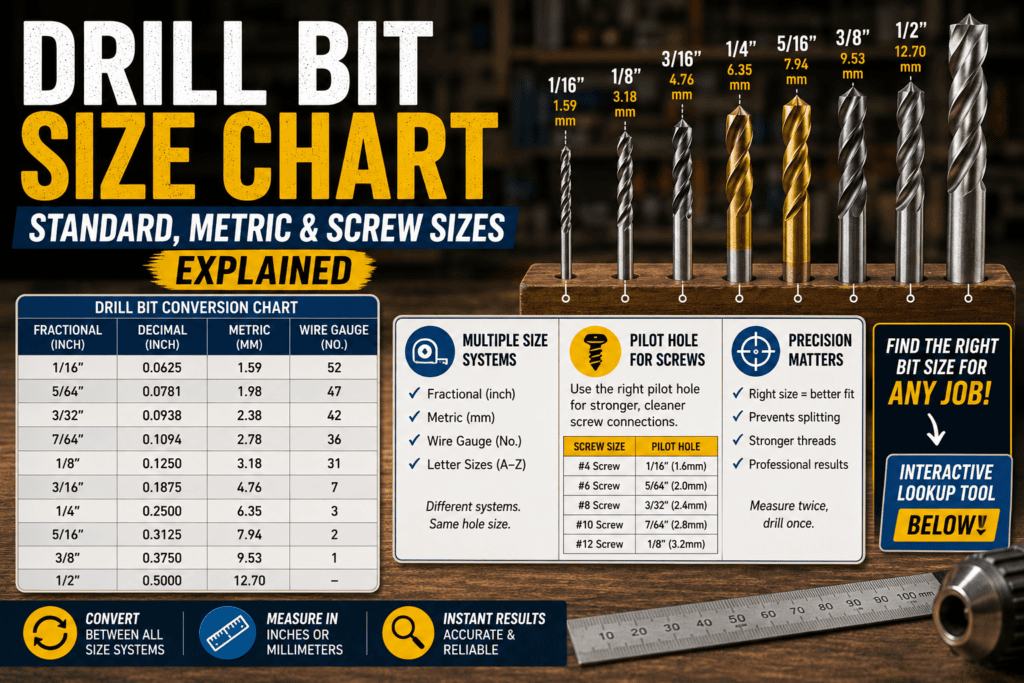
Drill Bit Size Conversion Chart — Fractional, Decimal, and Metric
Refer to the folloing table for Drill Bit Size Chart:
| Fractional (inch) | Decimal (inch) | Metric (mm) | Closest wire gauge |
|---|---|---|---|
| 1/16″ | 0.0625″ | 1.59mm | No. 52 |
| 5/64″ | 0.0781″ | 1.98mm | No. 47 |
| 3/32″ | 0.0938″ | 2.38mm | No. 42 |
| 7/64″ | 0.1094″ | 2.78mm | No. 36 |
| 1/8″ | 0.1250″ | 3.18mm | No. 30 |
| 9/64″ | 0.1406″ | 3.57mm | No. 27 |
| 5/32″ | 0.1563″ | 3.97mm | No. 21 |
| 11/64″ | 0.1719″ | 4.37mm | No. 16 |
| 3/16″ | 0.1875″ | 4.76mm | No. 13 |
| 13/64″ | 0.2031″ | 5.16mm | No. 6 |
| 7/32″ | 0.2188″ | 5.56mm | No. 2 |
| 15/64″ | 0.2344″ | 5.95mm | Letter A |
| 1/4″ | 0.2500″ | 6.35mm | Letter D |
| 5/16″ | 0.3125″ | 7.94mm | Letter O |
| 3/8″ | 0.3750″ | 9.53mm | Letter V |
| 7/16″ | 0.4375″ | 11.11mm | — |
| 1/2″ | 0.5000″ | 12.70mm | — |
Common Metric Drill Bit Sizes and Their Inch Equivalents
| Metric (mm) | Decimal inch equivalent | Closest fractional inch |
|---|---|---|
| 1mm | 0.0394″ | 1/32″ (slightly smaller) |
| 2mm | 0.0787″ | 5/64″ (slightly smaller) |
| 3mm | 0.1181″ | 7/64″ (slightly smaller) |
| 4mm | 0.1575″ | 5/32″ (slightly smaller) |
| 5mm | 0.1969″ | 13/64″ (slightly larger) |
| 6mm | 0.2362″ | 15/64″ (slightly smaller) |
| 8mm | 0.3150″ | 5/16″ (slightly smaller) |
| 10mm | 0.3937″ | 25/64″ (very close) |
| 12mm | 0.4724″ | 15/32″ (slightly smaller) |
| 13mm | 0.5118″ | 1/2″ (slightly larger) |
Pilot Hole Sizes for Common Wood Screws
Choosing the correct pilot hole size for wood screws prevents splitting in hardwood and ensures the screw grips properly without stripping. As a general rule, pilot holes should be slightly smaller than the screw’s shank diameter for softwood, and closer to the shank size for hardwood where splitting risk is higher.
| Screw size | Pilot bit for softwood | Pilot bit for hardwood |
|---|---|---|
| No. 4 | 1/16″ | 5/64″ |
| No. 6 | 5/64″ | 7/64″ |
| No. 8 | 3/32″ | 1/8″ |
| No. 10 | 7/64″ | 1/8″ |
| No. 12 | 1/8″ | 9/64″ |
| 1/4″ lag screw | 3/16″ | 7/32″ |
Tap Drill Sizes for Common Machine Screw Threads
When threading a hole with a tap, the pilot hole (tap drill size) must leave the correct amount of material for the tap to cut clean threads. Using the wrong tap drill size either breaks the tap (hole too small) or produces weak, shallow threads (hole too large).
| Thread size | Tap drill size | Decimal equivalent |
|---|---|---|
| No. 4-40 | No. 43 | 0.0890″ |
| No. 6-32 | No. 36 | 0.1065″ |
| No. 8-32 | No. 29 | 0.1360″ |
| No. 10-24 | No. 25 | 0.1495″ |
| 1/4-20 | No. 7 | 0.2010″ |
| 5/16-18 | Letter F | 0.2570″ |
| 3/8-16 | Letter 5/16″ | 0.3125″ |
🔧 Drill Bit Size Converter
Enter a size in any system below and instantly see its equivalent in all other systems, eliminating the need of Drill Bit Size Chart.
How to Read a Drill Bit Index
Most quality drill bit sets come in an organised index case with each bit slotted into a numbered or labelled position. If you have lost track of which bit is which:
- Use a digital caliper — measure the shank diameter directly for the most accurate reading
- Compare against a drill gauge — a flat metal plate with graduated holes that you slot the bit shank into until it fits snugly
- Check for printed markings — many quality bits have the size stamped or printed on the shank, though this wears off over time with use.
For guidance on which bit type to choose once you know the size you need, read our Drill Bit Types guide. If your bits keep breaking despite using the correct size, read our Drill Bit Breaking troubleshooting guide. Combining these with drill bit size chart will ease your work.
Still confused about drill bit size chart? Refer to following frequently asked questions.
Frequently Asked Questions
What size drill bit do I need for a 1/4 inch bolt?
For a clearance hole that allows a 1/4 inch bolt to pass through freely, use a 17/64″ or 9/32″ bit, which gives a small amount of clearance. For a tight fit a 1/4″ bit can work but may require some force. For threading a 1/4-20 tapped hole, use a No. 7 bit (0.201″) as the tap drill size. Further, you can refer to our Drill Bit Size Chart.
Is a 6mm drill bit the same as a 1/4 inch bit?
Not exactly. A 1/4 inch bit measures 6.35mm, while a 6mm bit is slightly smaller at 0.2362 inches. The difference is small (about 0.35mm) and rarely matters for general wood drilling, but it can matter for precision metalwork, dowel joints, or any application requiring an exact fit.
Why do wire gauge drill bit numbers go in reverse?
The wire gauge numbering system was originally developed for sizing wire, not drill bits, and was later adopted by the drill bit industry. In wire gauge systems, a higher number traditionally indicates a thinner wire — and that convention carried over directly into drill bit sizing, which is why No. 80 is the smallest bit and No. 1 is among the largest in that numbered range.
What pilot hole size should I use for a deck screw?
For a standard No. 8 to No. 10 deck screw in softwood decking like pressure-treated pine, a 3/32″ to 7/64″ pilot hole is typical. For hardwood decking like ipe or cumaru, increase to 1/8″ to 9/64″ to prevent splitting, since hardwood decking is significantly more prone to cracking than softwood without an adequately sized pilot hole.
How accurate do I need to be when converting between metric and imperial drill sizes?
For general woodworking and home DIY, rounding to the nearest readily available size is perfectly fine — the small differences between systems (typically under 0.5mm) rarely affect function. For precision applications like machining, threading, or dowel joinery where exact fit matters, use the precise decimal conversion and select the bit that most closely matches your actual requirement rather than rounding. You can use our drill bit size chart as well.
What is the smallest and largest standard drill bit size?
On the wire gauge system, the smallest standard bit is No. 80 at 0.0135 inches (0.343mm) — extremely fine, used mainly in jewellery and electronics work. On the large end, standard twist bit sets commonly go up to 1/2 inch (12.7mm) or 13mm, though larger specialty bits, spade bits, and hole saws extend well beyond that for bigger holes. Refer to our Drill Bit Size Chart for further clarification.