An impact driver is one of the most useful tools you can own. Whether you are building a deck, assembling furniture, installing cabinets, or working on a construction site, a good impact driver makes screw driving faster, easier, and far less tiring than a standard drill.
But with dozens of models available across every price range, choosing the right one is not straightforward. This guide cuts through the noise and ranks the best impact drivers of 2026 based on torque, runtime, size, weight, and real-world usability — not just spec sheet numbers.
Not sure whether you need an impact driver or a regular drill? Read our Impact Driver vs Drill guide first to make sure you are buying the right tool for your needs.
What to Look for in an Impact Driver
Before jumping into the rankings, here is what actually matters when choosing an impact driver:
- Torque (in-lbs): Higher torque means more driving force. Most quality impact drivers sit between 1,500 and 2,000 in-lbs. More is not always better — too much torque can strip screws in softwood.
- IPM (Impacts Per Minute): How many times per minute the hammering mechanism fires. Higher IPM generally means faster driving.
- Speed settings: Multiple speed modes let you match the tool to the task — slower for precision, faster for bulk driving.
- Weight and size: A compact, lightweight driver reduces fatigue significantly over a long workday.
- Battery platform: Sticking to one brand’s battery ecosystem saves money on batteries long term.
- Motor type: Brushless motors offer better runtime and longer lifespan. Read our Brushless vs Brushed Motor guide for a full breakdown.
According to Popular Mechanics, the most important factors for most users are torque, weight, and battery compatibility — not maximum speed or the number of features.
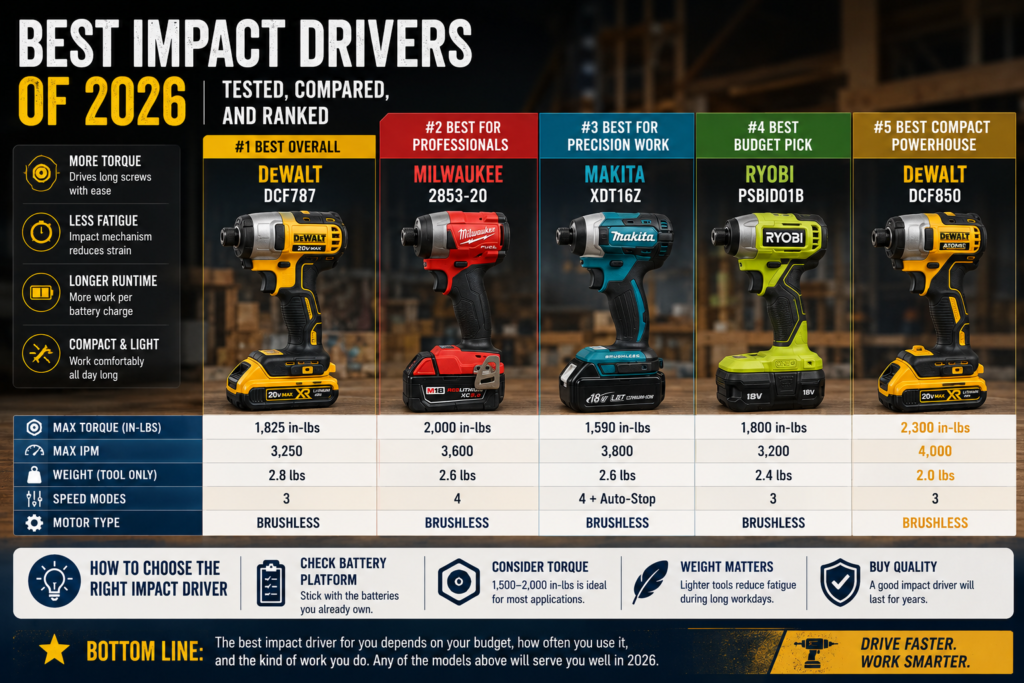
Best Impact Drivers of 2026 — Quick Comparison
| Model | Torque | Max IPM | Weight | Motor | Best For |
|---|---|---|---|---|---|
| DeWalt DCF787 | 1,825 in-lbs | 3,250 | 2.8 lbs | Brushless | Best overall |
| Milwaukee 2853-20 | 2,000 in-lbs | 3,600 | 2.6 lbs | Brushless | Best for professionals |
| Makita XDT16Z | 1,590 in-lbs | 3,800 | 2.6 lbs | Brushless | Best for precision work |
| Ryobi PSBID01B | 1,800 in-lbs | 3,200 | 2.4 lbs | Brushless | Best budget pick |
| DeWalt DCF850 | 2,300 in-lbs | 4,000 | 2.0 lbs | Brushless | Best compact powerhouse |
1. DeWalt DCF787 — Best Overall
The DeWalt DCF787 sits at the top of our list for 2026 because it hits the best balance of power, size, weight, and battery compatibility for the widest range of users.
| Specification | Value |
|---|---|
| Voltage | 20V MAX |
| Max torque | 1,825 in-lbs |
| Max IPM | 3,250 |
| Max RPM | 2,800 |
| Speed modes | 3 |
| Weight (tool only) | 2.8 lbs |
| Motor | Brushless |
| ✅ Pros * Excellent torque for the size * Three speed modes for versatility * Compact and lightweight * Works with all DeWalt 20V MAX batteries * Brushless motor for long runtime | ❌ Cons * Sold as tool only (battery separate) * Not the highest torque in class * Belt clip not included |
Who it is for: The DCF787 is the right choice for serious DIYers and light professionals who want a reliable, compact brushless impact driver that works seamlessly within the DeWalt 20V MAX ecosystem. If you already own DeWalt batteries this is an easy decision.
2. Milwaukee 2853-20 M18 FUEL — Best for Professionals
The Milwaukee 2853-20 is the tool professionals reach for when they need maximum performance all day long. It delivers the highest torque of any model on this list and pairs it with Milwaukee’s REDLINK PLUS intelligence system that protects both the tool and battery under heavy load.
| Specification | Value |
|---|---|
| Voltage | 18V M18 |
| Max torque | 2,000 in-lbs |
| Max IPM | 3,600 |
| Speed modes | 4 |
| Weight (tool only) | 2.6 lbs |
| Motor | Brushless (POWERSTATE) |
| ✅ Pros * Highest torque in its class * Four speed modes * REDLINK intelligence protects tool * Extremely durable build quality * Compatible with entire M18 lineup | ❌ Cons * Premium price * Tool only — batteries cost extra * M18 batteries expensive vs competitors |
Who it is for: Contractors and professionals who use their tools daily and need maximum torque, durability, and the backing of Milwaukee’s extensive M18 battery ecosystem.
3. Makita XDT16Z — Best for Precision Work
The Makita XDT16Z stands out for its Makita Auto-Stop mode, which automatically stops driving when a screw is fully seated. This near-eliminates stripped screws and makes it the most precise impact driver on this list — ideal for finish work, cabinetry, and any task where screw depth matters.
| Specification | Value |
|---|---|
| Voltage | 18V LXT |
| Max torque | 1,590 in-lbs |
| Max IPM | 3,800 |
| Speed modes | 4 + Auto-Stop |
| Weight (tool only) | 2.6 lbs |
| Motor | Brushless |
| ✅ Pros * Auto-Stop mode prevents over-driving * Highest IPM for fast driving * Four speed modes * Compact and well-balanced * Compatible with Makita 18V LXT batteries | ❌ Cons * Lower max torque than Milwaukee * Tool only * Auto-Stop takes adjustment to master |
Who it is for: DIYers and professionals doing finish carpentry, cabinet installation, or any work where driving screws to exactly the right depth matters. Also a great choice for anyone already invested in the Makita LXT battery platform.
4. Ryobi PSBID01B — Best Budget Pick
The Ryobi PSBID01B proves that you do not need to spend a premium to get a brushless impact driver with solid performance. It delivers 1,800 in-lbs of torque — competitive with the DeWalt DCF787 — at a fraction of the price, making it the best choice for homeowners and occasional users who do not need professional-grade durability.
| Specification | Value |
|---|---|
| Voltage | 18V ONE+ |
| Max torque | 1,800 in-lbs |
| Max IPM | 3,200 |
| Speed modes | 3 |
| Weight (tool only) | 2.4 lbs |
| Motor | Brushless |
| ✅ Pros * Best value brushless impact driver * Lightest model on this list * Compatible with 225+ Ryobi ONE+ tools * Good torque for the price * Widely available | ❌ Cons * Not built for heavy professional use * Ryobi batteries less efficient than premium brands * Fewer accessories available |
Who it is for: Homeowners and budget-conscious buyers who want a brushless impact driver without paying professional prices. The Ryobi ONE+ battery ecosystem is also a great entry point if you plan to add more tools over time.
5. DeWalt DCF850 — Best Compact Powerhouse
The DeWalt DCF850 ATOMIC is the most impressive compact impact driver on the market in 2026. It weighs just 2.0 lbs — lighter than anything else on this list — yet delivers 2,300 in-lbs of torque, the second highest here. If you work in tight spaces or overhead for long periods, nothing else comes close.
| Specification | Value |
|---|---|
| Voltage | 20V MAX ATOMIC |
| Max torque | 2,300 in-lbs |
| Max IPM | 4,000 |
| Speed modes | 3 |
| Weight (tool only) | 2.0 lbs |
| Motor | Brushless |
| ✅ Pros * Lightest model on this list at 2.0 lbs * Extremely high torque for the size * Highest IPM at 4,000 * Compatible with DeWalt 20V MAX batteries * Ideal for tight spaces and overhead work | ❌ Cons * Premium price * Tool only * Very high torque can strip screws in softwood |
Who it is for: Electricians, plumbers, HVAC technicians, and anyone who regularly works in confined spaces or overhead where weight and size matter more than anything else.
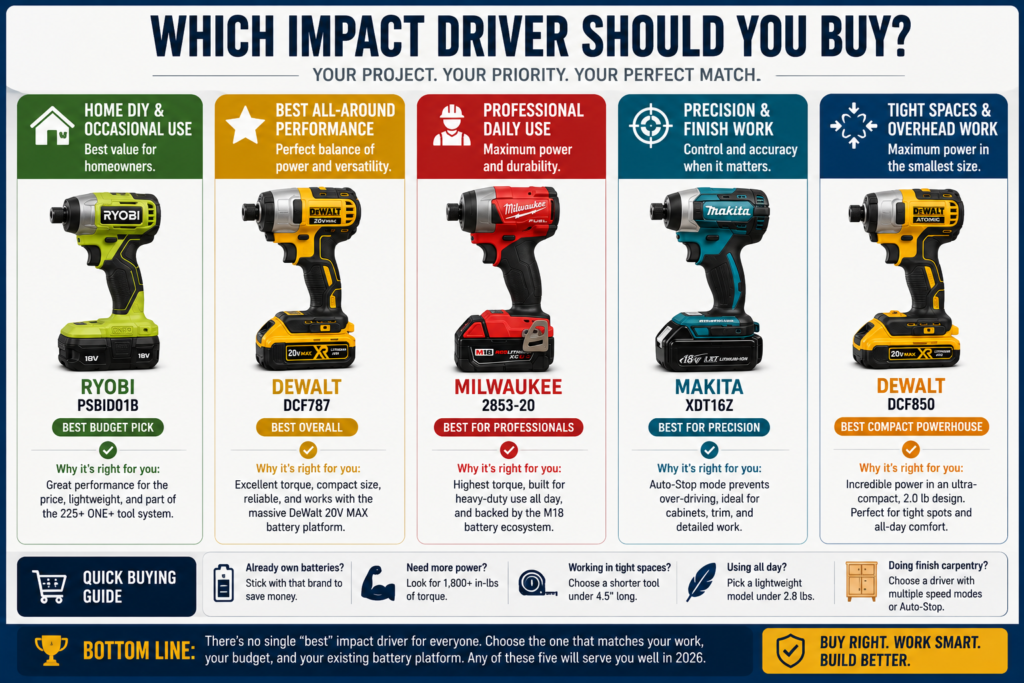
Which Impact Driver Should You Buy?
| Your situation | Best choice |
|---|---|
| Best all-round choice for most people | DeWalt DCF787 |
| Professional daily use, maximum torque | Milwaukee 2853-20 |
| Finish work and precision driving | Makita XDT16Z |
| Budget-conscious homeowner | Ryobi PSBID01B |
| Tight spaces, overhead work, compact size | DeWalt DCF850 ATOMIC |
If you already own DeWalt 20V MAX batteries from tools like the DeWalt 20V Max Drill or the DeWalt 20V Impact Driver, the DCF787 or DCF850 are natural additions to your toolkit without needing to invest in a new battery platform.
here comes a tool, which helps you to choose the best impcat drivers:
Impact Driver Finder Tool
Find the best impact driver for your needs
Frequently Asked Questions
What is a good torque rating for an impact driver?
For most DIY and home use, 1,500 to 1,800 in-lbs of torque is more than sufficient. For professional construction work involving lag bolts and structural screws, look for 1,800 to 2,300 in-lbs. More torque is not always better — very high torque on soft materials increases the risk of stripping screws.
Are all impact drivers compatible with any bit?
Impact drivers use a 1/4 inch hex collet, which accepts any standard 1/4 inch hex shank bit. However, not all bits are rated for impact use. Always use bits specifically labeled as impact-rated — they are made from tougher steel that can handle the hammering forces without snapping. Regular drill bits can break in an impact driver.
Can I use an impact driver for lag bolts?
Yes, and it excels at this task. Impact drivers handle lag bolts far better than standard drills because the hammering mechanism provides the sustained high torque needed to drive large fasteners into dense materials. Use a hex shank socket adapter to attach the appropriate socket size.
How long do impact driver batteries last?
This depends on the battery capacity (Ah rating) and the intensity of use. A 2Ah battery in moderate use typically lasts 20 to 30 minutes of continuous driving. A 4Ah battery doubles that. For detailed guidance on choosing the right battery, read our DeWalt 5Ah vs 2Ah Battery Comparison.
Is a more expensive impact driver always better?
Not always. For occasional home use, a mid-range brushless impact driver like the Ryobi PSBID01B delivers excellent performance at a lower price. The premium you pay for professional tools like the Milwaukee 2853-20 buys durability, build quality, and performance under sustained heavy use — factors that matter far more for daily professional use than occasional DIY.
What is the difference between IPM and RPM in an impact driver?
RPM (revolutions per minute) measures how fast the chuck rotates. IPM (impacts per minute) measures how many times the hammering mechanism fires per minute. Both affect driving speed, but IPM is the more relevant figure for impact drivers because the hammering action is what makes them effective at driving fasteners under high resistance.
Should I buy a brushless impact driver or brushed?
In 2026, brushless is strongly recommended for any impact driver purchase. The efficiency, runtime, and lifespan advantages are significant, and the price difference between brushed and brushless impact drivers has narrowed considerably. For a full explanation, read our Brushless vs Brushed Motor guide.